
Dark Kitchen Insurance UK | Ghost & Cloud Kitchen Cover
Why do dark kitchens need specialist insurance?
The dark kitchen — also called a ghost, cloud or virtual kitchen — has quietly become one of UK hospitality's fastest-growing models. These are delivery-only food operations with no customer-facing storefront, preparing meals to order for platforms like Deliveroo, Uber Eats and Just Eat. A single unit can host dozens of "virtual brands", each with its own menu and listing, all cooking from the same kitchen. The model strips out front-of-house cost — and, with it, a lot of the assumptions that standard restaurant insurance is built on.
That is exactly why a generic café or restaurant policy is a poor fit. A dark kitchen concentrates the riskiest part of hospitality — intensive commercial cooking — often in a shared unit alongside other operators, while leaning almost entirely on third-party delivery platforms for its income. The result is an unusual risk stack: high fire exposure, food-safety liability multiplied across several brands, and a business-interruption profile that can be wrecked by a platform suspension as easily as a fire. Cover needs to be built around how a delivery-only kitchen actually works.
This guide explains what dark kitchen insurance covers, what the new UK regulation means, and how underwriters assess you — whether you run one brand or twenty. Miller & Partner approaches every placement through The Insurability Framework™ — a structured method covering underwriter intelligence, difficult-risk expertise, risk assessment and claims advocacy. It sits alongside our guides to commercial kitchen insurance and pub and restaurant cover.
Key facts at a glance
- The European dark/ghost/cloud kitchen market is valued at roughly $7.4 billion in 2026 and is forecast to reach over $25 billion by 2033 — rapid, sustained growth.
- In February 2026, the UK agreed its first formal definition of "dark kitchens", set to bring delivery-only outlets under strict planning and public-health oversight for the first time.
- A single dark kitchen can host 20–30 virtual brands at once — each a separate food-safety and liability exposure on the delivery apps.
- Cooking equipment is the leading cause of commercial kitchen fires, and dark kitchens run that equipment intensively, often in shared units.
- Business interruption for a dark kitchen turns on delivery-platform access as much as the premises — a suspension can stop income overnight.
- Food-safety and allergen liability is amplified when multiple brands share one kitchen — cross-contamination risk rises with every menu.
- A standard restaurant policy rarely fits this model, so dark kitchen cover is best arranged with a specialist hospitality broker.
What this guide covers
- Why do dark kitchens need specialist insurance?
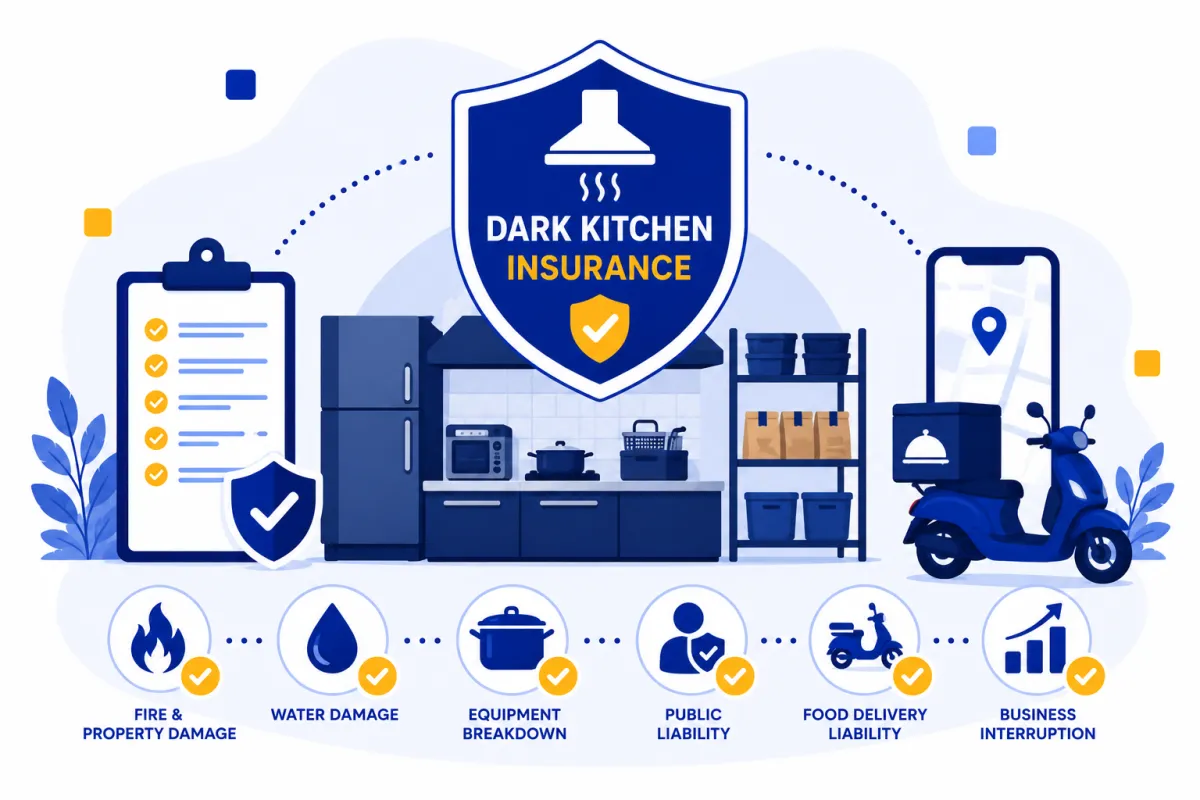
- What does dark kitchen insurance actually cover?
- Which covers are legally required versus recommended?
- What cover does your dark kitchen model need?
- Is your dark kitchen compliant and insurable?
- How high-risk is your dark kitchen to an underwriter?
- How does the new UK dark-kitchen regulation affect you?
- Why is delivery-platform dependence a business-interruption risk?
- How does running multiple virtual brands change your liability?
- What drives the cost of dark kitchen insurance?
- What do real dark kitchen claims look like?
- How should you handle a dark kitchen insurance claim?
- Glossary of key terms
- Dark kitchen insurance FAQs
- Related guides
What does dark kitchen insurance actually cover?
Dark kitchen insurance is a package, assembled around the delivery-only model rather than a dine-in restaurant. The most common gap we see is an operator buying a basic café policy that under-insures the kitchen, ignores delivery-platform dependence, and never contemplates several brands sharing one space. Here is how the core covers differ.
| Cover | What it protects against | Why a dark kitchen needs it |
|---|---|---|
| Property & Contents | Fire, flood, theft damage to the kitchen, equipment and fit-out | Essential. Intensive cooking equipment means high fire exposure. |
| Business Interruption | Lost income after an insured event stops you trading | Essential. A delivery-only kitchen has no walk-in fallback — see BI cover. |
| Product / Food Safety Liability | Illness or harm caused by the food you supply | Essential. Multiplied across every virtual brand you run. |
| Public Liability | Injury or damage to third parties (riders, contractors, visitors) | Essential. Delivery riders and staff move through the unit constantly. |
| Employers' Liability | Injury or illness to kitchen staff | Legally required if you employ anyone (£5m minimum). |
| Stock & Deterioration | Loss of frozen/chilled stock from refrigeration breakdown | Strongly recommended. High-volume kitchens hold significant perishable stock. |
| Cyber & Data | Breach of customer data, online-ordering system attack | Recommended. Orders and data flow through digital systems — see cyber insurance. |
Which covers are legally required versus recommended?
Only one is a legal must-have: Employers' Liability, required by the Employers' Liability (Compulsory Insurance) Act 1969 if you employ staff, with a £5m minimum. Beyond that, you must register as a food business with your local authority and comply with the food safety and hygiene regulations and allergen rules — not insurance requirements, but the framework your food-safety liability is judged against. Property, business interruption and product liability are "commercially essential" rather than legally mandated, but a serious operator — and any landlord or aggregator site — will expect them in place. Fire safety duties under the Regulatory Reform (Fire Safety) Order 2005 also sit behind your property and liability position, especially in shared units.
The story I hear most is the operator who scaled fast — three, four, five virtual brands on the apps — but never told their insurer. The original policy was rated for one takeaway concept, and when a food-safety claim came in against brand number four, the insurer had never been told it existed. Disclosing every brand you run from the kitchen isn't admin; it's what keeps the cover valid when a claim lands.
What cover does your dark kitchen model need?
The package shifts with your setup. Select the closest match to see the cover stack we would build — and where the delivery-only gap usually sits. For tailored terms, start a dark kitchen quote.
Cover Checker
Single-brand dark kitchen
Multi-brand / virtual brand operator
Aggregator-site tenant (e.g. delivery-hub unit)
Dark kitchen hub / landlord
Small unit / home-based delivery kitchen
Restaurant adding a delivery-only brand
Is your dark kitchen compliant and insurable?
Food safety, fire control and disclosure are what an underwriter looks at. Tick the controls you already have — each strengthens your application; each red flag is a question an insurer will raise before quoting.
Compliance & insurability checklist
- ✓Registered as a food business with your local authority, with a current hygiene rating.Red flag if missing
- ✓A documented HACCP / food-safety management system is in place.
- ✓Allergen controls and accurate labelling apply to every virtual brand.Red flag if missing
- ✓Kitchen fire suppression is fitted and extraction ducting is cleaned on schedule.Red flag if missing
- ✓Every brand you operate from the kitchen has been disclosed to your insurer.
- ✓Temperature control and a safe delivery-handover process are documented.
- ✓Stock sums insured reflect your frozen and chilled holdings.
- ✓Business interruption cover reflects your delivery-platform dependence.
How high-risk is your dark kitchen to an underwriter?
This assessor mirrors how a hospitality underwriter triages a dark kitchen. Choose your brand complexity and your food-safety and fire governance for an indicative risk tier.
Risk Assessor
How does the new UK dark-kitchen regulation affect you?
For years, dark kitchens grew faster than the rules around them, leaving local authorities and food-safety officers working without a clear, shared definition of what a delivery-only operation even was. That changed in February 2026, when the UK agreed its first formal definition of "dark kitchens" — a step set to bring delivery-only food outlets under stricter planning and public-health oversight for the first time and to close a long-standing regulatory gap.
For operators, the direction of travel is clear: more scrutiny of food safety, premises and planning, not less. From an insurance standpoint that matters because underwriters price against the regulatory bar a business is expected to meet. Whatever your model, the fundamentals already apply — registering as a food business with your local authority, complying with food-hygiene and allergen law, and meeting fire-safety duties. Getting those right is both a compliance necessity and the evidence that makes you straightforward to insure. Our commercial kitchen insurance guide covers the kitchen-safety dimension in more depth.
Why is delivery-platform dependence a business-interruption risk?
A traditional restaurant that loses its phone line still has diners at the door. A dark kitchen that loses its delivery platforms has nothing — because the platforms are the shopfront. That makes business interruption a different beast for a delivery-only operation. Income can stop not just because of a fire or flood, but because a platform suspends or deactivates a listing, suffers an outage, or changes terms. Standard BI cover is written around physical damage to the premises and may not respond to a purely commercial platform issue, so it is important to understand exactly what your policy covers and to set the indemnity period and sums insured to reflect a delivery-led income that can vanish quickly.
The wider lesson is to think about dependence the way an underwriter does: the more of your income that flows through a single channel, the more fragile it is. This is the same supply-chain logic we cover in contingent business interruption — and it is worth a frank conversation about what is, and is not, insurable in your model.
How does running multiple virtual brands change your liability?
Running several virtual brands from one kitchen is the model's superpower and its hidden liability. Each brand is a separate menu, a separate set of allergen declarations, and a separate promise to the customer — but they all share the same surfaces, equipment and staff. That concentrates cross-contamination and allergen risk: a single mistake can affect orders across multiple brands at once, and an allergen claim does not care which brand name was on the bag. Product-liability and food-safety exposure therefore scales with the number of brands, not the number of kitchens.
The practical points are straightforward but easily missed. Disclose every brand you run to your insurer, keep allergen and ingredient information accurate and brand-specific, and make sure your product-liability limit reflects the combined volume. An operator who treats five virtual brands as "one takeaway" for insurance purposes is carrying an exposure the policy was never rated for — which is exactly the kind of gap a specialist broker exists to close.
What drives the cost of dark kitchen insurance?
There is no flat price — premiums are built from your specific model. These are the factors that move the figure most, with the practical steps that bring it down.
| Rating factor | Why it affects your premium | How to mitigate it |
|---|---|---|
| Number of virtual brands | More brands multiply food-safety and product exposure. | Disclose all brands; match product-liability limits to volume. |
| Cooking type | Deep-fat frying and grilling carry the highest fire risk. | Fit suppression and keep ducting cleaned on schedule. |
| Premises type | Shared hubs raise fire-spread exposure across operators. | Confirm compartmentation and what the site policy covers. |
| Fire suppression & ducting | No suppression or dirty ducting is a major red flag. | Install suppression; document a cleaning regime. |
| Food-hygiene rating | A poor rating signals elevated food-safety risk. | Maintain a strong rating and HACCP records. |
| Allergen controls | Weak allergen management drives liability claims. | Keep brand-specific allergen information accurate. |
| Stock value (frozen/chilled) | High perishable stock raises deterioration exposure. | Set stock sums insured correctly; maintain refrigeration. |
| Platform dependence | Heavy reliance on one channel makes income fragile. | Set BI indemnity period and sums insured realistically. |
| Employee numbers | More staff increases employers'-liability exposure. | Hold EL and maintain safe-system-of-work records. |
| Cyber / online ordering | Customer data and order systems create breach risk. | Hold cyber cover with basic data controls. |
| Claims history | Prior claims raise pricing. | Disclose fully — see our claims-history guide. |
| Equipment age | Older equipment is more prone to breakdown and fire. | Service equipment and consider breakdown cover. |
What do real dark kitchen claims look like?
These fictionalised but realistic examples show how dark kitchen claims unfold — and what made the difference.
The fryer fire in a shared hub
A deep-fat fryer ignited during a busy evening service in a multi-operator delivery hub. The fire spread through shared extraction ducting, damaging the unit and a neighbouring kitchen and closing both for repairs. Lost income across the operator's brands mounted up during the closure.
The allergen across brands
A customer with a severe nut allergy ordered from one of the kitchen's five virtual brands and suffered a reaction after cross-contamination from another brand's prep. The claim alleged inadequate allergen control, and the insurer queried whether all five brands had been disclosed.
The refrigeration breakdown
A walk-in freezer failed overnight, spoiling a large quantity of frozen stock and forcing the kitchen to pause service across all its brands for two days while it restocked and deep-cleaned. Stock-deterioration and business-interruption cover absorbed the loss.
How should you handle a dark kitchen insurance claim?
If a fire, food-safety issue or breakdown hits, the first steps shape everything that follows. This is the order we walk clients through.
- Make the kitchen safe. Deal with any fire, injury or food-safety hazard immediately and stop service if needed to prevent further harm.
- Notify your insurer at once. Report the incident or claim promptly, before evidence is lost.
- Preserve evidence. Keep food-safety and temperature records, the affected product or batch, fire-service reports and platform order records.
- Do not admit liability. Be cooperative with customers and authorities, but avoid admissions of legal fault until insurers advise.
- Notify the relevant brand and platform. Identify which virtual brand and delivery platform the order related to, and follow their incident processes.
- Engage the local authority carefully. Coordinate any environmental-health or food-safety enforcement contact with your insurer-appointed advisers.
- Quantify the business interruption. Record lost income across all affected brands and platforms to support the BI claim.
- Review and improve controls. Once resolved, close the food-safety or fire gap the claim exposed to protect your renewal.
John Miller
John has 13+ years' specialist commercial insurance experience, with direct access to the Lloyd's market and specialist hospitality schemes. He arranges cover for food and hospitality businesses — including dark kitchens, multi-brand delivery operators and commercial kitchens — balancing fire, food-safety, stock and business-interruption exposures. Read more about John.
Glossary of key terms
- Dark kitchen
- A delivery-only food operation with no customer-facing storefront; also called a ghost, cloud or virtual kitchen.
- Virtual brand
- A delivery-app brand and menu run from a shared kitchen, often one of several from the same site.
- Aggregator
- A delivery platform such as Deliveroo, Uber Eats or Just Eat through which orders are taken.
- Kitchen hub
- A site that houses multiple operators' delivery-only kitchens under one roof.
- Product / food-safety liability
- Cover for illness or harm caused by the food you supply.
- Public liability
- Cover for injury or damage to third parties such as riders or contractors.
- Business interruption (BI)
- Cover replacing lost income when an insured event stops you trading.
- Indemnity period
- The maximum time a BI policy will pay out while you recover.
- Stock deterioration
- Loss of frozen or chilled stock, typically from refrigeration breakdown.
- HACCP
- Hazard Analysis and Critical Control Points — a structured food-safety management system.
- Allergen control
- The procedures that keep allergen information accurate and prevent cross-contamination.
- Fire suppression
- An automatic system that extinguishes cooking-equipment fires, often required by insurers.
- Ducting cleaning
- Scheduled cleaning of extraction ducts to reduce grease-fire risk.
- Food business registration
- The legal requirement to register a food business with the local authority.
- Material change
- A change to your business (e.g. a new brand) that you must tell your insurer about.





Instagram
LinkedIn