


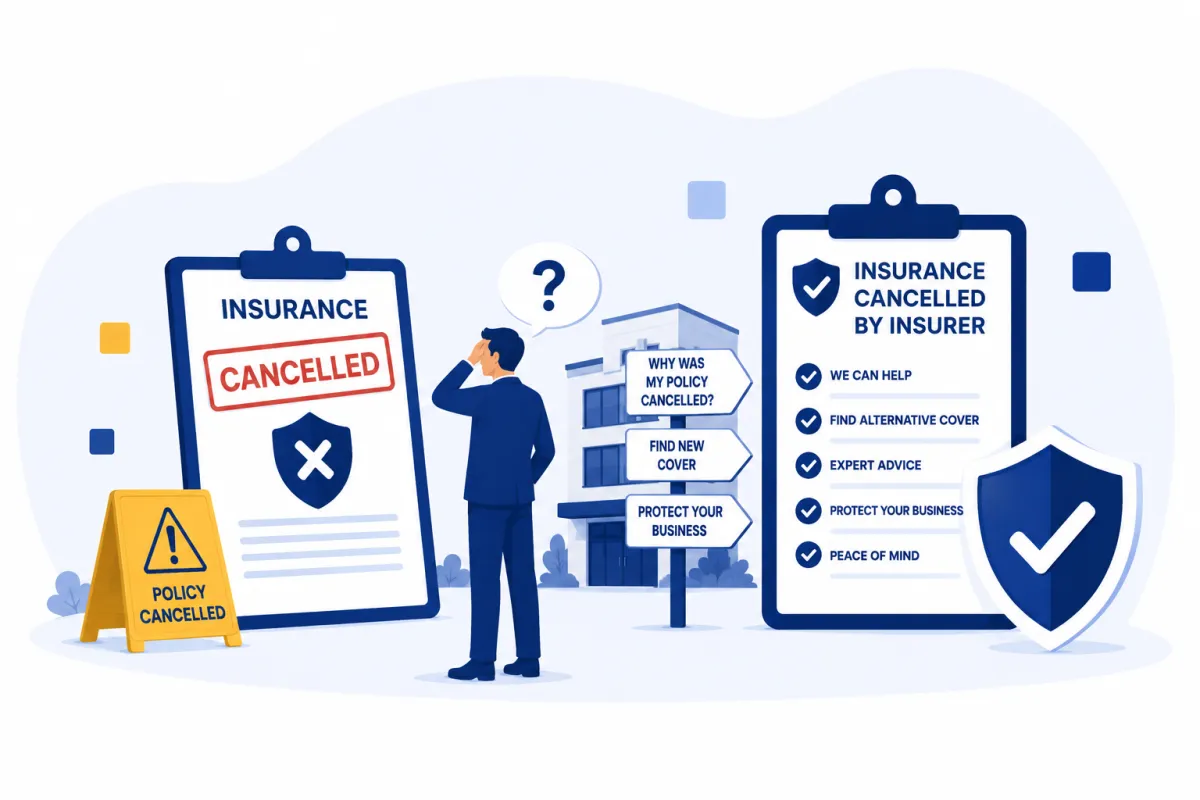
Business Insurance Cancelled by Your Insurer? What to Do Now
Had your insurance cancelled?
We find replacement cover for UK businesses whose policies have been cancelled or not renewed, using specialist and Lloyd’s markets. Get a quote online or speak to a specialist broker directly.
Why does a cancelled policy need specialist treatment?
Few letters land harder than the one telling you your insurer is cancelling — or worse, voiding — your policy partway through the year. The immediate problem is the gap in cover. The lasting problem is the mark it leaves: a cancellation or voidance is something you must declare to every future insurer, often for the rest of your trading life, and it makes the next placement harder, dearer, and occasionally impossible through standard channels.
It gets worse if it is handled badly. There are two very different things an insurer can do — cancel the policy going forward, or avoid it as though it never existed — and the consequences diverge sharply. Miss the short window to re-place and you can breach compulsory-insurance law, lease conditions or finance agreements. Fail to declare the cancellation on your next proposal and the new insurer can cancel or void that policy too, turning one black mark into a cascade. And many businesses accept an avoidance as final when, in reality, it can be challenged.
This is precisely the adverse-risk work we do. At Miller & Partner we re-place cover quickly for businesses carrying a cancellation or voidance, present the history honestly so a single marker doesn't define you, handle the disclosure traps, and — where an avoidance looks unfair — support the challenge. It sits alongside our guidance for businesses refused cover and those carrying a claims history, but a mid-term cancellation has its own distinct traps.
A cancellation or voidance is exactly the kind of marker that makes standard insurers walk away and a specialist lean in. Here is how each pillar applies.
Key facts if your insurer cancels, at a glance
- An insurer can end your policy mid-term in two ways: cancellation (going forward, with notice) or avoidance/voidance (treating it as if it never existed).
- Cancellation usually follows a policy-condition breach — non-payment, non-cooperation, an unnotified material change — and you keep cover up to the cancellation date.
- Avoidance is the harsher remedy: the policy is unwound, claims refused, and for deliberate or reckless non-disclosure the insurer can keep your premium under the Insurance Act 2015.
- You typically have a short window — often around seven days — to arrange replacement cover before the policy ends.
- Every future proposal asks whether you have ever had insurance cancelled, voided or refused — and the question usually has no time limit.
- Failing to declare a past cancellation lets the next insurer cancel or void that policy too — one black mark can cascade into several.
- An avoidance can be challenged — through the insurer and, if needed, the Financial Ombudsman Service — and is often less clear-cut than presented.
Cancellation vs avoidance — what's the difference?
This distinction is the single most important thing to understand, because the two outcomes feel similar but are worlds apart. Cancellation ends the policy going forward from a future date, under a cancellation clause in the contract; you were covered up to that point, you usually get a refund of unused premium, and any valid claim before the cancellation date stands. Avoidance — also called voidance — treats the policy as if it never existed, unwinding it back to inception (or to the date of a mid-term misrepresentation); claims are refused, and depending on the conduct the premium may be returned or kept.
| Feature | Cancellation | Avoidance / voidance |
|---|---|---|
| Effect on cover | Ends from a future date | Unwound as if it never existed |
| Typical trigger | Breach of a policy condition | Qualifying non-disclosure / misrepresentation |
| Claims before the date | Valid claims stand | Refused — no policy is deemed to have existed |
| Premium | Pro-rata or short-rate refund | Returned, or kept if deliberate/reckless |
| Notice | Given (often around 7 days) | Effective from inception; notice differs |
| Future declaration | Declare on every future proposal | Declare on every future proposal |
| Severity | Serious | More serious |
Both must be declared to future insurers, but an avoidance signals a non-disclosure or misrepresentation finding, which underwriters treat far more cautiously. Knowing which one you are facing — and whether the insurer has it right — shapes everything that follows.
Why do insurers cancel a policy mid-term?
Cancellation almost always traces back to a breach of the policy's terms. The most common trigger is non-payment — and because monthly premiums are frequently a loan from a finance company rather than the insurer, a missed instalment or a defaulted premium-finance agreement can set cancellation in motion. Other triggers include a material change in the risk that wasn't notified (a change of trade, use, occupancy or location), non-cooperation during a claim, a breach of a policy condition or warranty, suspected fraud, or simply an unacceptable loss experience the insurer no longer wishes to carry.
The important point is that not all cancellations carry the same weight. A cancellation for a missed payment, promptly remedied and honestly explained, is a very different story to one tied to a claims dispute or suspected fraud — and presenting that difference clearly to the next underwriter is a large part of getting re-covered on sensible terms.
The cases that frustrate me most are the avoidable ones — a business cancelled over a premium-finance default it could have fixed in a day, then left scrambling for cover with a cancellation now on its record forever. A missed direct debit became a permanent mark that follows them to every future renewal. When someone comes to us straight after a cancellation, the first job is to stop the gap, and the second is to make sure the story is told properly — because the reason behind a cancellation matters far more to the next insurer than the bare fact of it.
Why must you declare a cancellation forever?
Every commercial and personal proposal form asks a version of the same question: have you ever had insurance cancelled, voided, declined or special terms imposed? Crucially, unlike questions about spent convictions, this one usually carries no time limit — "ever" means ever. A cancellation from years ago still has to be declared, and insurers retain and share this information on industry databases, so it is discoverable whether you mention it or not.
How does one cancellation cascade into several?
This is the trap that turns a single setback into a spiral. A business has a policy cancelled — say, for a missed payment. At the next renewal it either doesn't realise it must declare the cancellation, or decides the reason was trivial and leaves it off. Months later a claim arises, the new insurer checks the databases, finds the undisclosed cancellation, and voids the new policy for non-disclosure. Now the business has two markers instead of one, a refused claim, and a much harder placement than it started with.
The cascade is entirely avoidable, and the cure is simple: declare every cancellation and voidance, every time, and present the context honestly. A specialist broker makes sure the disclosure is complete and framed properly, so the marker is managed rather than allowed to multiply. Breaking the spiral is one of the most valuable things we do for businesses in this position — the same disclosure discipline that protects any business refused elsewhere.
Cover checker: what's your situation?
Select the situation that fits. Each gives the immediate priorities — and where you see "specialist placement needed," that is exactly the work a specialist broker does for you.
- CRITICAL Note the cancellation date — you're covered until then, but must re-place before it.
- LEGAL Bridge any compulsory cover (employers' liability, motor) before it lapses.
- ESSENTIAL Find out exactly why — the reason shapes the next placement. Specialist placement needed.
- RECOMMENDED Engage a broker immediately to re-cover before the gap opens.
- CONSIDER Check whether the trigger (e.g. missed payment) can be remedied.
- CRITICAL A voidance means no policy is deemed to have existed — any claim is refused. Act fast.
- ESSENTIAL Ask the insurer to set out the basis in writing — careless, or deliberate/reckless?
- RECOMMENDED Consider challenging it — an avoidance is often less clear-cut than presented.
- LEGAL Re-place cover immediately; you are uninsured from inception.
- CONSIDER The Financial Ombudsman Service if the insurer won't reconsider.
- CRITICAL Check whether paying the arrears can reinstate the policy before the date.
- ESSENTIAL Remember the premium-finance loan may continue even if cover ends.
- RECOMMENDED If reinstatement isn't possible, re-place with the cancellation honestly declared. Specialist placement needed.
- CONSIDER A non-payment cancellation is usually the most recoverable type.
- LEGAL Keep compulsory cover live throughout.
- LEGAL Declare every cancellation and voidance — the question has no time limit.
- CRITICAL Never leave it off to get a cleaner quote — that risks voiding the new policy.
- RECOMMENDED Use a broker to present the context so it's understood, not just flagged. Specialist placement needed.
- ESSENTIAL Gather the cancellation reason and any remedy you took.
- CONSIDER Terms improve as the marker ages with clean trading.
- CRITICAL Time is short — get a broker building a submission now to avoid a gap. Specialist placement needed.
- LEGAL Bridge compulsory cover first so you stay lawful to trade.
- ESSENTIAL Have your schedule, claims history and the cancellation details ready.
- RECOMMENDED Expect the specialist market rather than a price-comparison panel.
- CONSIDER Short-term cover while a full programme is arranged.
- ESSENTIAL Ask the insurer to justify the avoidance in writing and to confirm whether it pleads deliberate/reckless conduct.
- RECOMMENDED Challenge it — insurers must prove their case, and it's often not clear-cut.
- CRITICAL Re-place cover meanwhile so you're not trading uninsured.
- CONSIDER Escalate to the Financial Ombudsman Service if unresolved.
- LEGAL Take advice before accepting any avoidance as final.
How do you re-place cover after a cancellation?
The priority after a cancellation is to avoid a gap — especially for compulsory classes, where a lapse can stop you trading or breach the law. Because the standard market is wary of a cancellation marker, the placement usually needs the specialist and Lloyd's markets, and it needs the history presented properly: what was cancelled, why, what was remedied, and what has changed. A specialist broker can take your schedule and the cancellation details and put rated terms in front of you quickly, bridging compulsory cover first and rebuilding the full programme on secure paper.
Honesty is non-negotiable and, counter-intuitively, it is also your strongest card. An underwriter shown a fully-disclosed, well-explained cancellation can price it; one who later discovers a concealed one prices in the worst case or voids the policy. This is the same craft we apply to any adverse-risk placement — turning a marker that frightens generalists into a manageable, fairly-priced risk.
Red-flag check: how exposed are you?
Tick each item that is true. Each is a sign your position needs attention before it gets worse.
Placeability assessor: how hard will re-cover be?
Choose two factors for an indicative read on how straightforward re-placing your cover is likely to be. Guidance, not advice.
What are the Insurance Act remedies for non-disclosure?
When an insurer avoids a policy for non-disclosure or misrepresentation, the remedy it is entitled to depends on the policyholder's conduct — and this is where many avoidances are presented as harsher than the law actually allows. Under the Insurance Act 2015 (for commercial policies) and the Consumer Insurance (Disclosure and Representations) Act 2012 (for consumers), there are three possible outcomes.
If the breach was deliberate or reckless, the insurer can avoid the policy, refuse all claims and keep the premium. If the breach was neither deliberate nor reckless but the insurer would not have offered cover at all had it known the truth, it can still avoid — but must return the premium. And if the insurer would have offered cover on different terms or at a higher premium, it cannot avoid outright: it must apply a proportionate remedy, for example reducing a claim payment to reflect the higher premium it would have charged. The crucial point is that full avoidance is only available in the first two situations — and the insurer must be able to prove which applies.
| Conduct | What the insurer can do | Premium |
|---|---|---|
| Deliberate or reckless | Avoid the policy and refuse claims | Kept by the insurer |
| Careless — would not have covered at all | Avoid the policy | Returned to you |
| Careless — would have covered on other terms | Proportionate remedy (reduced claim / amended terms) | Adjusted, not forfeited |
Can you challenge an unfair avoidance?
Yes — and many businesses give up far too easily. Insurers sometimes present an avoidance as an open-and-shut fait accompli, relying on a policyholder's lack of knowledge to make it stick. In reality the burden is on the insurer to prove its case. If it wants to assert that a breach was deliberate or reckless — the only route that lets it keep your premium and refuse everything — the courts have made clear it must distinctly plead and prove that conduct; it cannot simply assume the worst. Where it cannot, it is pushed back to the careless analysis, which may mean a proportionate remedy rather than a total refusal.
The practical route is to ask the insurer to set out, in writing, exactly what it says you failed to disclose and on what basis, then to test that against what you were actually asked and what you reasonably knew. If it does not stack up, you can escalate — including, free of charge, to the Financial Ombudsman Service, which can direct an insurer to reinstate cover, pay a reduced claim or refund premium with interest. We are not solicitors and do not give legal advice, but we routinely help clients understand whether an avoidance looks soft and support them in pushing back while we re-place cover so they are not left trading uninsured in the meantime.
What determines whether you can get cover again?
Re-covering after a cancellation is very achievable; the terms depend on a handful of factors, most of which you can influence with the right presentation. Almost every one is a reason a specialist placement succeeds where a direct application is declined.
| Factor | Why it matters | How to strengthen it |
|---|---|---|
| Cancellation vs voidance | A voidance signals non-disclosure | Clarify which it was and the basis |
| Reason for the marker | Non-payment is softer than a claims/fraud issue | Explain and evidence the cause |
| Full disclosure | Concealment voids the new policy | Declare every marker, every time |
| Remedy taken | Shows the issue is resolved | Evidence what you fixed |
| Time since | Markers soften with clean trading | Build a clean record |
| Claims history | Compounds or eases the picture | Present alongside the cancellation |
| Continuity of cover | Gaps worsen the risk view | Avoid lapses; bridge promptly |
| Quality of presentation | Context turns a decline into terms | Full submission via a specialist |
| Sector | Some trades are harder regardless | Match to insurers with appetite |
| Risk management | Good controls reassure underwriters | Document procedures |
| Premium structure | Finance default may have triggered it | Arrange a workable payment plan |
| Broker market access | Markers need specialist markets | Use a broker with Lloyd's access |
Three real-world cancellation case studies
These composites reflect the situations we see most often. Figures are illustrative, but the dynamics — and the difference the right placement makes — are real.
Hartley Joinery — cancelled for a finance default
A joinery firm had its commercial combined policy cancelled mid-term after two missed premium-finance instalments during a cash-flow squeeze. With seven days' notice, the firm faced a gap on its compulsory employers' liability cover. We confirmed reinstatement was no longer available, bridged the compulsory cover the same day, and re-placed the full programme with the cancellation honestly declared and explained as a one-off finance issue now resolved. The lesson: a non-payment cancellation is the most recoverable type — but it still becomes a permanent marker, so it must be declared. Premium settled around 15% higher, improving at renewal as the marker aged.
Oakvale Care — the voidance that was pushed back
A care provider had its property policy voided after the insurer said it had failed to disclose a prior subsidence claim, refusing a live £75,000 escape-of-water claim. On review, the non-disclosure looked careless rather than deliberate, and the insurer had not distinctly pleaded reckless conduct. The matter was challenged on that basis; rather than a total refusal, it resolved on a proportionate footing with a substantial part of the claim recovered, and we re-placed cover meanwhile so the home was never uninsured. The lesson: an avoidance is not always final — test the basis before accepting it.
Bramley Logistics — the cancellation that cascaded
A haulier whose fleet policy had been cancelled the previous year took out new cover without declaring the cancellation, reasoning it was "old news." When a £120,000 fleet accident claim followed, the new insurer checked the databases, found the undisclosed cancellation, and voided the new policy for non-disclosure — leaving the claim unpaid and two markers on the record. We rebuilt the placement from scratch with everything declared, and restored cover, but at materially worse terms than honest disclosure would have secured a year earlier. The lesson: the "have you ever" question has no time limit; one undeclared cancellation became two markers and an unpaid claim.
What to do if your insurer cancels or voids your policy
If you have received a cancellation or avoidance notice, work through these eight steps in order. The first few are urgent; the rest protect your position and stop one marker becoming several.
- Identify which it is. Establish whether the insurer is cancelling the policy going forward or avoiding it from inception — the consequences differ sharply.
- Note the date and protect compulsory cover. You are covered until a cancellation date but not after; bridge employers' liability or motor cover before any lapse.
- Ask for the reason in writing. Get the insurer to set out the basis — non-payment, breach, or the conduct it alleges for an avoidance.
- Check whether it can be remedied. For a non-payment cancellation, find out if paying arrears reinstates the policy before the date.
- Engage a specialist broker. Use a broker with adverse-risk and Lloyd's access to re-place cover with the marker declared and explained.
- Re-place without a gap. Bridge compulsory classes immediately and rebuild the full programme on rated security.
- Consider challenging an avoidance. Test the insurer's basis; escalate to the Financial Ombudsman Service if it looks unfair.
- Declare it on every future proposal. The "have you ever" question has no time limit — disclose it each time and let your broker frame the context.

Cancellation & avoidance glossary
- Mid-term cancellation
- Where an insurer ends a policy part-way through its term, going forward from a notified date under a cancellation clause.
- Avoidance / voidance
- Where an insurer treats a policy as if it never existed, unwinding it back to inception (or to a mid-term misrepresentation) and refusing claims.
- Cancellation clause
- The policy condition setting out when and how the insurer (or you) may cancel, and the notice required.
- Notice period
- The time between a cancellation notice and the policy ending — often around seven days, giving you a window to re-place.
- Pro-rata refund
- A refund of premium for the unused period, calculated in proportion to the time remaining.
- Short-rate
- A refund basis that retains slightly more than pro-rata, reflecting the insurer's costs of early cancellation.
- Qualifying misrepresentation
- A misrepresentation that, but for it, would have led the insurer to act differently — the trigger for a remedy.
- Duty of fair presentation
- The Insurance Act 2015 obligation on commercial policyholders to disclose every material circumstance.
- Deliberate or reckless
- The most serious category of breach — the only one that lets an insurer avoid and keep the premium; it must be distinctly proved.
- Proportionate remedy
- Where a careless breach would have led to different terms, the insurer adjusts the claim rather than avoiding the policy.
- CIDRA 2012
- The Consumer Insurance (Disclosure and Representations) Act 2012, governing disclosure for consumer policies.
- Insurance Act 2015
- The statute governing disclosure and remedies for commercial insurance contracts in the UK.
- Material change in risk
- A change to the insured risk — trade, use, occupancy or location — that must be notified and can trigger cancellation if not.
- Premium-finance default
- A missed instalment on a premium-finance loan — a common trigger for mid-term cancellation.
- Financial Ombudsman Service
- The free, independent service that resolves disputes between consumers or small businesses and financial firms, including avoidances.
- "Have you ever" declaration
- The open-ended proposal question requiring disclosure of any past cancellation, voidance or refusal, with no time limit.
Frequently asked questions
What's the difference between a cancelled and a voided policy?
Can I get insurance after a policy was cancelled?
How long do I have to declare a cancellation?
How long do I have to get new cover after a cancellation?
Why was my policy cancelled for non-payment?
Can I challenge a voided policy?
What are the Insurance Act remedies if I didn't disclose something?
Will a cancellation increase my premium?
Is a cancellation the same as being refused cover?
Does a cancellation affect my directors or other policies?
Should I just not mention an old cancellation to save money?
Do you place cover after a cancellation or voidance?
Related specialist guides
- Insurance for Businesses Refused Cover
- Business Insurance Refused Elsewhere
- Business Insurance With a Claims History
- Business Insurance With CCJs or Poor Credit
- Specialist Broker for Adverse-Risk Insurance
- High-Risk Public Liability Insurance
- Insurance After Insolvency or Liquidation
- CVA Insurance
- Phoenix Company Insurance
- Insurer in Liquidation
- Business Insurance After a Fire Claim
- Business Insurance After a Flood Claim
- Directors & Officers Insurance
- Professional Indemnity Insurance
- Commercial Insurance
- Adverse-Risk Insights Hub
This guide is general information, not advice for your specific circumstances, and does not constitute legal or financial advice. The treatment of a cancellation or avoidance depends on the policy terms and the facts. Always read your cancellation/avoidance notice carefully and take advice before accepting it as final. Miller & Partner Limited is an Appointed Representative of Gauntlet Risk Management Ltd, which is authorised and regulated by the Financial Conduct Authority.







Instagram
LinkedIn