


Office to Residential Conversion Insurance UK | Developers
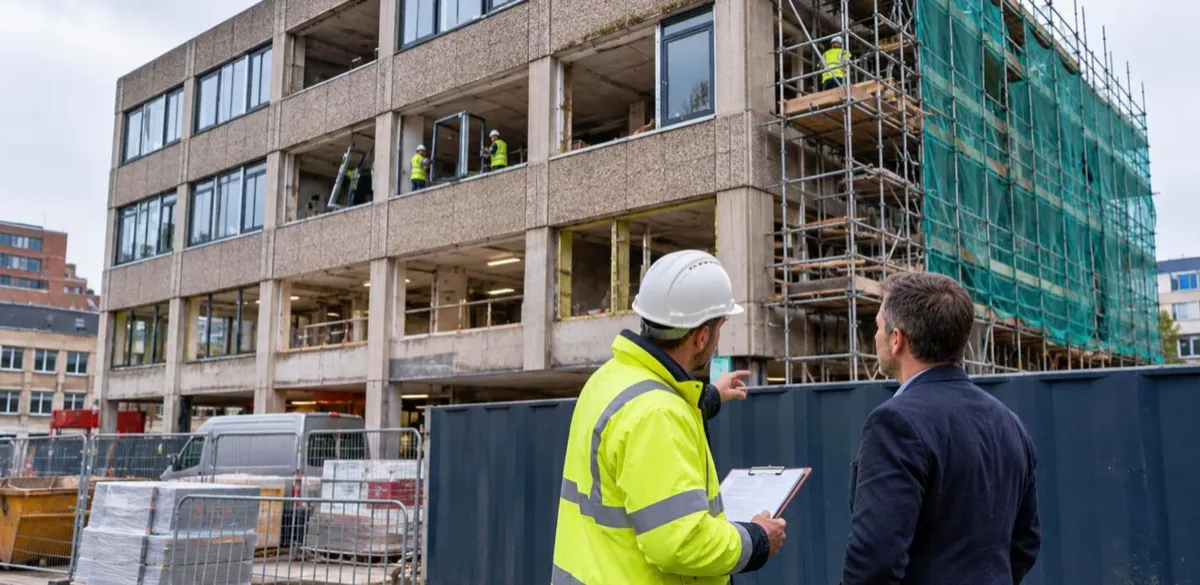
Office to residential conversion insurance protects developers and investors turning offices into flats, whether under permitted development or full planning permission. During the works you need contract works cover for the new build-out, cover for the existing structure, which many contractors' policies exclude, and public liability as the site owner. Most projects also need employers' liability if you employ anyone directly, cover for plant and materials, and non-negligent liability if neighbouring properties could be damaged. Lenders usually insist on cover being in place before funds are released. Once the flats are finished, cover moves to a residential block policy. Insurers look at the building's age and construction, the scope of works, who your contractor is, site security, fire safety and how long the building will be empty.
Key facts at a glance
- The existing building needs cover. Many contractors' policies only cover the new works, leaving the original structure uninsured.
- Lenders set requirements. Bridging and development lenders usually need to be noted on the policy before releasing funds.
- Empty buildings are higher risk. Vacant offices attract theft, arson and squatters during works.
- Fire safety is under scrutiny. Insurers look at fire separation, escape routes and cladding in converted blocks.
- Cover must change on completion. Once flats are occupied, you need a residential block policy.
What insurance does an office conversion need?
An office to residential conversion usually needs contract works, existing structures cover, public liability, employers' liability, plant and materials cover and, where neighbours could be affected, non-negligent liability.
| Cover | What it protects | Watch out for |
|---|---|---|
| Contract works | The new works, materials and fit-out | Who arranges it under your building contract |
| Existing structures | The original building during works | Often excluded from contractors' policies |
| Public liability | Injury or damage to third parties as site owner | Trespassers on an empty site |
| Non-negligent liability | Damage to neighbouring property without negligence | Often required by party wall agreements |
| Plant and materials | Owned and hired plant, tools and stored materials | Theft from site |
| Delay in start-up | Lost rent or sales if damage delays completion | Lenders may ask for it |
Our main guide to property refurbishment insurance explains how these covers fit together across different project types.
Why conversions are harder to insure than new builds
Conversions work inside an existing building, often an older one with asbestos, outdated services and unknown defects. Insurers are wary of the existing structure and of fire risk during and after the works.
Office buildings from the 1960s to 1980s may contain asbestos or RAAC, and some have non-standard construction. If your building does, see our guides to RAAC property insurance and non-standard construction property insurance.
JCT contracts set out whether the employer or the contractor insures the existing structure and the works. Make sure your insurance matches the option in your contract, or you could be left uninsured.
What do insurers ask about a conversion?
Insurers ask about the building, the works, the contractor, the programme, site security and fire safety.
- Building. Age, construction, floors, asbestos and any RAAC or cladding
- Works. Scope, contract value and whether structural changes are involved
- Contractor. Name, experience and their own insurance
- Programme. Start date, duration and how long the building will be empty
- Security. Hoarding, alarms, CCTV and inspections
- Fire safety. Hot works controls, temporary fire alarms and compartmentation
After completion
When the flats are finished and let or sold, the works policy ends and the building needs a residential block policy.
Arrange the block policy before practical completion so there is no gap. Our guides to block of flats insurance and mixed-use block insurance explain what that cover looks like, including where the ground floor stays commercial.
How do you set up conversion insurance?
- Read your building contract. Know who insures what.
- Describe the building. Construction, age and known issues.
- Confirm the works. Scope, value and programme.
- Share lender requirements. So the policy meets them first time.
- Plan site security. Especially while the building is empty.
- Arrange the block policy. Before completion.
Frequently asked questions
Often not. Many contractors' policies only cover the new works, so the existing structure needs its own cover.
Yes. Development and bridging lenders usually need to be noted on the policy before drawdown.
Not really. Insurers focus on the building, the works and fire safety rather than the planning route.
Only if the insurer knows it is unoccupied. Security and inspection conditions usually apply.
It covers damage to neighbouring property caused by your works even when no one was negligent, and is often required by party wall agreements.
The works policy ends and you need a residential block policy, ideally arranged before completion.
Related guides from Miller & Partner

Miller & Partner Limited (FRN 1029698) is an Appointed Representative of Gauntlet Risk Management Ltd (FRN 308081), which is authorised and regulated by the Financial Conduct Authority. Miller & Partner Limited is registered in England and Wales (company number 16206282) and trades from Vivian House, Roman Bridge Close, Mumbles, Swansea SA3 5BG. This article is general information, not a personal recommendation or an offer of cover. Cover is subject to insurer acceptance and the full terms, conditions and exclusions of the policy issued.






Instagram
LinkedIn