
FS Register FRN 1029698

Five Star Rated on Google

13+ years specialist broking experience

General information, not advice. Written for general guidance and drawing on external sources as well as our own experience. It isn't a personal recommendation and doesn't take account of your circumstances — full disclaimer and sources.

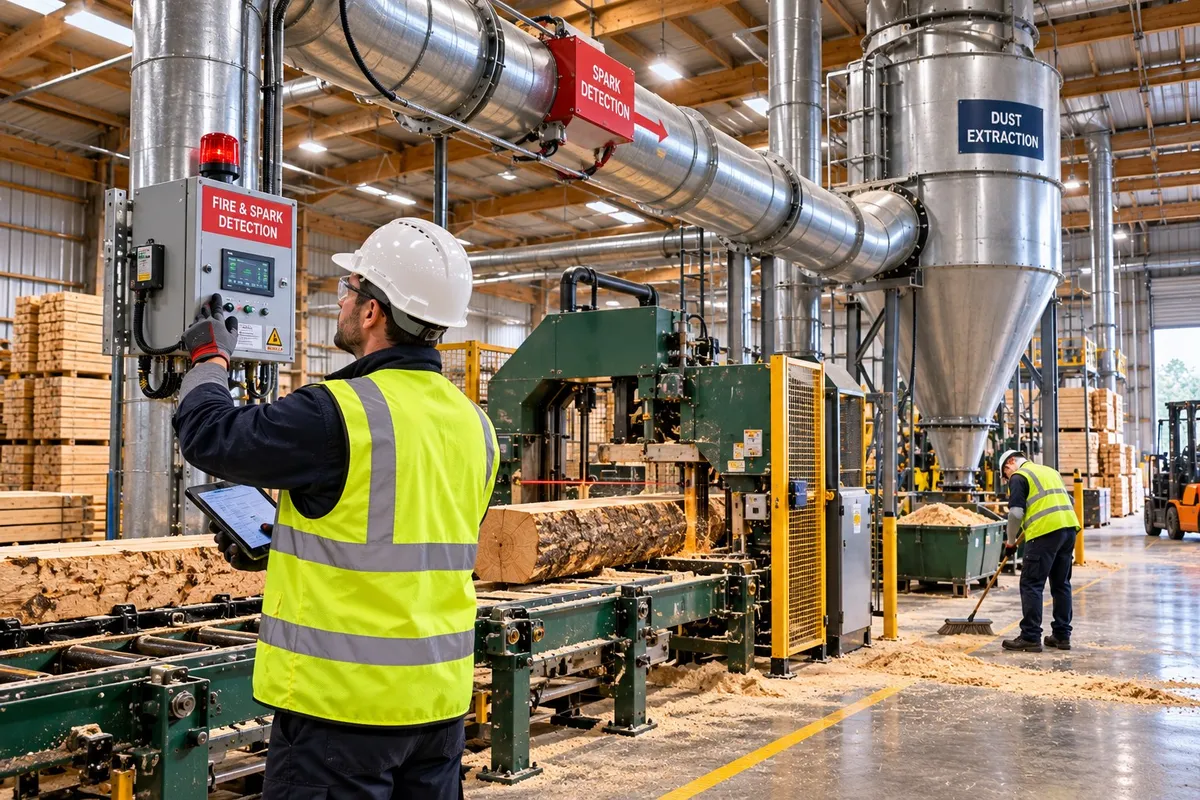
Maintenance worker checking dust extraction ductwork and a spark detection panel above a band saw line in a UK sawmill

Sawmill Dust Extraction & Fire Insurance Conditions | UK

October 24, 2026

Published: 24 October 2026 | Reading time: 8 minutes | Category: Manufacturing | Author: John Miller, Miller & Partner

Last reviewed by John Miller, Director & Principal Broker — 24 October 2026
FS Register FRN 1029698 13+ years specialist commercial broking Lloyd's & specialist MGA market access Independent UK broker

Wood dust is the single biggest factor in how insurers rate a sawmill. Fine dust settles on beams, ducts, motors and electrics, where a spark or hot bearing can ignite it, and in the wrong conditions it can explode. Insurers therefore look closely at your dust extraction system, how often it is cleaned and maintained, whether spark detection is fitted and whether you have a DSEAR assessment. Good controls and good records widen the market and improve terms; poor ones lead to loadings, conditions or a decline.

Wood dust and fire conditions putting pressure on your premium? Talk to a broker who places sawmill risks.

Key facts at a glance

  1. Dust drives the fire rating. Housekeeping is often the first thing a surveyor judges.
  2. Extraction must be maintained. LEV is examined and tested at least every 14 months under COSHH.
  3. Spark detection matters. It is one of the most effective improvements a sawmill can make.
  4. DSEAR applies. Combustible wood dust needs a documented risk assessment.
  5. Conditions bite. Breaching a dust or cleaning condition can reduce or defeat a fire claim.

Why do insurers focus on wood dust?

Because wood dust is both fuel and a route for fire to spread. A small fire at a saw can travel through ductwork and dust layers to the rest of the building in minutes.

Most serious sawmill fires start small: a blunt blade, a failed bearing, a piece of tramp metal hitting a cutter or an overheated motor. What turns a small fire into a total loss is usually dust. Layers on beams and ledges, dust inside ductwork and overloaded filter units all give a fire somewhere to go. Insurers know this, which is why our sawmill and timber yard insurance page puts dust control at the centre of how sawmills are underwritten.

There is also an explosion risk. Fine dust suspended in air, for example inside a filter unit or when a layer is disturbed by a first small blast, can ignite with great force. That is why dust collectors are usually sited outside, fitted with explosion relief and isolated from the building.

What will an insurer's surveyor look at?

A surveyor will walk the site looking at dust build-up, the extraction system, ignition sources and the paperwork that proves controls are maintained.
AreaWhat they checkEvidence that helps
HousekeepingDust on beams, ledges, light fittings, motors and electricsWritten cleaning schedule and signed records
Extraction systemDuct condition, leaks, blockages and airflow at each machineCurrent LEV examination and test report
Dust collectorsLocation, explosion relief, isolation and emptying arrangementsDesign information and maintenance logs
Spark detectionDetectors and extinguishing in ductworkService and test certificates
ElectricsDust-tight fittings, condition of wiring and motorsElectrical inspection and thermographic survey
Hot workWelding, grinding and cutting near dustHot work permit system and completed permits

What dust-related conditions appear on sawmill policies?

Common conditions cover cleaning frequency, extraction maintenance, waste removal, hot work and the operation of spark detection. They are written into the policy and must be followed.

Typical wording requires dust and waste to be removed from the building at the end of each working day or shift, extraction systems to be maintained under contract, spark detection to be kept in working order, and hot work to be carried out only under a permit. Some insurers also require collectors to be emptied at set intervals or before they reach a certain level. Under the Insurance Act 2015, a breach of a condition designed to reduce a particular type of loss should not defeat a claim that the breach could not have increased, but disputes are costly and the safest route is a condition you can actually comply with. If a claim has been rejected for a breach, our guide to policy problems after a claim explains your options.

How do you improve your dust risk before renewal?

  1. Write down your cleaning routine. Set out what is cleaned, how often and by whom, then keep signed records.
  2. Get the LEV report up to date. Fix the defects it identifies and keep evidence that you did.
  3. Review the dust collectors. Check location, explosion relief and isolation with a competent engineer.
  4. Consider spark detection. It protects ductwork and collectors, and insurers recognise it.
  5. Commission a thermographic survey. Hot spots in motors and electrics are a common ignition source.
  6. Complete or refresh your DSEAR assessment. Act on its findings and record what you changed.

Business interruption is the other side of the fire risk. Replacement saw lines and extraction systems can take many months to source, so check your indemnity period against realistic lead times; our guide to business interruption insurance explains how.

Do not over-promise on the proposal Answer dust and cleaning questions to reflect how the site really runs, not how it runs on a good day. Under the duty of fair presentation, an inaccurate answer can give an insurer grounds to reduce or refuse a claim. If routines slip during busy periods, tell your broker so the conditions can be set realistically.

What if your site has had a dust fire before?

A previous fire narrows the market but rarely closes it. Insurers want to know the cause, what has changed and how you will stop it happening again.

A short report explaining the ignition source, the damage, the improvements made and the new controls is often the deciding document. We cover this in detail in our guide to sawmill insurance after a refusal or fire. The same dust principles apply to firewood producers and timber merchants with cutting services; see our guides to firewood and kiln-dried log insurance and timber merchant insurance.

Frequently asked questions

Explosion is normally an insured peril on a sawmill property policy, but cover can depend on meeting conditions about dust extraction, cleaning and maintenance. If those conditions are breached, a claim can be reduced or declined, so it is important to know exactly what your policy requires.

There is no single interval that suits every site. It depends on throughput, species and how quickly dust builds up. Insurers want to see a documented schedule based on your own conditions, records that it is followed, and evidence that build-up is checked between cleans.

Local exhaust ventilation must be thoroughly examined and tested at least every 14 months under COSHH. Insurers ask for the latest report because it shows the extraction system is working as designed, which matters for fire as well as health.

Not always, but it is one of the most effective improvements a sawmill can make, and some insurers make it a requirement for larger sites. Where it is fitted, keep the service records, as insurers will ask whether the system is maintained and tested.

Yes. Fine wood dust is a combustible dust, so the Dangerous Substances and Explosive Atmospheres Regulations require you to assess the risk and put controls in place. Underwriters often ask whether a DSEAR assessment has been done and acted on.

Housekeeping is one of the first things a surveyor sees. A site with clean beams, ducts and electrics and good records presents a much better fire risk, which can widen the market and improve the terms on offer.

Related guides from Miller & Partner

Want your dust and fire controls to count at renewal? Send us your extraction and cleaning records and we will present them properly.

John Miller, Director and Principal Broker at Miller & Partner, specialist broker for sawmills, timber yards and wood processing businesses
Written and reviewed by John Miller Director & Principal Broker, Miller & Partner Over 13 years of specialist commercial insurance experience, formerly with Brown & Brown and AXA. Places hard-to-place property risks through Lloyd's syndicates and specialist MGAs, including composite panel, timber frame and other non-standard construction.
Our regulatory status Miller & Partner Limited (FRN 1029698) is an Appointed Representative of Gauntlet Risk Management Ltd (FRN 308081), which is authorised and regulated by the Financial Conduct Authority. Miller & Partner Limited is registered in England and Wales (company number 16206282) and trades from Vivian House, Roman Bridge Close, Mumbles, Swansea SA3 5BG. This article is general information, not a personal recommendation or an offer of cover. Cover is subject to insurer acceptance and the full terms, conditions and exclusions of the policy issued. Panel and fire safety points are a summary; take specialist advice on your own building.
Back to Blog
About this article General information, not advice. Published for general guidance and drawing on external sources as well as our own experience. It is not a personal recommendation, a quotation, or an offer of cover, and it doesn't take account of your circumstances. Read more + Close −

Where the information comes from

Our articles are compiled from a range of sources: regulators and public bodies such as the FCA, the Civil Aviation Authority, the Health and Safety Executive and Companies House; government publications and legislation; industry and trade bodies; insurer and market documentation; and published research and news reporting. Not everything stated originates from Miller & Partner. Where information comes from a third party we believe it to be accurate at the date of publication, but we haven't independently verified every external source and we don't warrant its accuracy or completeness. Where a point matters to a decision you're making, go to the original source and check it.

Figures, examples and case studies

Premium ranges, cost figures, limits and worked examples are illustrative only. They are not quotations, not offers of cover, and no cover is provided or implied on the basis of them. What you're actually charged depends on underwriting, and what you're actually covered for depends on the policy wording issued to you. Where an article includes a claim example, scenario or case study, it is illustrative unless we say otherwise — such examples are typically composites written to show how a policy section responds, and they don't describe an identifiable client, claim or settlement.

Interactive tools

Any calculators, cover checkers, risk assessors or similar tools on our site produce general guidance from the small number of answers you give them. They can't see your business, and their output is not a personal recommendation, an assessment of your actual risk, or a quotation.

Rules and market conditions change

Law, regulation, tax treatment, insurer appetite and policy wordings all change, sometimes at short notice. Content is accurate to the best of our knowledge on the date shown on the article and we don't undertake to update it as things move. An article you're reading some time after publication may be out of date.

Third parties and external links

References to insurers, underwriters, trade bodies, software, training providers or other organisations are for information only. They don't imply endorsement, recommendation, partnership or affiliation in either direction unless stated. We're not responsible for the content of external websites we link to.

Not legal, tax or accounting advice

Nothing here is legal, tax, accounting or regulatory advice. Where an article discusses statutory duties, contract terms or compliance obligations, take advice from an appropriately qualified professional on your own position before acting.

How we write these

We use AI tools in researching and drafting our published content. Every article is reviewed and signed off by a named, accountable person at Miller & Partner before it is published, and responsibility for what appears here rests with us.

Our regulatory status

Miller & Partner Ltd is an Appointed Representative of Gauntlet Risk Management Ltd, which is authorised and regulated by the Financial Conduct Authority (FRN 308081). Miller & Partner Ltd is entered on the FCA Register under reference 1029698. Registered in England and Wales, company number 16206282. Registered office: Vivian House, Roman Bridge Close, Mumbles, Swansea, SA3 5BG.

Spotted something wrong?

We'd rather know. Email [email protected] or call 01792 001350 and we'll review and correct it.

For advice on your own insurance arrangements, speak to us directly — that's when we can take your circumstances into account and give you a recommendation.

Ready to protect your business?
Get expert advice and a tailored commercial insurance quote today.

✔ Independent broker
✔ Access to leading UK insurers
✔ Fast turnaround

[Request a quote]

[[email protected]]
[Call 01792 001350]

Exclusive Offer

Free Insurance Review
& Zero Broker Fee

Let us review your current insurance and see if we can improve your cover while reducing the cost.

✓
Free no-obligation insurance review tailored to your business
£
Zero broker fee on all new policies
⚡
Fast response from a real insurance specialist

You're in 🎉

Thanks for requesting your free review. We'll be in touch shortly.

🔒 No spam, ever. Your details are safe with us.

We're an Appointed Representative of Gauntlet Risk Management Ltd, which is authorised and regulated by the FCA. You can check our entry on the FCA Register.

MEET THE Director

Hey, I'm John!

I started Miller & Partner with the aim to bring back personable, approachable broking to UK businesses who were tired of large corporate brokers and feeling like they were just another number.

I have built this brokerage up with no pushy sales techniques or big business tactics, just honest, approachable and professional relationships with my clients.

Over 13 years experience in business insurance

Client first approach

5* rated broker on Google

Office: Vivian House, Roman Bridge Close, Mumbles, Swansea, SA3 5BG

Miller & Partner Ltd is an Appointed Representative of Gauntlet Risk Management Ltd, which is authorised and regulated by the Financial Conduct Authority (FRN 308081). Miller & Partner Ltd is entered on the Financial Services Register under firm reference number 1029698. You may check this on the Financial Services Register by visiting the FCA website at https://www.fca.org.uk/firms/financial-services-register or by contacting the FCA on 0800 111 6768. Miller & Partner Ltd is registered in England & Wales, company number 16206282. Registered office: 20 Vivian House, Roman Bridge Close, Swansea, SA3 5BG.