


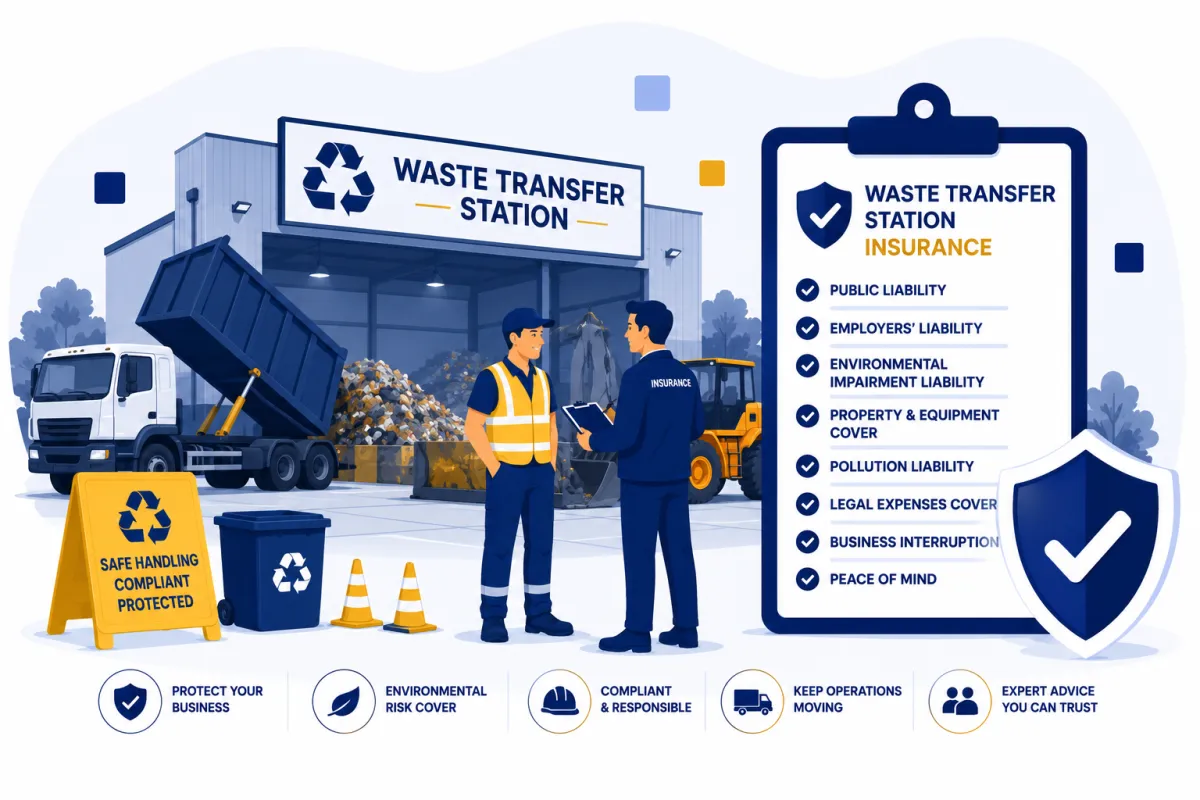
Waste Transfer Station Insurance UK | Specialist Broker
Why is waste transfer station insurance so hard to place in 2026?
Waste transfer stations sit in one of the most distressed corners of the entire UK commercial insurance market. Over the past decade, a sustained run of large fire losses has driven mainstream insurers out of the waste and recycling sector almost entirely — and the insurers that remain apply strict underwriting requirements, higher excesses, and premium rates that can run to multiples of what a comparable industrial unit would pay. If you operate a transfer station, a materials recovery facility (MRF), a skip hire yard or a recycling operation, you have probably already discovered that the comparison sites won't quote you, most brokers can't help you, and your renewal terms arrive later and cost more every year.
This is exactly the territory Miller & Partner works in. As a specialist broker for adverse and hard-to-place risks, we place cover for businesses that the standard market has walked away from — including operators who have been refused cover elsewhere or non-renewed after a loss. This guide explains why the waste market hardened, what the Environment Agency and HSE expect of your site, what a properly structured waste transfer station policy must contain, and — critically — how to present your risk so that specialist underwriters actually want to write it.
How does the Insurability Framework apply to waste sites?
Underwriter Intelligence
We know which specialist markets are still writing waste risks in 2026, what their appetite triggers are, and what makes them decline. For waste sites, that means presenting your fire prevention plan, waste acceptance procedures and battery quarantine protocol before the underwriter has to ask.
Difficult Risk Expertise
Waste is a declined-by-default sector. Our Lloyd's market and specialist MGA access reaches the underwriters who still have capacity for transfer stations, MRFs and skip operators — including risks with prior fire losses or lapsed cover.
Risk Assessment
We audit your site the way an insurer's surveyor will: pile sizes and separation distances against your Fire Prevention Plan, ignition sources, thermal detection, vehicle/pedestrian segregation, and the exposures hidden in your waste acceptance paperwork.
Claims Advocacy
Waste fires produce complex, contested claims — average clauses, indemnity period arguments, EA cost recovery. When it happens, you deal with a named broker who fights your corner, not a call centre.
Key facts at a glance
- Waste and recycling recorded a fatal injury rate of 5.47 per 100,000 workers in 2025/26 — roughly 15 times the all-industry average of 0.37, and second only to agriculture (HSE, July 2026).
- Lithium-ion batteries in the waste stream now cause over 1,200 fires a year in UK bin lorries and waste sites — up 71% from around 700 in 2022.
- Li-ion batteries are linked to roughly 48% of all UK waste fires, at an estimated cost of £158 million a year to operators, fire services and the environment.
- Individual waste site fire claims have reached £20 million; a major waste fire can burn for days and trigger EA enforcement, road closures and community claims within a 1km radius.
- An approved Environment Agency Fire Prevention Plan (FPP) — covering pile sizes, 6-metre separation, maximum 6-month storage and firefighting water — is a precondition of your environmental permit and the first document a waste underwriter asks for.
- Being struck by a moving vehicle accounts for around 48% of deaths in the waste sector, against roughly 17% across all industries — which is why underwriters interrogate your traffic management plan.
- Property rates for waste risks can run from roughly 0.4% to 2%+ of declared values depending on materials handled and fire risk management — several times typical industrial rates.
What must a waste transfer station policy include that a standard one won't?
The single most dangerous assumption a waste operator can make is that a standard commercial combined policy — the sort sold online to workshops and warehouses — will respond to a waste site loss. It almost certainly won't. Waste operations breach the warranties, conditions and exclusions of standard wordings in half a dozen places at once. The comparison below shows where a generic policy fails and what a specialist waste wording does differently.
| Exposure | Standard commercial policy | Specialist waste transfer station wording |
|---|---|---|
| Fire at combustible waste piles | Waste storage typically excluded or voids cover via undisclosed material change of risk | Written with full disclosure of waste types, pile management and FPP compliance; fire cover priced accordingly |
| Pollution / contamination | Sudden and accidental pollution only — often excluded entirely for waste trades | Environmental impairment liability (EIL) available: gradual pollution, clean-up costs, EA cost recovery, statutory defence |
| Firefighting water run-off damage | Not contemplated; third-party contamination claims likely declined | Addressed through EIL and public liability extensions aligned to your FPP water management plan |
| Business interruption after a major fire | 12-month indemnity period standard — far too short for permit-dependent rebuilds | 24–36 month indemnity periods, with increased cost of working and loss of permit considerations |
| Plant: shredders, balers, trommels, loading shovels | Generic contents definition; hired-in plant and continuing hire charges often missed | Scheduled own plant, hired-in plant, continuing hire charges and breakdown options |
| Waste acceptance / rejected loads | No mechanism — disputes fall outside cover | Underwriting reflects documented waste acceptance procedures and quarantine protocol, protecting claims position |
| Vehicle movements on site | RTA-only motor cover; yard incidents fall between motor and liability policies | Motor fleet and liability sections dovetailed so yard, weighbridge and tipping-face incidents don't fall in the gap |
Why have insurers withdrawn from the waste and recycling sector?
The waste insurance market's contraction wasn't a single event — it was a compounding cycle. A rising frequency of large site fires through the 2010s produced loss ratios that mainstream property insurers couldn't sustain, and most responded by withdrawing from the sector altogether. The insurers that stayed repriced sharply and attached conditions: mandatory risk surveys, thermal detection requirements, pile management warranties and substantially higher excesses.
What kept the market hard rather than letting it recover was that the underlying fire risk kept getting worse. The growth of lithium-ion batteries in household and commercial waste streams introduced an ignition source that no amount of traditional housekeeping fully controls — a crushed vape or laptop battery can initiate thermal runaway deep inside a residual waste pile hours after tipping. At the same time, claims severity rose: waste fires burn hot, reignite, resist extinguishment and produce secondary losses — plume damage, contaminated firefighting water, EA enforcement, community disruption — that multiply the final bill far beyond the property damage itself.
The practical consequence for operators is a two-tier market. Sites that can demonstrate disciplined fire risk management — an implemented FPP, detection technology, battery quarantine, clean housekeeping records — can still access competitive specialist terms. Sites that can't are quoted defensively, restricted, or declined outright. If you've already been declined, our guide to insurance when you've been refused elsewhere explains how specialist placement works from that position.
From recent placement conversations
The most frustrating conversations I have are with transfer station operators who've been non-renewed with 30 days' notice after a decade with the same insurer — not because of anything they did, but because the insurer exited the whole sector. They come to us assuming they're uninsurable. They're usually not.
What actually decides the outcome is evidence. One operator we placed last year had been declined by three brokers. The difference wasn't the risk — it was that we submitted their approved Fire Prevention Plan, twelve months of pile inspection records, their battery quarantine log and thermal camera maintenance certificates as a single underwriting pack. The underwriter's words: "this is the first waste presentation this year I haven't had to chase." They quoted. Two others followed. Presentation is not decoration in this sector — it is the placement.
How are lithium-ion battery fires reshaping waste site underwriting?
Lithium-ion batteries are now the defining underwriting issue for the entire waste sector. Batteries discarded in general waste and mixed recycling — loose, or hidden inside electricals such as vapes, phones, toothbrushes and power tools — get crushed, punctured or heated during collection and processing. Damaged cells enter thermal runaway: a self-accelerating chemical reaction that generates its own oxygen, which means the resulting fires reignite repeatedly and can burn for days.
The numbers are stark. Battery-related fires in the UK waste system have climbed past 1,200 a year — a 71% rise on 2022 — and research by Eunomia and the Environmental Services Association attributes around 48% of all UK waste fires to lithium-ion batteries, at an annual cost of roughly £158 million. Around 94% of UK local authorities report battery fires in the waste stream as a growing challenge. For an individual operator, the exposure is existential: single claims at waste facilities have reached £20 million.
Underwriters have responded by making battery risk management a gateway question. Expect to be asked, in detail, about:
- Waste acceptance procedures — how incoming loads are screened, what your rejection protocol is, and how WEEE and battery contamination is documented back to the producer.
- Detection technology — thermal imaging cameras over tipping halls and residual piles, hotspot alarms, and whether detection is monitored outside operating hours (most catastrophic waste fires develop overnight).
- Battery quarantine — a designated, separated quarantine container for recovered batteries and suspect items, with documented removal by a licensed carrier.
- Pile discipline — stock rotation and residence time controls, because a battery buried in a static pile is a slow fuse.
Operators storing or processing battery-heavy streams (WEEE lines, vape recovery, EV-related waste) face the sharpest scrutiny of all — this end of the market overlaps with the specialist territory we cover in our guide to battery storage facility insurance, where thermal runaway is the central underwriting concern.
What does the Environment Agency Fire Prevention Plan actually require?
If your site holds an environmental permit and accepts combustible waste, an approved Fire Prevention Plan (FPP) is not optional — the Environment Agency requires it as a condition of permitting, and in practice the FPP must be approved before a permit is issued or varied. The EA's fire prevention plan guidance sets three objectives: minimise the likelihood of a fire, aim for extinguishment within four hours, and minimise the spread of fire within the site and to neighbouring sites.
The prescriptive detail matters because underwriters use the same document as their underwriting baseline. The guidance requires, among other things:
- Scaled site plans showing waste piles, buildings, hazardous material stores, and all permanent ignition sources kept a minimum of 6 metres from combustible waste.
- Maximum pile sizes and separation distances for each material type, with fire walls of adequate height and construction where separation can't be achieved.
- Maximum storage duration — combustible wastes stored for less than 6 months, with documented stock rotation to control self-combustion risk.
- Quarantine areas kept permanently clear, sized to receive a burning pile.
- Firefighting water calculations — as a benchmark, a 300m³ pile of combustible material normally requires a supply of at least 2,000 litres per minute — plus containment measures so contaminated run-off doesn't pollute watercourses.
- Detection and suppression appropriate to the materials stored, including suppression systems for materials stored inside buildings.
What insurance covers does a waste transfer station need?
A waste transfer station programme is genuinely combined — it has to knit together property, casualty, environmental, motor and engineering covers so that a single incident (which will usually touch several at once) doesn't fall between sections. The core structure looks like this:
Property damage and stock
Buildings, fixed plant, weighbridges, and processing machinery, insured at correct reinstatement values. Waste sites are acutely exposed to underinsurance and the condition of average — plant replacement costs have inflated sharply, and a declared value set three renewals ago can leave you self-insuring a third of your own fire.
Business interruption
The most commonly mis-structured cover in the sector — see the dedicated section below and our full guide to business interruption insurance.
Employers' liability
Legally required under the Employers' Liability (Compulsory Insurance) Act 1969, and priced in this sector against some of the worst injury statistics in the UK economy. Underwriters will examine machinery guarding, isolation procedures, and above all vehicle/pedestrian segregation.
Public liability
Third-party injury and property damage — including smoke plume and nuisance claims from neighbours after a fire. Waste operations sit firmly in the territory we cover in our guide to high-risk public liability insurance; expect contract terms from local authority clients to demand £10m limits.
Environmental impairment liability (EIL)
The cover most operators discover they don't have only after the EA serves a remediation notice. Covered in detail below.
Plant, machinery and engineering
Owned and hired-in plant, breakdown, and statutory inspection — see the plant section below and our guides to plant and machinery insurance and engineering inspection.
Motor fleet
Collection vehicles, hook loaders, skip lorries and artics — with the fleet and liability sections aligned so on-site incidents don't fall into the gap between them.
Cover checker: what does your waste operation need?
Select the profile closest to your operation. Tags show what's legally required, essential, or worth considering. Every waste programme should be built individually — this checker maps the starting point.
- LEGALEmployers' liability (£10m) — compulsory with any staff; sector injury rates make this heavily underwritten.
- ESSENTIALProperty damage on specialist waste wording — FPP-aligned fire cover for buildings, plant and stock.
- ESSENTIALBusiness interruption, 24–36 month indemnity period — permit-dependent rebuilds don't fit 12 months.
- ESSENTIALPublic liability (£10m) — plume, run-off and neighbour claims; local authority contracts usually require it.
- RECOMMENDEDEnvironmental impairment liability — gradual pollution and EA cost recovery sit outside standard PL.
- CRITICALThermal detection + battery quarantine protocol — increasingly a condition of cover, not just a discount. Specialist placement needed if you've had a previous fire claim.
- LEGALMotor fleet — skip lorries and hook loaders; RTA cover is compulsory, but confirm on-site tipping incidents are picked up.
- LEGALEmployers' liability (£10m) — drivers and yard staff.
- ESSENTIALPublic liability incl. skips on highway — Highways Act permits and lighting/guarding conditions must be reflected in the wording.
- ESSENTIALYard property and stock cover — stored skips and sorted material are combustible stock in insurer eyes.
- RECOMMENDEDGoods in transit / load liability — for contaminated or disputed loads.
- CONSIDEREIL — if you hold a permitted yard rather than operating carrier-only.
- LEGALEmployers' liability (£10m) — cutting, baling and depollution work drives severity.
- ESSENTIALProperty on ELV/scrap wording — FPP pile rules for end-of-life vehicles (stacks two wide, three high) are underwriting conditions.
- ESSENTIALPublic liability — public-facing weighbridges and collections raise footfall exposure.
- CRITICALEV and hybrid battery protocol — undepolluted EVs are the fastest-hardening sub-risk in the scrap sector; underwriters expect documented handling and quarantine.
- RECOMMENDEDEIL — fluids, ground contamination and historic land condition.
- CONSIDERTrade credit — metal price volatility and buyer default; see our trade credit insurance guide.
- CRITICALThermal runaway risk controls — WEEE and battery streams are the epicentre of the sector's fire losses; expect survey-led underwriting and specialist placement.
- LEGALEmployers' liability (£10m) — manual sorting lines carry sharps, chemical and battery exposure.
- ESSENTIALProperty with detection/suppression conditions — thermal cameras and out-of-hours monitoring are frequently mandatory.
- ESSENTIALBusiness interruption with supplier/customer extensions — downstream reprocessor dependency; see contingent BI.
- RECOMMENDEDEIL — heavy metals and electrolyte contamination.
- RECOMMENDEDPublic liability (£10m) — plume and neighbouring premises exposure is elevated.
- CRITICALSpecialist placement only — hazardous waste consignments, COSHH exposure and permit conditions put this outside packaged products entirely.
- LEGALEmployers' liability (£10m) — chemical exposure and occupational disease underwriting applies.
- ESSENTIALEIL with gradual pollution — for hazardous handlers this is arguably as important as the property section.
- ESSENTIALPublic liability with contractual liability review — producer contracts push liability downstream to you.
- ESSENTIALProperty + BI on fully disclosed basis — consignment records form part of the fair presentation.
- RECOMMENDEDDirectors' & officers' — EA prosecutions increasingly name directors personally; see our D&O guide.
- LEGALMotor / goods in transit — carriers need load liability aligned to duty of care paperwork.
- ESSENTIALPublic liability — collection and delivery exposures at third-party premises.
- ESSENTIALProfessional indemnity — brokers and consultants advising on classification and disposal routes carry advice risk; standard market PI often excludes waste, so see our professional indemnity page.
- RECOMMENDEDLegal expenses — duty of care disputes and EA interviews under caution.
- CONSIDERCyber — weighbridge and consignment systems are increasingly targeted; see our cyber insurance page.
- CONSIDEREL — required the moment you employ anyone, including part-time yard help.
How dangerous is the waste sector — and what does that mean for EL and PL?
Casualty underwriters price waste risks against the sector's safety record, and that record remains one of the worst in the UK. The HSE's annual fatality statistics published in July 2026 show the waste and recycling sector recorded a fatal injury rate of 5.47 per 100,000 workers in 2025/26 — around 15 times the all-industry average of 0.37, and the second-highest rate of any main sector after agriculture. Six workers and three members of the public died in waste-related incidents over the year, and RIDDOR data recorded over 1,500 non-fatal employee injuries in the sector in the previous reporting year.
The pattern of harm shapes the underwriting questions. Being struck by a moving vehicle accounts for roughly 48% of deaths in waste and recycling against about 17% across all industries — which is why every serious waste proposal form interrogates traffic management: one-way systems, physically segregated pedestrian routes, banksmen, reversing aids, and exclusion zones around the tipping face. Machinery entanglement is the fastest-rising cause of serious injury, putting guarding, interlocks and lock-off/isolation procedures under equal scrutiny. The HSE's waste and recycling guidance, together with the industry's WISH (Waste Industry Safety and Health) forum guidance, sets the standard your risk presentation will be judged against.
Enforcement risk compounds the picture. In April 2026, a Hampshire waste company was prosecuted under the Health and Safety at Work etc. Act 1974 after a worker sorting waste lost both lower legs to a reversing 15-tonne excavator; the court indicated a fine of £180,000, reduced to £120,000 for the guilty plea — academic only because the company had already entered liquidation. That case is a compressed lesson in this sector's risk chain: a segregation failure became a life-changing injury, a prosecution, and ultimately an insolvency.
Why is pollution excluded from standard liability policies?
Standard public liability wordings restrict pollution cover to "sudden, identifiable, unintended and unexpected" incidents — and for waste trades, many insurers strike pollution cover out entirely. That leaves precisely the exposures a waste site is most likely to face uninsured: gradual leaching into ground or groundwater, contaminated firefighting run-off reaching a watercourse, historic contamination surfacing during works, and — most expensively — regulator-driven clean-up.
Environmental impairment liability (EIL) fills that gap. A properly structured EIL policy for a waste operation covers sudden and gradual pollution, first-party and third-party clean-up costs, statutory liabilities under the environmental damage regime, EA cost recovery, and legal defence — including representation during EA investigations. Given that the Environment Agency's own research suggests a serious waste fire can affect people within at least a 1km radius, and that firefighting water run-off is treated as a pollution event in its own right, EIL is the difference between a bad month and an existential one for most permitted sites.
FPP readiness checklist: would your site pass underwriting scrutiny?
Tap each item you can evidence today — not "mostly do", but could hand to a surveyor as a document or show on a walk-round. Your score maps to how an underwriter will read the risk.
Why is the indemnity period the most important number on your BI schedule?
Business interruption failures in the waste sector rarely come from the cover being absent — they come from the indemnity period being too short. A serious fire at a permitted waste site does not resolve on a warehouse timeline. Before rebuilding even starts you may face EA investigation, site clearance of fire-damaged waste (itself hazardous waste, at hazardous waste disposal prices), planning and permit variation, FPP re-approval, and only then reconstruction and recommissioning. Twelve months is routinely not enough; specialist brokers structure waste BI on 24 or 36-month indemnity periods for exactly this reason.
Two further structural points matter. First, declare gross profit correctly and check the sum insured annually — waste gate fees and material revenues have moved sharply, and average applies to BI just as it does to property. Second, consider increased cost of working generously: after a fire, diverting contracted waste to third-party facilities at spot gate fees is often the only way to keep collection contracts alive, and it is expensive. Our guides to day one reinstatement and business interruption cover the underlying mechanics in detail.
What about plant, machinery and statutory inspection?
Shredders, balers, trommels, picking stations, loading shovels and material handlers are the productive heart of a transfer station — and its second-biggest loss driver after fire. Owned plant should be scheduled at current replacement values (secondhand shredder prices alone have moved enough in recent years to create instant underinsurance), hired-in plant cover must match hire agreement liabilities including continuing hire charges, and breakdown cover deserves genuine consideration given lead times on major components.
Separately, lifting equipment and pressure systems on site carry statutory examination duties under LOLER and PUWER — grab cranes, hook loaders, compactors and air receivers all typically require periodic thorough examination by a competent person. Insurer-provided engineering inspection services discharge this efficiently alongside the insurance itself; our engineering inspection insurance guide explains how the inspection and insurance elements fit together.
Risk assessor: how will an underwriter score your site?
What regulatory framework applies to waste transfer stations?
Waste is one of the most densely regulated activities in the UK economy, and every layer of that regulation feeds directly into how your insurance is underwritten and how a claim will be handled. The pillars are:
Environmental permitting
Transfer stations, MRFs and treatment facilities operate under environmental permits issued under the Environmental Permitting (England and Wales) Regulations 2016. The permit defines the waste codes you may accept, throughput and storage limits, infrastructure requirements and — for combustible waste — incorporates your approved Fire Prevention Plan. Operating outside permit conditions is a criminal offence, exposes you to suspension or revocation, and gives an insurer a material fact argument if it emerges after a loss.
Duty of care
Section 34 of the Environmental Protection Act 1990 imposes the waste duty of care on everyone in the chain — producer, carrier, and your site as receiver. Waste transfer notes and consignment notes aren't administrative decoration: after a fire or pollution incident they are the evidence trail that determines whether a contaminated load was your failure or your customer's, which in turn shapes recovery prospects on the claim.
Health and safety
The Health and Safety at Work etc. Act 1974 and its subordinate regulations (PUWER, LOLER, the Workplace Regulations) apply with particular force in a sector with the second-worst fatality rate in the UK. HSE's refreshed waste and recycling guidance and the WISH forum's industry guidance define what "reasonably practicable" looks like for traffic management, machinery guarding and waste handling — and sentencing under the Definitive Guideline links fines to turnover, so a serious incident at a mid-sized operator routinely produces a six-figure fine on top of the civil claim.
Fire safety
Alongside the EA's FPP regime, occupied buildings on site fall under the Regulatory Reform (Fire Safety) Order 2005, requiring a suitable and sufficient fire risk assessment. Underwriters expect the FPP and the FRA to tell the same story.
What drives the cost of waste transfer station insurance?
There is no meaningful "average premium" for a waste site — the spread between a disciplined inert-waste operation and a battery-contaminated residual site with a loss history is enormous. What every operator can do is understand the rating factors and work the ones within their control:
| Rating factor | Why it moves your premium | Mitigation |
|---|---|---|
| Waste streams handled | Combustibility and battery contamination risk define the fire exposure | Accurate stream disclosure; segregate and price battery-risk streams separately |
| FPP compliance | Several wordings make it a condition; drift = defence risk = defensive pricing | Quarterly documented FPP audits; update the plan when the site changes |
| Fire detection & suppression | Overnight detection is the difference between a hotspot and a total loss | Thermal cameras with out-of-hours alerting; suppression in buildings |
| Battery quarantine protocol | The sector's #1 loss driver; underwriters now gateway on it | Written protocol, quarantine container, licensed removal records |
| Pile management & housekeeping | Pile size, separation and residence time govern fire spread and self-combustion | Marked footprints, stock rotation records, photographic inspection log |
| Claims history | Prior fire or liability losses reprice everything for 3–5 years | Evidence what changed since the loss; see our claims history guide |
| Construction & site layout | Combustible buildings, tight boundaries and neighbouring premises raise severity | Fire walls, boundary separation, clear quarantine space |
| Traffic management | Vehicle strikes cause ~48% of sector deaths; EL/PL rating follows | Segregated walkways, one-way systems, reversing controls, banksman rules |
| Machinery risk | Entanglement is the fastest-rising serious injury cause | Guarding audits, isolation/lock-off, statutory inspection up to date |
| Declared values | Underinsurance triggers average; overdeclaration wastes premium | Reinstatement-basis valuations refreshed at least every 2–3 years |
| Indemnity period & BI basis | Longer indemnity costs more — but 12 months is false economy | Model a realistic permit-and-rebuild timeline; buy 24–36 months |
| Security & arson controls | Waste sites attract trespass and deliberate ignition | Fencing, CCTV, lighting, out-of-hours monitoring |
| Permit & compliance record | EA compliance ratings and enforcement history are underwriting facts | Disclose fully; show closed-out actions with evidence |
| Continuity of cover | Lapses and mid-term cancellations are declinature red flags | Start renewal early; never let cover gap while shopping the market |
What do real waste site claims look like?
These three fictionalised but market-realistic case studies show how waste losses actually unfold — and where the structural decisions made at placement decided the outcome.
Case study 1: The overnight battery fire — £3.4m property and BI loss
A Midlands transfer station handling mixed commercial waste suffered a fire that started in a residual pile around 11pm — investigation pointed to a crushed e-scooter battery tipped that afternoon. With no thermal detection, the fire wasn't identified until a passing driver called 999 at 1am. The processing building, two shredders and a picking line were destroyed; the fire burned for three days and required firefighting water containment the site was never designed for.
The numbers: £1.9m property damage, £1.1m business interruption over a 19-month reinstatement (EA investigation, permit variation, FPP re-approval, then rebuild), £400,000 in site clearance of fire-damaged waste — a cost category the operator hadn't considered until fire-damaged mixed waste was classified as hazardous.
The lesson: the policy paid because the operator's specialist wording carried a 24-month indemnity period and debris removal extension sized for waste. On the 12-month indemnity period they had held two years earlier, the BI claim would have stopped seven months before reopening. Renewal premium rose 62% — with thermal cameras installed as a condition — and returned to market rates over three years.
Case study 2: The firefighting run-off — £780,000 pollution claim standard PL wouldn't touch
A skip operator's yard fire in the North West was extinguished within four hours — a success story, until contaminated firefighting water escaped through an unsealed surface drain into a brook. The Environment Agency undertook emergency works, pursued cost recovery, and a downstream fishery claimed for stock losses.
The numbers: £310,000 EA cost recovery and remediation, £360,000 third-party claims including the fishery, £110,000 legal and environmental consultancy costs. Total: £780,000.
The lesson: the operator's public liability insurer initially reserved its position — the escape unfolded over hours through an existing drainage defect, engaging the gradual pollution exclusion. The claim was ultimately met under the environmental impairment liability policy the operator had bought, reluctantly, at their broker's insistence two renewals earlier for £4,200 a year. Without EIL, the business — with £600,000 annual turnover — would almost certainly have failed. Post-claim, EIL premium doubled; the operator considers it the best money the business spends.
Case study 3: The reversing telehandler — £925,000 EL settlement and a director in interview
An agency worker at a family-run MRF was struck by a reversing telehandler while crossing the yard to the welfare unit — the designated walkway had been coned off for weeks during resurfacing with no alternative route marked. He suffered pelvic and spinal injuries ending his working life at 38.
The numbers: EL settlement of £925,000 including future loss of earnings and care; HSE prosecution under the Health and Safety at Work etc. Act 1974 resulting in a £160,000 fine under the Definitive Guideline; £45,000 defence costs. Directors were interviewed under caution, though not personally charged.
The lesson: the EL policy responded fully — but the prosecution, fine and reputational damage sat outside it (fines are uninsurable as a matter of public policy). The claim triggered a five-year EL loading of 40% and survey conditions at every renewal. The £6,000 traffic management scheme the operator installed afterwards — barriers, marked crossings, reversing cameras — was quoted before the incident and deferred. Vehicle segregation is the single highest-return safety investment a waste operator can make, and underwriters price it accordingly.
What if your waste site cover has been refused or cancelled?
Refusal, non-renewal and mid-term cancellation are common enough in this sector that they carry less stigma with specialist underwriters than operators fear — but they must be handled correctly. Every future proposal form will ask whether you have ever been refused cover, and the duty of fair presentation makes the answer permanent. The workable path is the one we set out in our guides to insurance for businesses refused cover and insurance after insolvency (relevant where a previous waste company failed): disclose everything, evidence what has changed, and approach the specialist market through a broker who can frame the risk — never through serial applications that create a paper trail of declines. Operators with CCJs or adverse credit alongside a hard-to-place trade need both issues presented together, once, properly.
How do you manage a major claim at a waste site?
Waste claims are won and lost in the first fortnight. This is the sequence we run with clients:
- Make the site safe and preserve the scene. Life safety first; then, so far as safe, preserve the seat of the fire or incident area — causation evidence determines recovery prospects against third parties.
- Notify your broker immediately — same day. Late notification is a policy condition breach. Your broker triggers insurer notification across every affected section: property, BI, liability, EIL, motor, engineering.
- Notify regulators in parallel. RIDDOR reporting for injuries; the Environment Agency for pollution events or permit-relevant incidents. Take legal advice before giving interviews under caution.
- Document everything from hour one. Photographs, CCTV and thermal camera exports, weighbridge records, waste transfer notes for recent loads, staff statements while memories are fresh.
- Control communications. One spokesperson; no speculation about cause to neighbours, press or social media — statements made now surface in liability proceedings later.
- Engage a loss adjuster on the right footing. The insurer's adjuster is professional but not your representative. On major losses, we advise on whether appointing your own loss assessor or claims preparation accountant is justified — on complex BI claims it usually is.
- Mitigate the interruption — and keep receipts. Divert contracted waste to third-party facilities, hire replacement plant, protect key contracts. Reasonable mitigation costs are recoverable as increased cost of working; undocumented ones are arguments.
- Manage the reinstatement timeline actively. EA liaison, permit variation, FPP re-approval and rebuild must run concurrently wherever possible — every sequential month consumes indemnity period. Your broker should be chasing all four tracks, not just the builder.

About the author — John Miller
John Miller is Director & Principal Broker at Miller & Partner Limited (FCA Firm Ref 1029698), with over 13 years' specialist commercial insurance experience and direct access to the Lloyd's Market and specialist MGA schemes. John specialises in adverse and hard-to-place risks — including waste, recycling and other sectors the standard market has exited — placing cover for operators others have declined. He was previously the #1 Account Executive at Brown & Brown and #1 Salesperson at AXA.
Read more about John · Office: Vivian House, Roman Bridge Close, Mumbles, Swansea SA3 5BG · 01792 001350
Glossary of waste insurance terms
- Waste transfer station
- A permitted facility where waste is received, bulked, sorted or temporarily stored before onward transport to treatment, recycling or disposal.
- Materials recovery facility (MRF)
- A site that separates mixed recyclables into marketable material streams using mechanical and manual sorting.
- Environmental permit
- Authorisation under the Environmental Permitting (England and Wales) Regulations 2016 defining what waste a site may accept, in what quantities, and under what conditions.
- Fire Prevention Plan (FPP)
- The Environment Agency-approved plan required for permitted sites storing combustible waste, covering pile sizes, separation, storage duration, detection and firefighting water.
- Thermal runaway
- The self-accelerating reaction in a damaged lithium-ion battery that generates heat and oxygen internally, producing fires that reignite and resist extinguishment.
- Waste duty of care
- The obligation under s.34 Environmental Protection Act 1990 on everyone handling waste to ensure it is managed and transferred lawfully, evidenced by transfer notes.
- Waste transfer note / consignment note
- The documentation accompanying non-hazardous (transfer note) or hazardous (consignment note) waste movements — the evidential backbone of any contaminated-load dispute.
- Environmental impairment liability (EIL)
- Specialist insurance for pollution risks, including gradual pollution, clean-up costs and regulator cost recovery, which standard liability policies exclude.
- Gradual pollution
- Contamination occurring over time rather than from one sudden identifiable event — the standard-market exclusion that catches most real waste-site pollution losses.
- Condition of average
- The policy mechanism that proportionately reduces claim payments where declared values are below true values — acutely dangerous in a sector with inflating plant costs.
- Indemnity period
- The maximum time business interruption cover pays after a loss. Waste sites need 24–36 months to accommodate investigation, permitting and rebuild.
- Increased cost of working (ICOW)
- Business interruption cover for reasonable extra costs — such as diverting waste to third-party gate fees — incurred to keep trading after an insured loss.
- Quarantine area
- A permanently clear area required by the FPP, sized to receive a burning or suspect waste pile safely away from other combustibles.
- Waste acceptance procedure
- The documented process for inspecting, accepting, rejecting and recording incoming loads — an underwriting gateway for battery-contamination risk.
- WISH
- The Waste Industry Safety and Health Forum, whose guidance defines recognised good practice for waste sector safety, referenced by HSE and by underwriters.
- Fair presentation
- The duty under the Insurance Act 2015 to disclose every material circumstance about the risk — including waste types, losses, enforcement history and refused cover.
- Non-renewal
- An insurer's decision not to offer renewal terms — common where insurers exit the waste sector, and disclosable on future proposals.






Instagram
LinkedIn