

FS Register FRN 1029698

Five Star Rated on Google

13+ years specialist broking experience

General information, not advice. Written for general guidance and drawing on external sources as well as our own experience. It isn't a personal recommendation and doesn't take account of your circumstances — full disclaimer and sources.

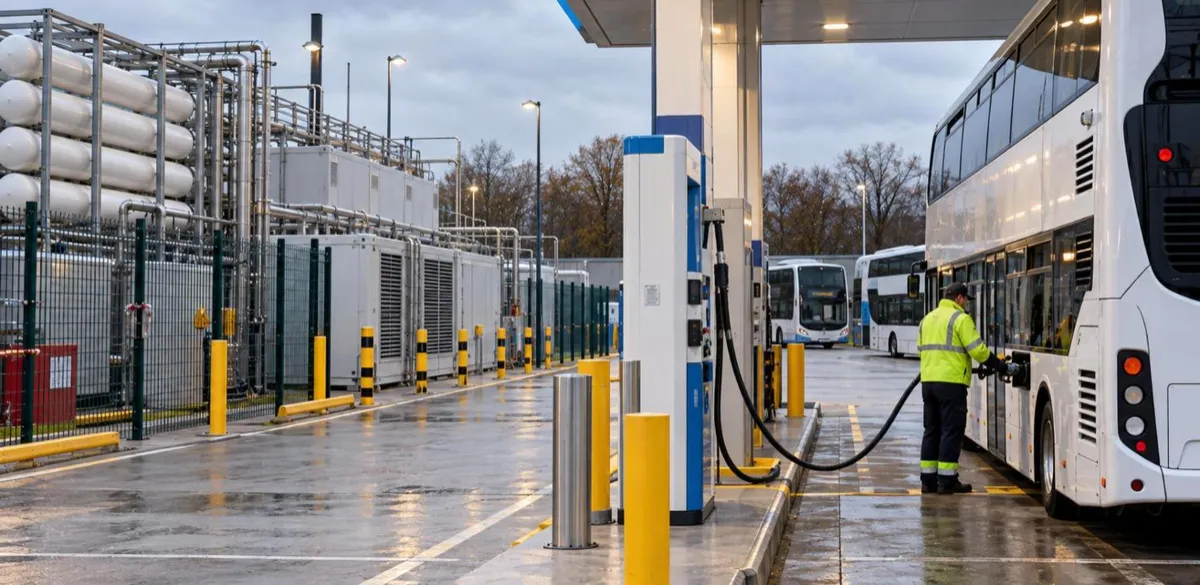
Fuel cell bus being refuelled at a hydrogen refuelling station in a UK bus depot

Hydrogen Refuelling Station Insurance UK | Specialist Cover

October 30, 2026

Published: 30 October 2026 | Reading time: 7 minutes | Category: Renewable Energy | Author: John Miller, Miller & Partner

Last reviewed by John Miller, Director & Principal Broker — 30 October 2026
FS Register FRN 102969813+ years specialist commercial brokingLloyd's & specialist MGA market accessIndependent UK broker

Hydrogen refuelling station insurance covers the dispensers, compressors, storage and on-site production at stations that fuel buses, lorries, vans and cars with hydrogen. The main covers are property damage and machinery breakdown for the equipment, business interruption for lost fuel sales or contract income, and public and products liability for injury or damage caused at the station or by the hydrogen you supply. Station operators also need employers' liability and, in most cases, environmental liability. Insurers look closely at the station's design under DSEAR, the dispensing pressure, how much hydrogen is stored, separation from public areas and other fuels, and who maintains the equipment. Many UK stations now serve fleets rather than the public, which changes how the liability risk is assessed.

Running or planning a hydrogen refuelling station? We'll arrange cover that reflects your equipment, your customers and your contracts.

Key facts at a glance

  1. Most stations now serve fleets. Bus, lorry and depot stations have replaced many public forecourt sites, and the insurance follows that shift.
  2. Compressors are the weak point. High-pressure compression is where breakdown claims tend to happen.
  3. Products liability matters. If contaminated or off-spec hydrogen damages a customer's fuel cell, the claim lands on you.
  4. Downtime is expensive. Fleet contracts can carry penalties if vehicles can't be refuelled.
  5. Location shapes the price. Shared forecourts, depots and public sites are each rated differently.

What insurance does a hydrogen refuelling station need?

A refuelling station usually needs property and breakdown cover for the equipment, business interruption, public and products liability, employers' liability and environmental liability.

CoverWhat it protectsWatch out for
Property damageDispensers, compressors, storage, chillers and canopiesFire and explosion deductibles
Machinery breakdownSudden failure of compressors, chillers and controlsWear and tear exclusions on seals and valves
Business interruptionLost fuel sales and contract incomeLong lead times for imported parts
Public liabilityInjury or damage to drivers and the publicLimits lower than the site owner requires
Products liabilityDamage caused by the hydrogen you supplyFuel quality and contamination claims
Environmental liabilityPollution clean-up costsShared sites with liquid fuel storage

Stations that produce their own hydrogen on site have more in common with a production plant, which we cover in our guide to hydrogen production insurance.

Why are refuelling stations a specialist risk?

A hydrogen station combines high-pressure gas, members of the public or third-party drivers, and expensive equipment that's hard to replace quickly.

Hydrogen is dispensed at very high pressure, which puts heavy demands on compressors, hoses, nozzles and valves. Those parts wear, and a failure can stop the station until a specialist engineer and the right part arrive. That's why insurers want to see a maintenance contract and a sensible spares holding before they offer strong breakdown and interruption cover.

The liability side depends on who uses the station. A depot station refuelling your own buses is a more controlled risk than a public site where any driver can pull in. Shared forecourts, where hydrogen sits alongside petrol, diesel or EV chargers, bring their own questions about separation distances and who is responsible for what.

Read the site agreement

If the station sits on someone else's land, such as a depot, port or service area, the agreement will set insurance requirements. Check the liability limit, any indemnity you've given and whether the landowner must be named on your policy.

What do insurers ask about a refuelling station?

Insurers want to understand the equipment, the site and the customers.

  • Equipment. Dispensing pressure, compressor type, storage capacity and the manufacturer
  • Supply. Whether hydrogen is delivered by tube trailer or produced on site
  • Site. Location, layout, separation distances and other fuels on site
  • Customers. Your own fleet, contracted fleets or the public
  • Safety. DSEAR assessment, leak detection, emergency shutdown and staff training
  • Maintenance. Who services the station, response times and spares held
  • Contracts. Fleet supply agreements, penalties and site lease terms

How can a station operator keep cover affordable?

  1. Keep a full maintenance record. Show insurers the service history for every compressor and dispenser.
  2. Hold critical spares. A spare compressor component can cut a long interruption to days.
  3. Train every operator. Document training for staff and for drivers who self-serve.
  4. Control fuel quality. Keep testing records to defend product liability claims.
  5. Match the indemnity period to reality. Base it on how long a replacement part really takes to arrive.

Frequently asked questions

Usually not. Most forecourt policies are written for petrol and diesel and exclude or don't rate hydrogen.

Sudden breakdown can be covered under a machinery breakdown policy, but wear and tear on seals and valves usually isn't.

That's a products liability claim. Make sure your policy includes products cover and keep fuel quality records.

Yes. Even if only your own vehicles use it, you need property, breakdown and liability cover for the station.

The station is covered on site. The trailer in transit is normally the supplier's responsibility, so check the delivery contract.

Site owners and fleet customers often ask for £10 million. Check your agreements before choosing a limit.

Yes. The build needs construction cover first, then the operational policy starts at handover.

It can. Insurers will look at separation from other fuels and who controls the site.

It's recommended, especially on shared sites with liquid fuel storage.

Yes. Operators with more than one site can usually combine them on one programme.

Related guides from Miller & Partner

Need your station insured? Send us the station specification, storage volumes and who you supply, and we'll come back with terms.

John Miller, Director and Principal Broker at Miller & Partner
Written and reviewed by John Miller Director & Principal Broker, Miller & Partner Over 13 years of specialist commercial insurance experience, formerly with Brown & Brown and AXA. Places hard-to-place energy and property risks through Lloyd's syndicates and specialist MGAs, including heat networks, battery storage, solar and hydrogen projects.
Our regulatory status

Miller & Partner Limited (FRN 1029698) is an Appointed Representative of Gauntlet Risk Management Ltd (FRN 308081), which is authorised and regulated by the Financial Conduct Authority. Miller & Partner Limited is registered in England and Wales (company number 16206282) and trades from Vivian House, Roman Bridge Close, Mumbles, Swansea SA3 5BG. This article is general information, not a personal recommendation or an offer of cover. Cover is subject to insurer acceptance and the full terms, conditions and exclusions of the policy issued.


Back to Blog
About this article General information, not advice. Published for general guidance and drawing on external sources as well as our own experience. It is not a personal recommendation, a quotation, or an offer of cover, and it doesn't take account of your circumstances. Read more + Close −

Where the information comes from

Our articles are compiled from a range of sources: regulators and public bodies such as the FCA, the Civil Aviation Authority, the Health and Safety Executive and Companies House; government publications and legislation; industry and trade bodies; insurer and market documentation; and published research and news reporting. Not everything stated originates from Miller & Partner. Where information comes from a third party we believe it to be accurate at the date of publication, but we haven't independently verified every external source and we don't warrant its accuracy or completeness. Where a point matters to a decision you're making, go to the original source and check it.

Figures, examples and case studies

Premium ranges, cost figures, limits and worked examples are illustrative only. They are not quotations, not offers of cover, and no cover is provided or implied on the basis of them. What you're actually charged depends on underwriting, and what you're actually covered for depends on the policy wording issued to you. Where an article includes a claim example, scenario or case study, it is illustrative unless we say otherwise — such examples are typically composites written to show how a policy section responds, and they don't describe an identifiable client, claim or settlement.

Interactive tools

Any calculators, cover checkers, risk assessors or similar tools on our site produce general guidance from the small number of answers you give them. They can't see your business, and their output is not a personal recommendation, an assessment of your actual risk, or a quotation.

Rules and market conditions change

Law, regulation, tax treatment, insurer appetite and policy wordings all change, sometimes at short notice. Content is accurate to the best of our knowledge on the date shown on the article and we don't undertake to update it as things move. An article you're reading some time after publication may be out of date.

Third parties and external links

References to insurers, underwriters, trade bodies, software, training providers or other organisations are for information only. They don't imply endorsement, recommendation, partnership or affiliation in either direction unless stated. We're not responsible for the content of external websites we link to.

Not legal, tax or accounting advice

Nothing here is legal, tax, accounting or regulatory advice. Where an article discusses statutory duties, contract terms or compliance obligations, take advice from an appropriately qualified professional on your own position before acting.

How we write these

We use AI tools in researching and drafting our published content. Every article is reviewed and signed off by a named, accountable person at Miller & Partner before it is published, and responsibility for what appears here rests with us.

Our regulatory status

Miller & Partner Ltd is an Appointed Representative of Gauntlet Risk Management Ltd, which is authorised and regulated by the Financial Conduct Authority (FRN 308081). Miller & Partner Ltd is entered on the FCA Register under reference 1029698. Registered in England and Wales, company number 16206282. Registered office: Vivian House, Roman Bridge Close, Mumbles, Swansea, SA3 5BG.

Spotted something wrong?

We'd rather know. Email [email protected] or call 01792 001350 and we'll review and correct it.

For advice on your own insurance arrangements, speak to us directly — that's when we can take your circumstances into account and give you a recommendation.

Ready to protect your business?
Get expert advice and a tailored commercial insurance quote today.

✔ Independent broker
✔ Access to leading UK insurers
✔ Fast turnaround

[Request a quote]

[[email protected]]
[Call 01792 001350]

Exclusive Offer

Free Insurance Review
& Zero Broker Fee

Let us review your current insurance and see if we can improve your cover while reducing the cost.

✓
Free no-obligation insurance review tailored to your business
£
Zero broker fee on all new policies
⚡
Fast response from a real insurance specialist

You're in 🎉

Thanks for requesting your free review. We'll be in touch shortly.

🔒 No spam, ever. Your details are safe with us.

We're an Appointed Representative of Gauntlet Risk Management Ltd, which is authorised and regulated by the FCA. You can check our entry on the FCA Register.

MEET THE Director

Hey, I'm John!

I started Miller & Partner with the aim to bring back personable, approachable broking to UK businesses who were tired of large corporate brokers and feeling like they were just another number.

I have built this brokerage up with no pushy sales techniques or big business tactics, just honest, approachable and professional relationships with my clients.

Over 13 years experience in business insurance

Client first approach

5* rated broker on Google

Office: Vivian House, Roman Bridge Close, Mumbles, Swansea, SA3 5BG

Miller & Partner Ltd is an Appointed Representative of Gauntlet Risk Management Ltd, which is authorised and regulated by the Financial Conduct Authority (FRN 308081). Miller & Partner Ltd is entered on the Financial Services Register under firm reference number 1029698. You may check this on the Financial Services Register by visiting the FCA website at https://www.fca.org.uk/firms/financial-services-register or by contacting the FCA on 0800 111 6768. Miller & Partner Ltd is registered in England & Wales, company number 16206282. Registered office: 20 Vivian House, Roman Bridge Close, Swansea, SA3 5BG.




