


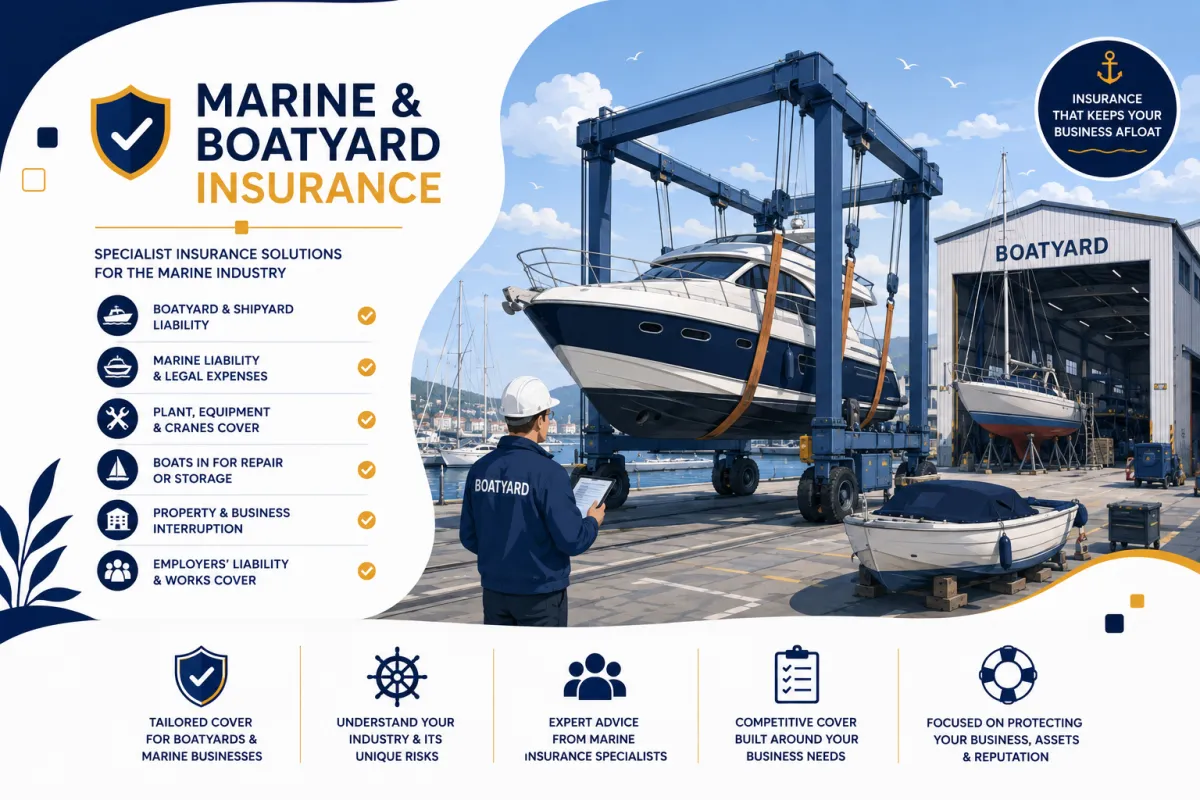
Marina & Boatyard Insurance UK | Specialist Operator Cover
Why is marina and boatyard insurance a different risk from any other property business?
Because you are the custodian of other people's most valuable possessions, on a site that is in the water by definition. A marina holds millions of pounds of third party property it does not own, lifts it with machinery, stores it in concentrated compounds, and does all of this somewhere exposed to storm, surge and tidal flooding. The central insurance mechanism is care, custody and control: standard public liability excludes damage to property in your care, so a marina without a specific customers' vessels extension is uninsured for the single most likely large claim it will ever face.
Key facts at a glance
- Public liability excludes property in your care, custody and control. That is a standard exclusion in almost every commercial wording. Customers' vessels on your berths, hardstanding, cradles or racking fall squarely within it, so the cover has to be bought back specifically with per-vessel and overall limits that reflect the boats you actually hold.
- The Ports and Marine Facilities Safety Code now reaches marinas. The Department for Transport's updated Code, previously applied to statutory harbour authorities, is now expected to be followed by marina operators — with a senior Duty Holder, an independent Designated Person auditing annually, a formal Marine Safety Management System, and a published Marine Safety Plan.
- The Code is not statutory, but that does not make it optional in practice. British Marine's guidance notes it carries considerable weight in legal contexts. In a negligence claim, a non-statutory code that the industry regards as good practice is exactly what a court uses to measure whether you acted reasonably.
- Compliance is declared to the Maritime and Coastguard Agency. The exercise runs on a roughly three-yearly cycle, with Duty Holders submitting declarations; the most recent invitation closed on 31 March 2026 and compliant organisations are published on GOV.UK. A published declaration is a useful thing to put in front of an underwriter.
- The boat hoist is the severity machine. Lifting equipment used to move vessels falls under the Lifting Operations and Lifting Equipment Regulations 1998, requiring thorough examination by a competent person. A dropped yacht is a single-item, six or seven figure loss involving a boat you do not own.
- Winter storage concentrates the whole year's exposure into one compound. Rows of shrink-wrapped hulls, fuel in tanks, lithium batteries in modern craft and hot works nearby produce the sector's classic catastrophe. Aggregate values in a storage yard routinely exceed the entire declared sum insured on the buildings.
- Berth holder terms do not exclude what you think they exclude. Attempts to exclude liability for negligence are constrained by the Unfair Contract Terms Act 1977 and, for consumers, the Consumer Rights Act 2015. A clause disclaiming all responsibility for customers' craft is frequently unenforceable exactly when it matters.
Marinas and boatyards get insured badly for an understandable reason: they look like property businesses. There is land, there are buildings, there is a yard, there are customers paying for a service. A generalist broker reaches for a commercial combined policy, the schedule looks sensible, and nobody notices that the largest thing on the site — several hundred boats belonging to other people — is sitting inside a standard exclusion.
The second reason is that the sector spans an enormous range. A tidal drying-out yard with forty moorings and a tractor is a different risk from a 500-berth coastal marina with a 70-tonne hoist, a fuel berth and a restaurant. The same wording will not sensibly serve both, and the questions an underwriter needs answered are different in each case.
This guide is written for the operator of the facility: the marina, boatyard, yacht harbour, dry stack or moorings business. It is deliberately distinct from our guide to marine trade insurance, which addresses the repairer, dealer and marine trades side of the industry. If you build, repair or sell boats, start there. If you hold other people's boats on your site, start here.
Why does public liability not cover customers' boats?
Because public liability insures damage to third party property that is not in your control, and a customer's boat on your site is in your control. The care, custody and control exclusion appears in almost every commercial liability wording. Its logic is that a business holding somebody else's property is better placed to insure it deliberately than to have it fall into a general liability limit. For a marina that means the exclusion removes cover for the exact property that defines the business, and the cover has to be bought back explicitly.
The buy-back goes by several names — customers' craft, vessels in care custody and control, marine trade liability — and the detail matters more than the label. Three parameters decide whether it will actually work:
- The any one vessel limit. Set against the most valuable boat you hold, not the average. One large motor yacht in for the winter can exceed a limit set for a yard full of thirty-foot cruisers.
- The overall or any one occurrence limit. A fire in a storage compound does not damage one boat. Model the aggregate: how many vessels, at what values, could be affected by a single event in your worst-case location on site.
- Whether cover applies afloat, ashore and in transit. A boat is on a berth, then in slings, then on a cradle, then on a trailer crossing the yard. Cover that lapses between those states is a gap you will find at the worst moment.
The question worth asking today. "What is my any one vessel limit, and what is the most valuable boat currently on my site?" If the second number is bigger than the first, you have a live, quantified, uninsured exposure — and it changes every time a new customer arrives. Marinas that check this seasonally rather than annually rarely get caught.
How does specialist marina cover compare with a commercial combined policy?
On six features that decide whether the site is genuinely protected. Customers' vessels, marine structures, lifting operations, storm and surge, wreck removal and pollution. A general commercial combined wording handles none of them well because none of them arise at a business park, and its silence on each is easy to mistake for cover.
| Feature | Standard commercial combined | Specialist marina & boatyard programme |
|---|---|---|
| Customers' vessels | Excluded by the care, custody and control exclusion | Written back with any one vessel and aggregate limits, afloat and ashore |
| Pontoons, piles and berthing structures | Frequently omitted or treated as unspecified external property | Scheduled and valued as the primary asset they are |
| Lifting operations | Hoist insured as plant; damage to the load rarely addressed | Load damage, lifting liability and examination regime integrated |
| Storm, surge and tidal flooding | Flood frequently excluded or heavily sub-limited at coastal sites | Rated deliberately against the site's actual exposure |
| Wreck removal and raising | Not contemplated | Addressed, including abandoned and unidentified craft |
| Pollution | Sudden and accidental only, if at all | Fuel berth, antifouling and yard operations considered explicitly |
| Business interruption | Set on annual turnover with a 12-month indemnity period | Reflects seasonality and the time to rebuild marine structures |
| Marine safety governance | Not asked about | Duty Holder, Designated Person and safety management system treated as rating evidence |
What does the updated Ports and Marine Facilities Safety Code mean for marinas?
It sets out a governance structure marinas are now expected to follow, and it will be used to judge you if something goes wrong. The Department for Transport's updated Code — long applied to statutory harbour authorities — now extends its expectations to marina operators. British Marine's guidance summarises the expectations as a senior Duty Holder accountable for marine safety, an independent Designated Person auditing the system annually, a formal Marine Safety Management System built on risk assessment, a Marine Safety Plan published at least every three years, a Conservancy Duty to keep facilities safe and fit for purpose, and demonstrable competence across marine operations staff.
The point most operators miss is the legal significance of a voluntary code. Because the Code is not statutory, there is no offence of failing to comply with it. But that is not the same as it being irrelevant. British Marine's own guidance notes that it carries considerable weight in legal contexts — and in a negligence claim, an industry code that describes what a competent operator should be doing is precisely the yardstick a court will apply when deciding whether you acted reasonably.
That makes the Code an insurance document as much as a safety one, in three ways:
- It defines the standard of care. A claimant's advisers will ask whether you had a Duty Holder, a Designated Person and a safety management system. "The Code is voluntary" is a weak answer if the industry has adopted it.
- It creates named roles. A senior individual accountable for marine safety performance is a person whose decisions become evidence, which is a good reason to look at directors' and officers' cover alongside — see directors and officers insurance.
- It produces underwriting evidence you already have to create. A risk assessment, an audited safety management system and a published safety plan are exactly what a specialist underwriter wants to see. Most marinas never think to include them in a submission.
The free upgrade. If you completed a compliance declaration to the Maritime and Coastguard Agency, that declaration and your safety management system should go into your insurance submission. You have already done the work for a regulatory purpose; it costs nothing to make it work a second time on your premium. If you did not participate, the underwriting conversation is harder and the litigation conversation is harder still.
How does the Insurability Framework apply to a marina?
A marina combines third party property in custody, heavy lifting, marine structures and flood exposure in a single risk — which puts it outside general commercial appetite. Most declines are not about how the business is run; they are about a market that cannot rate the combination. The Insurability Framework™ is our structured method for making that risk legible to underwriters who can.
The Insurability Framework applied to marine facilities
Four pillars, applied to marinas, boatyards, yacht harbours, dry stacks and moorings operators.
Marine underwriters price on custody controls and lifting discipline. Vessel value records, lifting procedures and examination currency, hot works permits, storage layout and your marine safety governance are what move the number. We present them before they are asked for.
Third party vessels in custody, marine structures and coastal flood exposure sit outside general commercial appetite. Placement runs through marine-aware Lloyd's syndicates and specialist MGAs that will write customers' craft properly rather than sub-limiting it into irrelevance.
The dangerous gaps are structural: an any one vessel limit below the biggest boat on site, pontoons missing from the schedule, no wreck removal provision, and a berth holder contract that does not do what the operator believes it does. We map each against the wording.
A marina claim usually involves an asset you do not own and an owner who is also a customer. Managing the coverage position and the commercial relationship at the same time is the whole job, and it is not something a call centre can do.
More on the method on our Insurability Framework page, and on comparable placements in our adverse risk insights hub.
What happens when a boat hoist drops a yacht?
You face a single-item loss on an asset you do not own, and the claim turns on your examination and procedure records. A travel lift or crane used to move vessels is lifting equipment under LOLER 1998, requiring thorough examination at prescribed intervals by a competent person. A dropped or crushed hull can be a total loss of a boat worth more than the marina's annual turnover, and the first documents requested will be the examination report, the lifting plan and the operator's competence record.
Lifting is where marina severity concentrates, for three reasons. The load is fragile, valuable and awkwardly shaped. The lift happens frequently, which normalises it. And it usually involves strops and slings positioned by judgement rather than by a fixed lifting point, so competence rather than equipment does most of the safety work.
What underwriters ask, and what good answers look like
- Thorough examination currency across every lifting appliance and accessory, including strops, which are frequently overlooked because they are cheap.
- Who is authorised to operate the hoist, how competence was assessed, and how often it is refreshed.
- Whether lifting plans exist for non-routine lifts — unusual hulls, keel configurations, or vessels at the upper end of the machine's capacity.
- How vessel weight is established. Owners routinely understate displacement, and a marina that relies on the owner's figure without challenge is accepting an avoidable risk.
- Whether damage to the load is insured, and at what limit. Many wordings cover the hoist and exclude or sub-limit the thing it is holding.
The statutory examination arrangement is frequently connected to the insurer, which means an out-of-date report is visible to the party who would otherwise pay the claim. Our engineering inspection insurance guide covers how that works.
Why is winter storage the biggest single exposure on the site?
Because it concentrates the year's entire value into one compound and then adds ignition sources. Hulls stored close together, many shrink-wrapped in plastic, most with fuel aboard, an increasing number carrying lithium battery systems, and yard work continuing nearby with grinders, heat guns and hot works. A fire in a storage compound does not damage one boat; it damages a row, and the aggregate frequently exceeds every other sum insured on the schedule combined.
The controls that materially change the outcome are unglamorous and cheap:
- Separation and firebreaks. Rows broken into blocks with genuine gaps, rather than boats packed to maximise revenue per square metre. This single decision does more than any other.
- A hot works permit system with a post-work watch period. Fires start after the work stops, which is why the watch period matters more than the permit.
- A documented position on shrink wrap. It spreads flame and it hides the early stages of a fire. Where it is used, the storage layout has to account for that.
- Lithium battery policy. Electric and hybrid craft, tenders and e-bikes stored aboard are a genuine and growing exposure. Charging arrangements, isolation over winter and separation are now standard underwriting questions.
- Fuel and gas. Whether tanks are drained, whether gas bottles are removed and where they are stored.
- An accurate live inventory with values. If you cannot say tonight what is in the yard and what it is worth, you cannot size a limit and you cannot prove a loss.
From recent placement conversations
"The conversation that repeats itself is about the any one vessel limit. I ask what it is, and the operator does not know. Then I ask what the most valuable boat on the hardstanding is right now, and they know that instantly, to the pound, because they lifted it last week. Those two numbers should be compared every season and almost nobody does it."
"The other one is pontoons. A marina will have a very carefully valued office building and a workshop, and then several hundred metres of pontoon, piles and finger berths carried as a round number somebody wrote down years ago. The buildings are the small part of the balance sheet. The structures in the water are the business, and they are the thing a storm actually takes."
What cover does your type of marine facility need?
Marine facilities vary enormously. Select the closest match to see the cover set we would build.
Marine facility cover checker
Coastal marina
- CRITICAL Customers' vessels written back against the care, custody and control exclusion, with an any one vessel limit above your largest berth holder.
- CRITICAL Storm and tidal surge cover addressed deliberately — a coastal marina cannot treat flood as a remote peril.
- ESSENTIAL Pontoons, piles, walkways and finger berths scheduled and valued properly.
- ESSENTIAL Lifting operations including damage to the load, with thorough examination current.
- LEGAL Employers' liability at £5m statutory minimum under the Employers' Liability (Compulsory Insurance) Act 1969; £10m is the practical standard.
- RECOMMENDED Wreck removal and pollution provision, including for abandoned craft.
- CONSIDER Business interruption reflecting seasonality and marine structure rebuild times.
Inland and canal marina
- CRITICAL Customers' vessels cover — residential boaters make the custody exposure continuous rather than seasonal.
- ESSENTIAL Liability for residential occupancy where boats are lived aboard, which changes the duty owed materially.
- ESSENTIAL Fluvial flood and bank stability exposure assessed rather than assumed.
- ESSENTIAL Solid fuel stove and gas exposure in narrowboats, a persistent fire and carbon monoxide risk.
- RECOMMENDED Landlord-style obligations where you provide services to liveaboard berth holders.
- CONSIDER Navigation authority obligations under your lease or licence.
Boatyard and hardstanding
- CRITICAL Aggregate customers' vessels limit modelled against a compound fire, not a single boat.
- CRITICAL Hot works permit system with a documented post-work watch period.
- ESSENTIAL Cradle, chock and prop failure — a boat falling over on the hard is a common and expensive claim.
- ESSENTIAL Pollution cover for antifouling removal, blasting residues and washdown water.
- RECOMMENDED Lithium battery storage and charging policy documented.
- CONSIDER Where you also carry out repair work, the trade exposures in our marine trade insurance guide.
Dry stack and racked storage
- CRITICAL Racking collapse exposure — a structural failure damages many vessels simultaneously.
- CRITICAL Aggregate limit modelled on the whole stack, since one event reaches everything in the structure.
- ESSENTIAL Forklift and handler operations, including damage to the load in transit within the site.
- ESSENTIAL Fire suppression and detection appropriate to a high-density enclosed store.
- RECOMMENDED Racking inspection regime documented and current.
- CONSIDER Business interruption where the structure itself is the operation and cannot be quickly replaced.
Moorings and swinging berths
- CRITICAL Mooring tackle inspection and replacement regime — a failed mooring that puts a boat ashore is a liability claim against you.
- ESSENTIAL Clarity on whether you supply the tackle or the owner does, which decides where liability sits.
- ESSENTIAL Public liability for tender and launch operations moving people to and from craft.
- RECOMMENDED Wreck removal provision, since a broken-adrift vessel becomes somebody's problem quickly.
- CONSIDER Storm contingency and how moorings are checked before and after severe weather.
Marina with hospitality and visitor facilities
- CRITICAL Public liability sized for visitor footfall as well as marine operations — pontoons and public access are a difficult combination.
- ESSENTIAL Food safety and licensed premises exposures declared where you operate a restaurant or bar.
- ESSENTIAL Water safety measures for non-boating visitors, including children, near unfenced water.
- RECOMMENDED Event cover where you host regattas, boat shows or functions.
- CONSIDER Cyber cover for booking, berthing and payment systems — see cyber insurance.
Which gaps should you check before your next renewal?
Tick anything you cannot answer immediately. Each is a gap we find regularly in marina programmes written on general commercial paper.
Marina and boatyard cover gap checklist
- You cannot state your any one vessel limit for customers' craft.
- The most valuable boat on site today exceeds that limit, or you do not know.
- Your aggregate customers' vessels limit has never been modelled against a compound fire.
- Pontoons, piles and finger berths are carried at a round number nobody has revisited.
- Cover for vessels is unclear at one of the transitions — afloat, in slings, ashore, in transit.
- Damage to the load during lifting is not clearly covered, or is sub-limited.
- Thorough examination dates for lifting appliances and accessories are not tracked centrally.
- There is no hot works permit system with a documented post-work watch period.
- You have no written policy on lithium batteries stored or charged on site.
- There is no provision for removing a sunken or abandoned vessel.
- Your berth holder terms have not been reviewed against consumer protection legislation.
- You have not appointed a Duty Holder or Designated Person under the Ports and Marine Facilities Safety Code.
Three or more ticks and your programme was written for a property business rather than a marine facility. Every item here is fixable at renewal; several of them are also the first questions a claimant's solicitor will ask.
How complex is your site to place?
Marine facility placement assessor
How do you insure pontoons, piles and a site that floods by design?
By valuing the marine structures properly and rating the water exposure deliberately rather than hoping a general flood extension covers it. A marina's principal assets are usually in the water: pontoons, finger berths, piles, walkways, bridges and breakwaters. They are expensive, they are slow to replace, and they are the first thing a storm damages. Meanwhile the site is by definition at the water's edge, so treating flood as a remote peril — the way a general commercial wording does — misdescribes the risk completely.
Getting marine structures right
- Schedule them separately. Pontoons carried inside a general "external property" heading are almost always undervalued and sometimes sub-limited into insignificance.
- Value on replacement, including installation. The cost of a pontoon is not the cost of the pontoon. Marine installation, piling plant, mobilisation and site access frequently exceed the materials.
- Account for lead times. Marine structures are not stock items. Replacement can take many months, which is a business interruption question as much as a property one.
- Include the things nobody lists. Piles, bridge ramps, service bollards, pontoon-mounted power and water, walkways and fendering.
- Review after every significant storm season. Damage that was patched rather than replaced changes the condition and the exposure.
The underinsurance mechanism. Where sums insured prove inadequate, average can apply and settlement is reduced proportionately — including on partial losses. A marina insured at 60% of true value can recover 60% of a storm claim that damaged a third of its pontoons. Our guide to underinsurance and the condition of average sets out how it works, and day one reinstatement insurance covers one route to managing inflation between valuations.
Storm, surge and the flood conversation
Coastal and estuarial marinas cannot approach flood the way an inland factory does. The exposure is structural to the business model, so the useful conversation is not whether flood is covered but on what terms, at what excess, and with what mitigation credited. Underwriters respond to specifics: recorded historic water levels, pontoon freeboard and pile height, storm procedures, whether craft are moved or double-moored ahead of severe weather, and who has authority to close the site.
Operators with flood history are not uninsurable, but they are a specialist placement. Our guides to flood zone 3 commercial property insurance and flood business interruption insurance cover the approach, and parametric flood insurance is worth understanding where conventional cover is restricted.
Who pays to remove a sunken or abandoned vessel?
Frequently the marina, and frequently without any contribution from the owner. A vessel that sinks on your berth, or is simply abandoned by an owner who stops paying and stops answering, becomes your operational problem. Raising, disposing of and dealing with the pollution from a sunken craft can cost far more than the boat was worth, and pursuing an absent or insolvent owner rarely recovers it. Wreck removal provision is a specific cover feature that general commercial wordings do not contain.
Abandonment is a persistent and under-discussed problem in the sector. Older craft of low value carry the highest disposal cost relative to worth, so they are the ones most likely to be walked away from. The marina is left holding an asset it does not own, cannot easily sell, and must lawfully dispose of.
Practical steps that reduce the exposure:
- Berth holder terms addressing abandonment and lien. Rights to sell or dispose of craft where fees are unpaid must be drafted properly to be exercisable.
- Evidence of condition on arrival. Photographs and a condition note at the point of arrival make later arguments about cause much shorter.
- Insurance verification for berth holders. Requiring proof of third party liability cover from every berth holder is standard good practice and materially reduces the number of situations where nobody else is insured.
- Prompt action on non-payment. The cost of dealing with an abandoned vessel rises with time, and so does the difficulty of contacting the owner.
- A wreck removal limit that reflects your deepest berth. Raising costs scale with depth, access and the size of the craft.
What pollution exposure does a boatyard carry?
More than most operators expect, and it is frequently the part of the wording nobody reads. Fuel handling, antifouling removal, hull blasting and washdown, waste oil, sewage pump-out and the routine consequence of a sinking all create pollution exposure at the water's edge, where a release disperses immediately and remediation is difficult. Standard liability wordings typically cover only sudden and accidental pollution, which excludes the gradual contamination that yard operations tend to produce.
Four exposures are worth naming specifically:
Fuel. A fuel berth is a petroleum installation with all that implies for storage, dispensing and spill response. Overfilling and hose failures are the common events, and a spill on water is immediately a third party and environmental matter rather than a site clean-up.
Antifouling and blasting. Removing old antifouling generates residue containing biocides. Containment, sheeting, vacuum extraction and disposal are the controls, and a yard that lets residue reach the water or the ground carries a gradual pollution exposure that its liability policy probably excludes.
Washdown water. Pressure washing hulls produces contaminated water in volume. Whether it goes to an interceptor, to foul sewer under a trade effluent consent, or straight to surface water is a question with regulatory consequences and it is one of the first things an environmental regulator asks about.
Historic contamination. Boatyards are old sites with long industrial histories. Contaminated land liability can attach to the current occupier or owner, and it survives a change of use or a sale. This is a due diligence question at acquisition and a disclosure question at placement.
Environmental impairment liability is a separate product. Where a site has gradual pollution exposure, historic contamination or significant fuel handling, a standalone environmental policy does what a liability extension cannot. It is not expensive relative to the exposure, and the underwriting process itself usually improves the site's controls.
Do your berth holder terms actually protect you?
Less than most operators believe, because you cannot contract out of liability for your own negligence in the way the older standard terms attempted. The Unfair Contract Terms Act 1977 restricts exclusion of liability in business contracts, and for consumer berth holders the Consumer Rights Act 2015 applies a fairness test to terms and requires transparency. A clause stating that boats are left entirely at owners' risk will not defeat a claim where the marina dropped the boat.
That does not make terms and conditions pointless — they do a great deal of useful work. It means they need to be doing the right work:
- Requiring berth holders to insure. The most effective single clause. It puts a first insurer in front of yours in most scenarios and reduces disputes about who responds.
- Allocating responsibility clearly rather than excluding it entirely. Terms that reasonably allocate risk are far more likely to survive scrutiny than terms that attempt a blanket disclaimer.
- Dealing with abandonment, unpaid fees, lien and disposal. These provisions are exercised rarely and matter enormously when they are.
- Setting out lifting and movement authority. Whether you may move a craft in an emergency, and on what basis, is worth having in writing before the storm rather than during it.
- Being transparent and legible. Under consumer legislation, a term buried in dense small print is more vulnerable than the same term expressed plainly.
British Marine publishes sector contract templates for members, which are a sensible starting point. Whatever you use, have it reviewed alongside your insurance rather than separately — the two documents allocate the same risks and should agree with each other.
What drives the cost of marina and boatyard insurance in 2026?
Vessel values in custody, flood and storm exposure, lifting operations and storage layout — with turnover a long way down the list. Two marinas with identical berth income can be priced very differently if one sits on an exposed coast holding large motor yachts and the other is inland with modest craft. Marine facilities are judgement-underwritten by a limited number of markets, so the quality of the submission has a direct effect on the number.
| Rating factor | Why it matters to the underwriter | What reduces the loading |
|---|---|---|
| Aggregate value of vessels in custody | Drives the realistic maximum loss more than any building on the site | An accurate live inventory with values, updated seasonally |
| Storage layout and separation | A compound fire reaches a row, not a boat | Firebreaks and blocks rather than maximum packing density |
| Hot works control | Yard fires typically start after the work stops | Permit system with a documented post-work watch period |
| Lithium battery exposure | Electric craft, tenders and e-bikes are a growing ignition source | Written charging, isolation and separation policy |
| Lifting operations | Single-item severity on assets you do not own | Thorough examination currency, operator competence, lifting plans, verified weights |
| Flood and storm exposure | Structural to the location; cannot be treated as remote | Historic level records, freeboard data, storm procedures and closure authority |
| Marine structure values | Pontoons are the principal asset and the first storm casualty | Scheduled valuations including installation cost and lead times |
| Marine safety governance | The Code's expectations are becoming the benchmark of reasonable care | Duty Holder, Designated Person, audited safety management system, published plan |
| Berth holder terms | Terms decide who insures what and how disputes resolve | Reviewed terms requiring berth holders to carry their own cover |
| Fuel and pollution controls | A release on water is immediately third party and environmental | Interceptors, containment, spill kit, trade effluent position documented |
| Claims record | Frequency predicts management quality more reliably than severity | A clean run, or a documented account of what changed after a loss |
| Ancillary activities | Hospitality, repair work and events each add distinct exposures | Declaring them deliberately rather than letting them be discovered |
| Presentation quality | Few markets write this class; ambiguity gets priced | A structured submission including your safety documentation |
What do real marina and boatyard claims look like?
The three examples below are illustrative composites written for this guide. They are not real clients and not actual claims; the figures are indicative of the shape and scale of loss in this sector, not settlements we have handled.
Case study 1 — The limit that was set for the wrong fleet
The situation. A south coast marina lifted a 62-foot motor yacht for antifouling. A strop was positioned incorrectly relative to the vessel's centre of gravity, and during the lift the hull shifted and struck the hoist frame, damaging the topsides, a stabiliser fin and the starboard shaft.
The consequence. Repair estimates came in at £680,000, with the vessel out of use for a full season. The owner also claimed loss of use.
The cover position. The marina held customers' vessels cover with an any one vessel limit of £250,000 — a figure set several years earlier when the site's largest craft was a 38-foot yacht. The berth mix had changed and nobody had revisited the limit. The marina met £430,000 of the repair cost from its own resources over two years, funded partly by selling land.
The lesson. The limit was not wrong when it was set; it became wrong as the business succeeded and attracted bigger boats. Renewal impact: any one vessel limit raised to £2m, aggregate modelled on a compound event, and a seasonal check introduced comparing the limit against the largest craft on site.
Case study 2 — Forty minutes after the grinder stopped
The situation. A boatyard carried out grinding work on a steel hull in the storage compound during winter lay-up. The permit required a one-hour watch period, which was not observed. Smouldering material ignited shrink wrap on an adjacent craft approximately forty minutes after work ceased.
The consequence. Fire spread along a tightly packed row. Nine vessels were destroyed or written off, four more were significantly damaged, and the yard's workshop was lost. Total insured and uninsured loss approached £2.9m.
The cover position. Material damage and customers' vessels cover both responded, but the aggregate customers' craft limit had been set on the assumption of a single-boat loss. It was exhausted with four owners unpaid. Those owners pursued the yard directly, and the resulting dispute ran for two years alongside a genuine loss of berth holders who did not return.
The lesson. The aggregate limit, not the any one vessel limit, is what a fire tests — and packing density is a commercial decision with an insurance consequence. Renewal impact: aggregate limit tripled, storage blocks separated with firebreaks, permit compliance audited weekly, premium up approximately 70%.
Case study 3 — The pontoon nobody had valued
The situation. A severe winter storm coincided with a spring tide at an estuarial marina. Three pontoon arms broke free from their piles, two of them taking moored craft with them. Craft grounded on the far shore; one sank at its berth.
The consequence. Marine structure damage was assessed at £1.4m to reinstate, with an eleven-month lead time on replacement pontoons and piling. Six customer vessels were damaged and one required raising and disposal.
The cover position. The pontoons had been carried within a general external property item at £600,000, a figure last reviewed six years earlier and never including installation cost. Average was applied and the marine structure settlement was reduced proportionately. Business interruption carried a twelve-month indemnity period against an eleven-month lead time, leaving no margin for the ramp-up of a lost season. There was no wreck removal provision, so raising and disposing of the sunken craft was met by the marina.
The lesson. Three separate structural errors — valuation, indemnity period and a missing cover feature — compounded in a single event. Renewal impact: structures professionally valued and scheduled, indemnity period extended to 24 months, wreck removal provision added.
How should a marina manage a claim?
Remember that the claimant is also your customer, and that the evidence disappears with the tide. Marina claims involve assets you do not own and owners who will be back next season, so the commercial relationship and the coverage position have to be managed together. Make people safe, protect the site from further loss, record the scene before anything is moved or washed away, and route the coverage conversation through your broker rather than settling it across the pontoon.
- Make people safe and prevent further damage. Contain a spill, secure adjacent craft, isolate power. Most policies require reasonable steps to prevent further loss, and in a marina the second boat is often saveable.
- Notify your broker the same day. Not when the repair estimate arrives and not when you have decided whose fault it was. Liability policies require notification of circumstances that may give rise to a claim.
- Record the scene immediately. Photographs and video, timestamped, before recovery. On the water, evidence moves: debris disperses, a sunken craft settles, a spill spreads. An hour's delay changes what can be established.
- Secure the operational records. Lifting plans and examination reports, strop positions, weight records, permits to work, berthing allocations, weather logs, CCTV and the berth holder's contract and condition record.
- Notify the relevant authorities where required. Pollution incidents, and events involving injury or navigational hazard, carry their own reporting duties to the environmental regulator, the harbour authority or the Maritime and Coastguard Agency.
- Do not accept liability to the owner. The instinct in a customer-facing business is to reassure. Sympathy is fine; accepting fault is not yours to give and can prejudice cover under the policy's conduct conditions.
- Establish whether the owner is insured. Most berth holders carry their own cover, and identifying it early frequently shortens the whole process and preserves the relationship.
- Complete a documented review and record what changed. At renewal, the difference between a loss that frightens underwriters and one they can price is a credible account of what you changed afterwards.

John Miller — Director & Principal Broker
John has spent over thirteen years placing specialist commercial risks, with a particular focus on businesses that hold other people's property. Marinas and boatyards are the clearest example he encounters: operations insured as property businesses when the largest thing on the site is several hundred boats belonging to somebody else, sitting inside a care, custody and control exclusion nobody has read. He works with marinas, boatyards, yacht harbours, dry stacks and moorings operators on the structural questions — vessel limits that match the berth mix, marine structures valued properly, lifting cover that includes the load, and terms and conditions that agree with the insurance rather than contradicting it.
Former #1 Account Executive at Brown & Brown and former #1 Salesperson at AXA, with direct access to the Lloyd's Market and specialist MGA schemes.
Glossary of marina and boatyard insurance terms
- Care, custody and control
- The standard liability exclusion removing cover for damage to third party property in the insured's possession or control. The central mechanism a marina must insure around.
- Customers' vessels cover
- The buy-back extension covering craft belonging to others while in the operator's care, typically with an any one vessel limit and an overall or any one occurrence limit.
- Any one vessel limit
- The maximum payable in respect of a single craft. Should be set against the most valuable boat on site, not the average.
- Aggregate limit
- The maximum payable for all vessels affected by one event. The limit a compound fire or a storm actually tests.
- Ports and Marine Facilities Safety Code (PMSC)
- The Department for Transport code setting out marine safety governance expectations. Updated to extend its reach to marina operators. Not statutory, but influential in legal contexts.
- Duty Holder
- The senior individual accountable under the Code for the organisation's marine safety performance, and the person who submits a compliance declaration.
- Designated Person
- An independent person expected under the Code to audit the marine safety management system, typically annually, and report to the Duty Holder or board.
- Marine Safety Management System
- The formal, risk-assessment-based system by which marine operations are managed. Expected under the Code and useful underwriting evidence.
- Conservancy Duty
- The duty to maintain facilities and the water area in a safe and fit-for-purpose condition, including matters such as depth, obstructions and navigational safety.
- Thorough examination
- The statutory examination of lifting equipment and accessories required under LOLER 1998, carried out by a competent person at prescribed intervals.
- Damage to the load
- Cover for the item being lifted, as distinct from cover for the lifting machine. Frequently excluded or sub-limited, and the single most important lifting cover feature for a marina.
- Wreck removal
- The cost of raising, recovering and disposing of a sunken or abandoned vessel, together with associated pollution response. Not a feature of general commercial wordings.
- Gradual pollution
- Contamination occurring over time rather than from a single sudden event. Typically excluded by liability policies, and the form most boatyard operations produce.
- Trade effluent consent
- Authorisation required to discharge commercial wastewater, such as hull washdown, to the foul sewer. Discharge to surface water is a separate and more serious question.
- Condition of average
- The mechanism reducing a claim proportionately where the sum insured is inadequate. Applies to partial losses as well as total ones.
- Indemnity period
- The maximum period for which business interruption responds. For marinas it should reflect marine structure lead times and lost season effects, not building rebuild time.
- Lien
- A right to retain a vessel against unpaid charges. Must be properly drafted into berth holder terms to be exercisable, and is central to dealing with abandonment.
Frequently asked questions
Does public liability cover damage to customers' boats?
No. Almost every commercial liability wording excludes damage to third party property in the insured's care, custody or control, and a customer's vessel on your berth, hardstanding or cradle falls squarely within that exclusion. The cover has to be bought back specifically as customers' vessels or marine trade liability, with an any one vessel limit and an aggregate limit set against the craft you actually hold.
What limit should I set for customers' vessels?
Set the any one vessel limit against the most valuable boat on your site rather than the average, and check it seasonally because the berth mix changes as the business grows. Set the aggregate limit by modelling a single event — a compound fire or a storm — across the vessels it could reach. Marinas are far more often caught by an inadequate aggregate than by an inadequate single-vessel limit.
Does the Ports and Marine Facilities Safety Code apply to marinas?
The updated Code, issued by the Department for Transport, extends its expectations to marina operators, having historically applied to statutory harbour authorities. British Marine's guidance summarises those expectations as a senior Duty Holder, an independent Designated Person auditing annually, a formal Marine Safety Management System, a published Marine Safety Plan and a Conservancy Duty to keep facilities safe and fit for purpose.
Is the Code legally binding?
It is not statutory, so there is no offence of failing to comply. But British Marine's guidance notes it carries considerable weight in legal contexts, and in a negligence claim an industry code describing what a competent operator should do is exactly what a court uses to assess whether you acted reasonably. In practice it is becoming the benchmark of reasonable care, which makes it an insurance document as well as a safety one.
Is damage to a boat during lifting covered?
Only if damage to the load is specifically covered and adequately limited. Many wordings insure the hoist itself while excluding or sub-limiting the vessel it is holding, which inverts the actual exposure. Lifting equipment also requires thorough examination under LOLER 1998, and the examination report, lifting plan and operator competence record are the first documents requested after a dropped boat.
Are pontoons and piles covered by a standard commercial policy?
Frequently they are carried inside a general external property heading, undervalued and sometimes sub-limited into insignificance. Marine structures are usually a marina's principal asset and the first thing a storm damages, so they should be scheduled and valued on replacement including marine installation cost, with lead times considered separately for business interruption purposes.
Who pays to remove a sunken or abandoned boat?
Frequently the marina, and frequently without any contribution from the owner. Raising, disposal and pollution response can cost far more than the craft was worth, and absent or insolvent owners rarely repay it. Wreck removal provision is a specific cover feature that general commercial wordings do not contain, and berth holder terms should address abandonment, lien and disposal rights properly.
Can I exclude liability for customers' boats in my terms and conditions?
Not for your own negligence, in the way older standard terms attempted. The Unfair Contract Terms Act 1977 restricts exclusion in business contracts, and the Consumer Rights Act 2015 applies a fairness and transparency test for consumer berth holders. Terms that allocate risk reasonably survive scrutiny far better than blanket disclaimers, and requiring berth holders to carry their own insurance is the single most effective clause.
What is the biggest risk in a boatyard?
Winter storage. It concentrates the year's entire value into one compound, then adds shrink wrap, fuel in tanks, lithium batteries and yard work with grinders and heat guns. A fire reaches a row rather than a boat. Separation and firebreaks, a hot works permit with a real post-work watch period, and a written lithium policy do more to change the outcome than any other controls available.
Can a marina in a flood zone get insurance?
Yes, though it is a specialist placement. Flood is structural to a marina's location, so the useful conversation is about terms, excess and mitigation credit rather than whether cover exists at all. Underwriters respond to specifics: historic water levels, pontoon freeboard and pile heights, storm procedures, whether craft are moved or double-moored ahead of severe weather, and who has authority to close the site.
Do I need environmental insurance for a boatyard?
If you handle fuel, remove antifouling, blast hulls or pressure wash on site, it is worth serious consideration. Standard liability wordings typically cover only sudden and accidental pollution, which excludes the gradual contamination yard operations tend to produce. Historic contamination on an old boatyard site is a separate exposure that can attach to the current occupier and survive a sale.
How do I find a specialist marina insurance broker?
Ask four questions: what is my any one vessel limit and how was it set, how are pontoons valued, is damage to the load covered during lifting, and is there a wreck removal provision. A specialist answers all four without hesitating, and will want your berth list, vessel values and marine safety documentation before quoting. Miller & Partner approaches every marine placement through the Insurability Framework — underwriter intelligence, difficult risk expertise, risk assessment and claims advocacy. Call 01792 001350 or email enquiries@millerandpartner.co.uk.
About this guide
This guide is general information about insurance for UK marinas, boatyards, yacht harbours, dry stack operators and moorings businesses. It is not advice, and it is not a recommendation to buy or hold any particular policy. Any cover described is subject to insurer acceptance, underwriting and the terms of the policy actually issued.
Miller & Partner is not affiliated with British Marine, the Department for Transport or the Maritime and Coastguard Agency, and this guide is not an official statement of the Ports and Marine Facilities Safety Code. The Code and its expectations are summarised from published sources as at the publication date and may change — check the current position directly for your own facility. Nothing here is legal advice; berth holder terms and conditions should be reviewed by a suitably qualified legal adviser.
The case studies are illustrative composites written for this guide. They are not real clients and not actual claims; the figures are indicative and are not settlements handled by Miller & Partner. The interactive cover checker, gap checklist and placement assessor are general information tools only — not personalised advice, not a recommendation and not a quotation.
Legislation and regulatory guidance are described as at the publication date shown at the top of this guide and may change. For our regulatory status, please see the footer of this website. To discuss a marina or boatyard placement, email enquiries@millerandpartner.co.uk or call 01792 001350.







Instagram
LinkedIn