


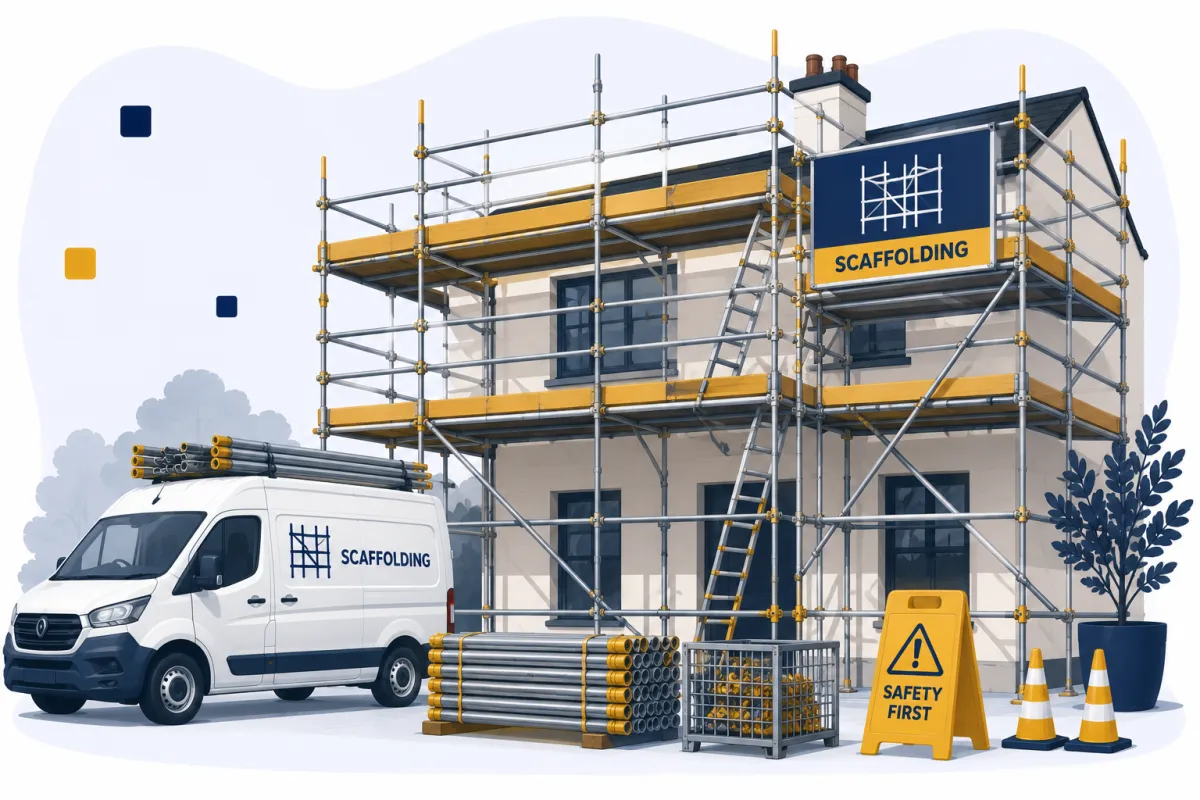
Scaffolding Insurance UK | Specialist Broker
Why is scaffolding one of the hardest trades to insure?
Scaffolding sits at the very top of the construction industry's risk hierarchy, and the insurance market treats it accordingly. It combines the exposures underwriters fear most — working at height, heavy materials, and temporary structures that other people's lives depend on — into a single trade where a single failure can be catastrophic. A scaffold collapse can kill workers and members of the public, bring down debris onto a busy street, and damage adjacent buildings; a fall during erection can end a scaffolder's life; a design error on a complex structure can trigger a claim years later. That severity is why many mainstream insurers won't quote scaffolding at all, and why those that do attach strict conditions on height, competence, inspection and design.
This is the territory Miller & Partner works in. As a specialist broker for adverse and hard-to-place risks, we place cover for high-risk construction trades the standard market avoids — the same approach behind our groundworks insurance page, where support and adjacent-structure exposures run in parallel — including scaffolding firms that have been refused cover elsewhere or non-renewed after a claim. This guide explains why collapse and falling-object liability is the defining exposure, why CISRS competence and NASC TG20 standards decide your terms, when scaffold design creates a professional-indemnity exposure, and how to present a scaffolding business so specialist underwriters actually want to write it.
How does The Insurability Framework™ apply to scaffolding?
Underwriter Intelligence
We know which specialist construction and Lloyd's markets still write scaffolding in 2026, and what drives their terms — CISRS card levels, NASC membership, TG20 or engineered designs, the 7-day inspection regime and height limits. We present that evidence before the underwriter has to ask.
Difficult Risk Expertise
Scaffolding is a decline-heavy class. Our specialist MGA and Lloyd's access reaches the underwriters who still have appetite for it — including firms with a prior collapse or fall claim, height-restricted risks, or a lapse in cover.
Risk Assessment
We audit the business the way an HSE inspector and a claimant's solicitor will: competence, SG4 fall-prevention, design responsibility, inspection records, highway licensing and materials security — the exposures that decide both premium and claim outcome.
Claims Advocacy
A scaffolding claim — a collapse, a fall, a design dispute — is catastrophic, contested and often criminal-investigation-adjacent. When it happens, you deal with a named broker who fights your corner, not a call centre.
Key facts at a glance
- Scaffolding is one of construction's highest-risk trades: collapse and falls can cause catastrophic injury, making it a class many insurers decline outright.
- Public liability of £5m is the practical minimum, and £10m is routinely required by principal contractors, councils for highway work, and NASC membership.
- Only CISRS-carded scaffolders may legally erect, alter or dismantle scaffolding, and underwriters treat card levels as a core rating factor.
- Standard scaffolds are designed to NASC TG20:21; anything outside its parameters needs a bespoke engineered design — which carries a professional-indemnity exposure.
- Scaffolding must be inspected before first use, at least every 7 days, and after alteration or adverse weather, with records retained — a lapsed inspection can void your position.
- Scaffolding on a public highway needs a licence under the Highways Act 1980, and councils typically require £10m public liability to grant it.
- High-value tube, boards, fittings and nets are a major theft target, making materials and plant cover a core part of the programme.
What must a scaffolding policy include that a general builder's won't?
Scaffolding firms are often sold — or try to buy — a generic contractor or tradesman policy, and it almost never fits. A general builder's wording isn't built for a trade whose core activity is creating temporary structures at height that the public and other trades rely on, and it typically caps or excludes the very things that define scaffolding risk: work above a certain height, collapse, and design responsibility. The comparison below shows where a general policy falls short and what a specialist scaffolding programme does differently. Our high-risk trades insurance guide covers the wider hard-to-place trades landscape.
| Exposure | Standard builder / tradesman policy | Specialist scaffolding programme |
|---|---|---|
| Height limit | Often capped (e.g. 10m) or excluded above a set height | Height working confirmed to the level you actually operate at |
| Collapse & structural failure | Poorly contemplated; disputes over cause | Public liability rated for the collapse exposure specifically |
| Falling objects to the public | Basic PL; debris/tool-drop severity not sized | PL sized for third-party and highway exposure |
| Scaffold design (PI) | No professional indemnity at all | PI available where you design beyond TG20 or advise on adequacy |
| Materials, tube & boards | Limited tools cover; theft from site under-provided | Contractors' all risks for materials on site and in transit |
| Labour-only / bona-fide subcontractors | Often mis-declared, prejudicing claims | Correctly rated for your labour model |
| Contingent / handover liability | Not addressed | Cover reflecting the handover certificate you issue |
Why is collapse and falling-object liability the defining exposure?
If one thing defines scaffolding insurance, it is the catastrophic public-liability potential of a structure failing or shedding objects. A scaffold is, by design, a temporary structure erected in and around occupied buildings, busy sites and public streets — so when it fails, the consequences reach far beyond the contractor. A collapse can cause multiple serious or fatal injuries to workers and passers-by, bring down debris onto a highway, and damage or destroy adjacent property. Even without a full collapse, a dropped tool, board or fitting from height can kill or seriously injure someone below. These are the claims that run into six and seven figures, and they are why £5m is the practical minimum public-liability limit and £10m is routinely demanded.
The exposure is amplified by where scaffolding happens. Working over pavements, adjoining shops and homes, and on the public highway multiplies the number of third parties at risk and brings additional duties (and, for highway work, a council indemnity requirement). This is precisely why underwriters interrogate a scaffolding firm's competence, inspection discipline and design controls so closely — those controls are what prevent the catastrophic claim, and evidencing them is what secures cover. The severity here is the same reason we treat scaffolding alongside our guidance on high-risk public liability insurance.
Why does working at height dominate your employers' liability risk?
Scaffolding is the working-at-height trade, and falls from height remain the single biggest cause of fatal injury in UK construction. The most dangerous moments are during erection and dismantling — before the finished structure's protection is in place — which is exactly what NASC's SG4 guidance ("Preventing falls in scaffolding operations") addresses. Every scaffolder your business employs is exposed to this risk on every job, which makes employers' liability not a formality but a front-line cover, and makes your fall-prevention regime central to how you're underwritten.
The duties flow from the Work at Height Regulations 2005 and the Health and Safety at Work etc. Act 1974: avoid working at height where possible, use the right equipment and safe systems, and ensure work is planned, supervised and carried out by competent people. An underwriter rating a scaffolder's EL wants to see SG4-compliant methods, harness and fall-arrest use during erection, CISRS competence, and a clean or well-explained accident record. A firm that can evidence a disciplined fall-prevention culture is both protecting its workforce and presenting a fundamentally more insurable risk.
When does scaffold design create a professional indemnity exposure?
Here is the exposure most scaffolding firms don't realise they carry. Standard scaffolds — common independent and putlog configurations — can be built to NASC TG20:21 compliance sheets without a bespoke calculation. But the moment a scaffold falls outside TG20 parameters — unusual height, loading, geometry, cantilevers, bridges, temporary roofs — it requires a bespoke design prepared by a competent engineer, who then carries legal responsibility for the structural adequacy of that design. If your business prepares or signs off designs, advises on loading or adequacy, or issues a handover certificate that others rely on, you have stepped from pure contracting into professional services — and the cover that responds is professional indemnity insurance, not public liability.
This matters because a design or advice failure can cause exactly the catastrophic outcomes above, and the resulting claim — brought by a client, a principal contractor or an injured party's insurer — is a professional-negligence claim that a PL-only policy won't answer. Two features sharpen it: PI is usually written on a claims-made basis, so a design defect surfacing years later is judged against the cover in force when the claim is made; and firms that mix contracting with design need both PL and PI structured to dovetail. A scaffolding business that understands where its design responsibility begins — and carries PI to match — is both safer and far more credible to underwriters.
From recent placement conversations
The scaffolding calls I take fall into two groups. The first is firms who've been flatly declined or hit with an eye-watering renewal because their previous broker put them on a generic contractor policy with a 10-metre height cap and no proper competence evidence — and the insurer took fright. The second is well-run firms who simply don't know that the bespoke designs they occasionally do, or the handover certificates they sign, are a professional-indemnity exposure their public liability won't touch.
The firms we place best treat their compliance file as their pitch: CISRS cards for every operative, SG4 method statements, TG20 sheets or engineered designs on record, a disciplined 7-day inspection routine, and PI arranged for the design work they do. Hand a specialist construction underwriter that package and a trade they'd otherwise decline becomes writable at a sensible price. In scaffolding, competence isn't just safety — it's the whole insurance argument.
What insurance covers does a scaffolding business need?
A scaffolding programme is genuinely combined, and the covers have to be structured together so a single incident — which will usually touch several at once — doesn't fall between them. The core structure looks like this:
Public liability (with collapse & falling objects)
The core cover, and the one that decides real protection. Third-party injury and property damage from collapse, falling objects and site operations — £5m minimum, £10m where clients, councils or NASC require it. See high-risk public liability.
Employers' liability
Legally required under the Employers' Liability (Compulsory Insurance) Act 1969 — and, given the fall-from-height exposure during erection and dismantle, a genuinely front-line risk. Minimum £5m (often £10m required).
Professional indemnity
Where you design beyond TG20, advise on loading or adequacy, or issue handover certificates others rely on. See professional indemnity insurance.
Contractors' all risks, materials & plant
Tube, boards, fittings, nets and access equipment on site and in transit — high-value and a major theft target. Insure at proper value to avoid underinsurance and the condition of average; see also how high-reach and specialist plant is scheduled on our demolition insurance page, where the same equipment exposures arise.
Business interruption, motor fleet and management liability
Income protection after an insured event; cover for scaffolding vehicles and materials in transit; and directors can be named personally after a serious incident (see our D&O guide).
Cover checker: what does your scaffolding business need?
Select the profile closest to your operation. Tags show what's legally required, essential, or worth considering. Every scaffolding programme should be built individually — this checker maps the starting point. Our main high-risk public liability guide covers the liability core.
- CRITICALPublic liability £5m with collapse and falling-object cover; specialist placement if you've had a previous claim.
- LEGALEmployers' liability (£10m) for your scaffolders.
- CRITICALCorrect height limit confirmed for the elevations you work.
- ESSENTIALMaterials & tools cover on site and in transit.
- RECOMMENDEDCISRS evidence for all operatives to secure best terms.
- CRITICALPublic liability £10m — principal contractors routinely require it.
- LEGALEmployers' liability (£10m).
- ESSENTIALContractors' all risks and contract-condition compliance (JCT/NEC).
- ESSENTIALNASC membership evidence where contracts demand it.
- CONSIDERWider contractor cover — see contractors combined.
- CRITICALProfessional indemnity — designing beyond TG20 or signing off adequacy is professional services; PL won't respond.
- CRITICALPublic liability £10m alongside the PI.
- LEGALEmployers' liability (£10m).
- ESSENTIALDesign competence evidenced — engineer qualifications on record.
- RECOMMENDEDPI run-off for the design claim tail — see run-off cover.
- CRITICALPublic liability £10m — councils require it to grant a highway licence and an indemnity.
- LEGALHighways Act 1980 licence for scaffolding on public land.
- LEGALEmployers' liability (£10m).
- ESSENTIALPublic-protection measures — lighting, netting, pedestrian management.
- CRITICALFalling-object controls evidenced for the public exposure.
- CRITICALPublic liability £5m with the correct height limit.
- LEGALEmployers' liability if you use any labour, including labour-only subbies.
- CRITICALAccurate labour declaration — mis-stating subcontractors prejudices claims.
- ESSENTIALMaterials, van & tools cover.
- CONSIDERIndividual-trade structure — see specialist tradesman liability.
- CRITICALHigher PL limits & engineered designs — industrial, petrochemical or complex access is the highest-severity profile.
- CRITICALProfessional indemnity for the bespoke design work.
- LEGALEmployers' liability (£10m).
- ESSENTIALAdvanced CISRS competence and site-specific RAMS.
- ESSENTIALContractors' all risks at industrial scale.
Why do CISRS, NASC and TG20 decide your terms?
Competence is the currency of scaffolding underwriting, and it has three names. CISRS (the Construction Industry Scaffolders Record Scheme) is the individual competence card scheme: only CISRS-carded scaffolders may legally erect, alter or dismantle scaffolding, and the card levels your operatives hold — labourer, trainee, scaffolder, advanced — signal how much of the work is done by fully competent people. NASC (the National Access and Scaffolding Confederation) is the industry trade body; membership requires passing a detailed audit (including minimum £10m public and employers' liability) and is increasingly demanded by principal contractors. TG20:21 is NASC's design guide for tube-and-fitting scaffolding, providing the compliance sheets that let standard scaffolds be built without bespoke calculation.
For insurance, these three are the levers that move your terms most. An underwriter reading a scaffolding risk wants to see CISRS cards for the workforce, NASC membership or equivalent standards where relevant, TG20 compliance for standard work with engineered designs on file for anything beyond it, and evidence that the firm actually works to SG4 and the inspection regime. A firm that presents that package is telling the market it manages the exact failures — incompetent erection, over-loaded or badly-tied structures, uninspected scaffolds — that produce the catastrophic claims. Competence, documented, is the single biggest thing you control in your premium.
What are the highway licence and public-space duties?
Any scaffold that stands on a public pavement, highway or other public space needs a licence from the local authority under the Highways Act 1980. Erecting scaffolding on public land without a licence is a criminal offence, and the licence application typically requires plans, pedestrian and traffic management arrangements, lighting and signing — and proof of insurance. Most highway authorities require the contractor to hold £10m public liability and to indemnify the council against claims arising from the scaffold.
This is a direct insurance driver: if you do any street-facing or town-centre work, your public-liability limit and the council's indemnity requirement are set externally, not by preference. It also raises your public exposure — pedestrians and traffic passing beneath the structure — which feeds the falling-object and collapse rating discussed above. Under the Construction (Design and Management) Regulations 2015, duties are also shared with the principal contractor and client, and getting your part of that chain documented is part of presenting a clean risk.
How do you cover scaffold materials, plant and theft?
Beyond liability, a scaffolding firm's other big exposure is its materials. Tube, boards, fittings, couplers, nets and access equipment represent serious capital, they sit on open sites and in yards, and they are a persistent theft and vandalism target — scaffold materials are portable, valuable and hard to trace. Contractors' all risks (or a materials/plant section) covers this stock against damage, theft and loss on site and in transit, and it's a core part of the programme, not an afterthought.
Two points matter for getting it right. First, value it accurately: scaffolding stock is easy to under-declare, and underinsurance triggers the condition of average, cutting every claim proportionately — see our guide to underinsurance and the condition of average. Second, security controls influence both availability and price: marked materials, secure yard storage, site security and good records all help. For firms with significant powered access or plant, a dedicated plant and machinery approach dovetails with the scaffolding cover within a contractors combined programme.
Red-flag checklist: would an underwriter worry about your business?
Tap each statement that is currently true of your business. These are the things that make a construction underwriter nervous — the more that light up, the harder (and pricier) your placement becomes. The first two are, on their own, potentially decisive.
Risk assessor: how will an underwriter score your business?
What regulations and duties apply to scaffolding?
Scaffolding sits under one of construction's densest duty frameworks, and each element feeds directly into how the risk is underwritten and how a claim is defended.
Working at height and health & safety
The Work at Height Regulations 2005 and the Health and Safety at Work etc. Act 1974 set the core duties — planning, competence, safe systems and fall prevention — enforced by the HSE with unlimited fines and, in serious cases, imprisonment. HSE guidance HSG150 covers health and safety in construction.
Competence and industry standards
CISRS certification is the recognised competence standard for scaffolders; NASC publishes the technical guidance the industry works to — TG20:21 (design of tube-and-fitting scaffolds) and SG4 (preventing falls during erection and dismantle).
Design and construction management
The Construction (Design and Management) Regulations 2015 allocate duties between client, principal contractor and scaffolding contractor. Scaffolds outside TG20 parameters require a bespoke engineered design, whose author carries legal responsibility for its structural adequacy.
Highways and inspection
Scaffolding on public land requires a licence under the Highways Act 1980. Scaffolds must be inspected before first use, at least every 7 days, and after alteration or adverse weather, with records retained — a lapsed inspection weakens both safety and your claim position.
What drives the cost of scaffolding insurance?
There is no meaningful "average premium" for scaffolding — the spread between a CISRS-carded domestic firm doing standard TG20 work and a bespoke-design industrial operation with a claim history is enormous. What every operator can do is understand the rating factors and work the ones within their control:
| Rating factor | Why it moves your premium | Mitigation |
|---|---|---|
| Maximum working height | Higher elevations raise fall and collapse severity | Declare accurately; match the height limit to your work |
| CISRS competence | Untrained erection is the biggest accident driver | CISRS cards for all operatives; advanced cards for complex work |
| Claims & HSE history | Prior collapse/fall claims reprice or restrict cover heavily | Evidence remediation; see our claims history guide |
| Design responsibility | Bespoke design adds a PI exposure | Engineered designs on file; PI arranged to match |
| Inspection discipline | Lapsed 7-day inspections weaken defence | Documented handover and 7-day inspection records |
| SG4 fall prevention | Erection/dismantle is the highest-risk phase | Harness/fall-arrest regime and SG4 method statements |
| Public / highway exposure | Town-centre and highway work multiplies third parties | Highway licences, netting, lighting, pedestrian management |
| Labour model | Mis-declared subcontractors prejudice claims | Declare labour-only and bona-fide subbies correctly |
| Public liability limit | Catastrophic claims need real capacity | £5m minimum; £10m for commercial/highway/NASC |
| Materials value & security | High-value stock drives property premium and theft risk | Accurate valuation, marked materials, secure yards |
| Turnover & project mix | Industrial/complex work is higher severity | Accurate declaration; separate high-hazard contracts |
| Continuity of cover | Lapses and cancellations are decline red flags | Start renewal early; never let cover gap |
What do real scaffolding claims look like?
These three fictionalised but market-realistic case studies show how scaffolding losses actually unfold — and where the decisions made at placement decided the outcome.
Case study 1: The collapse — £850,000 public liability claim
An inadequately tied scaffold on a town-centre elevation partially collapsed in high wind, injuring a pedestrian below and damaging the shopfront and stock of the premises beneath. The HSE investigated the tie pattern and inspection records; a civil claim followed from the injured party and the affected business.
The numbers: £560,000 for the pedestrian's serious injuries, £190,000 property and business-interruption loss to the shop, and £100,000 defence and investigation costs — £850,000 total, met under the firm's £10m public liability.
The lesson: the catastrophic public-liability potential is not theoretical — a single tie failure over a public pavement produced a near-million-pound claim. The £10m limit (required for the highway licence) is what stood between the firm and ruin; a £2m generic-policy limit could have been exhausted. Documented tie patterns and inspection records shaped how liability was apportioned.
Case study 2: The fall during dismantle — £320,000 employers' liability claim
A scaffolder fell during a dismantle when working without fall-arrest at a stage where the platform's edge protection had already been removed — a classic SG4 failure. He suffered life-changing spinal injuries and could not return to the trade.
The numbers: the employers' liability claim settled at £320,000 for the injuries and future loss of earnings. The firm also faced an HSE prosecution over its fall-prevention regime, the fine for which was uninsurable.
The lesson: the dismantle phase is where scaffolders die, and SG4 exists precisely to prevent this. The EL policy met the civil claim, but no policy pays a criminal fine — only a disciplined harness and method regime could have prevented both. The firm's subsequent SG4 overhaul was central to keeping its cover in place at renewal.
Case study 3: The design failure — £240,000 professional indemnity claim
A firm erected a bespoke cantilevered scaffold outside TG20 parameters, working from an in-house sketch rather than a proper engineered design. Under load it deflected and had to be evacuated and rebuilt, delaying the principal contractor's programme. The contractor claimed for the delay and rebuild costs, alleging the scaffold's design was inadequate.
The numbers: £240,000 covering the rebuild, the contractor's delay costs and legal fees — met under the firm's professional indemnity policy.
The lesson: this was a professional-negligence claim over a design, not a public-liability event — and a PL-only policy, which most scaffolders carry, would have paid nothing. Because the firm did occasional bespoke work, it held PI; without it, the £240,000 would have fallen on the business. Knowing where TG20 ends and engineered design begins is the whole point.
What if your business has been refused cover or non-renewed?
Refusal and non-renewal are common in scaffolding — insurers exit the class wholesale, or withdraw after a collapse or fall claim — but they carry less stigma with specialist underwriters than operators fear, provided they're handled correctly. Every future proposal asks whether you've been refused cover, and the duty of fair presentation makes the answer permanent, so serial applications that rack up declines are the worst approach. The workable path is the one we set out in our guides to insurance for businesses refused cover and business insurance refused elsewhere: disclose everything, evidence your CISRS competence, SG4 methods, design controls and inspection discipline, and approach the specialist market through a broker who can frame the risk. If a prior claim is the issue, our guide to business insurance with a claims history explains how competitive terms are rebuilt — present the claim and what changed, once, properly.
How do you manage a serious scaffolding incident?
Scaffolding incidents — a collapse, a fall, a dropped load — are managed, and claims are won or lost, in the first hours. This is the sequence we run with clients:
- Get medical help and make the area safe. Life safety first: call emergency services, administer first aid, and cordon off the structure and any area beneath it to prevent further injury from unstable scaffold or falling debris.
- Stop work and preserve the scene. Do not dismantle or alter the scaffold — the HSE and insurers will need to examine it. Preserve it as far as safe to do so.
- Preserve all records. Design (TG20 sheet or engineered drawing), handover and 7-day inspection records, CISRS cards, RAMS, and any photographs. In a scaffolding claim, this file is your defence.
- Notify your broker the same day. Late notification breaches policy conditions. Your broker triggers insurer notification across public liability, employers' liability and any professional-indemnity section engaged.
- Report to the authorities. A collapse, a fall or a dangerous occurrence is likely RIDDOR-reportable to the HSE. Report promptly and take advice before giving accounts that could feed a prosecution.
- Control communications. One spokesperson; no admissions of liability to the injured party, the principal contractor, the client, the press or on social media — statements made now surface in the claim and any HSE case later.
- Cooperate with the investigation. Give the HSE and insurer-appointed experts full access and your complete records. A well-documented file resolves matters faster and shapes liability fairly.
- Fix the root cause and evidence it. Whatever the investigation finds — ties, competence, design, inspection, fall prevention — correct it and document the change. It protects the next worker and your next renewal.

About the author — John Miller
John Miller is Director & Principal Broker at Miller & Partner Limited (FCA Firm Ref 1029698), with over 13 years' specialist commercial insurance experience and direct access to the Lloyd's Market and specialist MGA schemes. John specialises in adverse and hard-to-place risks — including scaffolding and other high-risk construction trades the standard market avoids — placing public liability, employers' liability and scaffold-design professional indemnity for firms others have declined. He was previously the #1 Account Executive at Brown & Brown and #1 Salesperson at AXA.
Read more about John · Office: Vivian House, Roman Bridge Close, Mumbles, Swansea SA3 5BG · 01792 001350
Glossary of scaffolding insurance terms
- CISRS
- The Construction Industry Scaffolders Record Scheme — the individual competence card scheme; only CISRS-carded scaffolders may legally erect, alter or dismantle scaffolding.
- NASC
- The National Access and Scaffolding Confederation — the industry trade body; membership requires an audit including minimum £10m public and employers' liability cover.
- TG20:21
- NASC's design guide for tube-and-fitting scaffolding, providing compliance sheets that let standard scaffolds be built without a bespoke calculation.
- SG4
- NASC guidance on preventing falls during scaffold erection, alteration and dismantling — the highest-risk phases of the work.
- Bespoke / engineered design
- A structural design required for scaffolds outside TG20 parameters, prepared by a competent engineer who carries legal responsibility for its adequacy.
- Handover certificate
- The document confirming a completed scaffold has been erected correctly, is safe for use, and stating its safe working load and any restrictions.
- Public liability (PL)
- Cover for third-party injury and property damage — here, principally collapse and falling-object claims. £5m minimum, £10m commonly required.
- Employers' liability (EL)
- Legally compulsory cover for injury or illness to employees — front-line for the fall-from-height exposure.
- Professional indemnity (PI)
- Cover for claims that your design or advice was negligent — engaged when you design beyond TG20 or certify adequacy.
- Contractors' all risks (CAR)
- Cover for works in progress and materials — tube, boards, fittings and nets — against damage, theft and loss on site and in transit.
- Work at Height Regulations 2005
- The regulations governing all work at height — planning, competence, equipment and fall prevention.
- Statutory inspection
- The required inspection of a scaffold before first use, at least every 7 days, and after alteration or adverse weather, with records retained.
- Highways Act 1980 licence
- The local-authority licence required to erect scaffolding on a public pavement or highway, usually conditional on £10m public liability.
- Condition of average
- The clause that proportionately reduces a claim where materials or property are underinsured against their true value.
- Labour-only subcontractor
- A worker supplied under your control and direction; must be correctly declared, as mis-statement can prejudice claims.
- Fair presentation
- The duty under the Insurance Act 2015 to disclose every material circumstance — height, competence, design, losses and refused cover.






Instagram
LinkedIn