


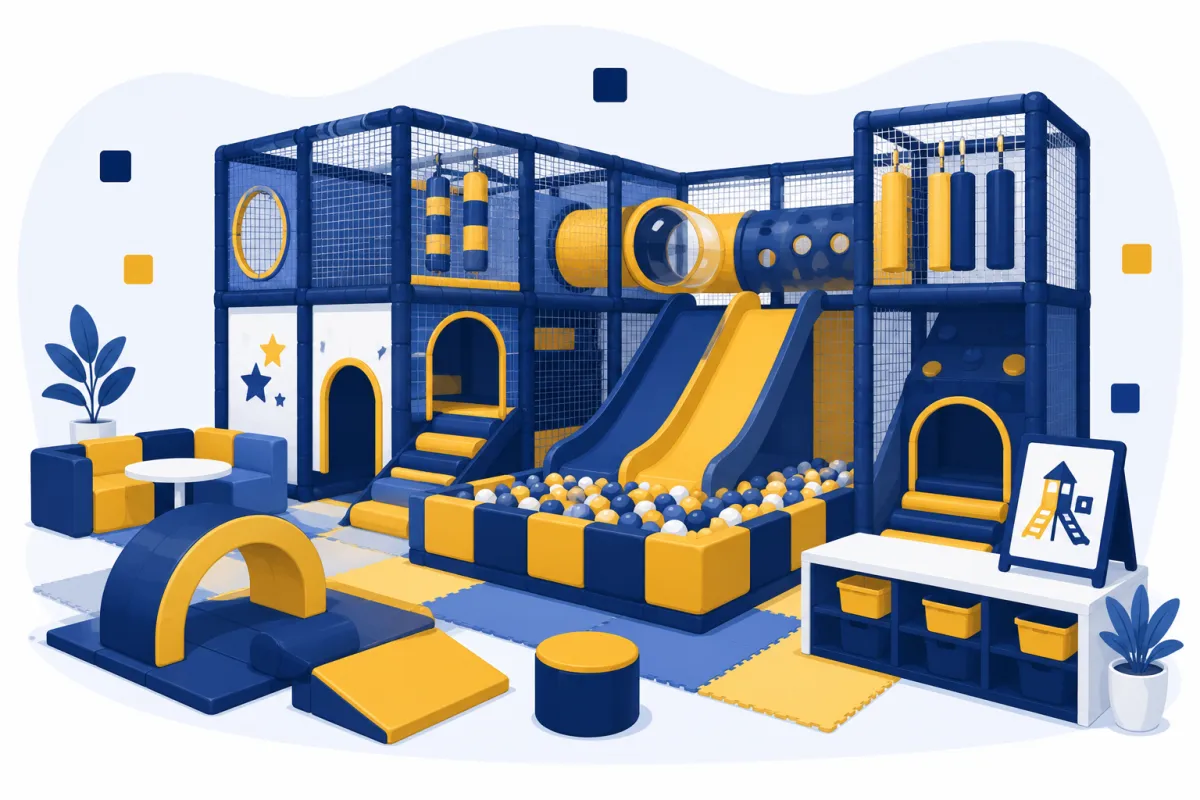
Soft Play Centre Insurance UK | Specialist Broker
Why does a soft play centre need specialist insurance treatment?
A soft play centre looks like one of the gentlest businesses imaginable — padded frames, ball pools, toddlers in socks. But to an underwriter it is a dense concentration of the exposures insurers like least, all under one roof: hundreds of young children at high footfall, a large combustible play structure, a food-serving café with allergen risk, and a duty of care to the most vulnerable customers in commercial life. The injuries are usually minor and frequent — but the tail risks are severe: a fire in a foam-and-netting structure, a safeguarding failure, a serious fall, or an allergic reaction in the café. That combination is why a generic "leisure premises" policy so often falls short, and why operators find their renewals rising and their options narrowing.
This is the territory Miller & Partner works in. As a specialist broker for adverse and hard-to-place risks, we place cover for children's leisure and activity operators the standard market treats cautiously — including centres that have been refused cover elsewhere or non-renewed after a claim. This guide explains why soft play is harder than it looks, what BS EN 1176 compliance means for your premium, what a properly built soft play policy must contain, and how to present your risk so specialist underwriters actually want to write it.
How does The Insurability Framework™ apply to soft play centres?
Underwriter Intelligence
We know which leisure and Lloyd's markets still write soft play in 2026, and what triggers their concern — foam fire loading, safeguarding policy, allergen management, RoSPA inspection status. We present your compliance evidence before the underwriter has to ask.
Difficult Risk Expertise
Children's leisure is a cautiously underwritten sector. Our specialist MGA and Lloyd's access reaches the underwriters who still have appetite for soft play and children's activity centres — including risks with a prior claim or a lapse in cover.
Risk Assessment
We audit your centre the way a claimant's solicitor will: RoSPA post-installation and annual inspections, daily check logs, capacity control, safeguarding and allergen procedures — the evidence that decides a claim before it is even made.
Claims Advocacy
A serious injury, fire or safeguarding claim at a children's venue is high-value and emotionally charged. When it happens, you deal with a named broker who fights your corner, not a call centre.
Key facts at a glance
- RoSPA reports approximately 40,000 children's playground injuries a year in the UK serious enough to need a hospital visit — the backdrop to every soft play public liability book.
- Fully-enclosed indoor play equipment is covered by BS EN 1176-10:2023 and BS 8409; compliance isn't law, but courts and insurers treat it as the benchmark of good practice.
- RoSPA recommends a minimum of £5 million public liability (and product liability) cover for a soft play centre — and many insurers require it.
- Play-frame foam is typically PVC-covered and must meet fire standard BS 5852 — because a soft play structure is, in fire terms, a large fuel load in a room full of children.
- A RoSPA post-installation inspection before opening and an independent annual inspection are strongly advised — and often a condition of cover.
- Maximum user numbers are calculated to Table 1 of BS EN 1176-10; exceeding capacity is a leading driver of injury claims.
- A café serving food brings allergen liability under Natasha's Law and the Consumer Protection Act into the same business — a wholly separate exposure from the play frame.
What must a soft play policy include that a standard one won't?
The most common mistake a soft play operator makes is buying a generic "leisure" or "café" policy that only really contemplates one side of the business. A soft play centre is several risks braided together — a play structure, a children's venue, a food business and a fixed commercial property — and a policy that misses any strand leaves a hole that only shows up after a claim. The comparison below shows where a generic policy fails and what a specialist soft play wording does differently.
| Exposure | Generic leisure / café policy | Specialist soft play wording |
|---|---|---|
| Child injury (public liability) | Low limits; child-injury severity underestimated | £5m–£10m limits, rated on RoSPA compliance and supervision |
| Fire in the play frame | Combustible foam loading not properly contemplated | Property cover rated on BS 5852 foam, sprinklers/detection and evacuation |
| Safeguarding / abuse | Rarely included; a growing exposure at children's venues | Abuse cover and safeguarding conditions built into the programme |
| Café allergen (Natasha's Law) | Food liability missed or excluded | Products & food-safety liability with allergen management reflected |
| Business interruption | 12-month indemnity, no allowance for fire rebuild or investigation | 18–24 month indemnity covering rebuild, re-fit and lost bookings |
| Party rooms & added activities | Undisclosed activities can void the claim | Each activity and party package disclosed and rated |
| Slips on café/hard-floor areas | Generic public liability; wet-floor claims common | Full occupiers' liability across play and non-play areas |
Why is soft play a harder insurance risk than it looks?
Soft play's insurance difficulty is a paradox: the individual injuries are usually minor, but the risk profile is one insurers treat with real caution. Four things drive that. First, footfall: a busy centre puts hundreds of children through the doors in a day, and volume alone generates a steady stream of slips, falls, collisions and minor fractures — a high-frequency public liability book. Second, the age of the customer: claims involving young children carry long limitation periods (a child has until their 21st birthday to bring a claim) and courts apply a higher duty of care. Third, the property: an enclosed play frame is a large combustible structure, and a fire in it is a total-loss, headline event. Fourth, the café: adding food service bolts a whole separate liability — allergens, hygiene, hot drinks near children — onto the same policy.
Layered on top is the reality that many centres operate on thin margins in leased units, so a serious claim or a fire can end the business outright. Insurers know this, and they price and select accordingly. The result is a two-tier market. Centres that can evidence RoSPA compliance, disciplined daily checks, capacity control, safeguarding and allergen management can still access competitive terms. Those that can't are quoted defensively, restricted, or declined. If you've already been declined, our guide to insurance when you've been refused elsewhere explains how specialist placement works from that position.
From recent placement conversations
Soft play operators are often blindsided at renewal. They've run a spotless centre for years, never had a serious claim, and then their premium jumps or their insurer exits children's leisure entirely — and suddenly they're being treated as a problem risk for reasons that have nothing to do with how they run the place.
What turns it around is evidence. The centres we place at the best terms hand us their RoSPA post-installation and annual inspection reports, their daily check logs, their safeguarding policy and their allergen matrix as a single pack — before anyone asks. It signals a professional operator managing a genuinely multi-stranded risk, and underwriters reward it. One operator we placed had been quoted a 70% increase; presenting the compliance evidence properly brought competing terms within days. In this sector, presentation is not decoration — it is the placement.
What are BS EN 1176-10 and BS 8409 — and why do underwriters insist on them?
BS EN 1176-10:2023 is the British/European standard for fully-enclosed play equipment — the technical benchmark for indoor soft play frames covering structure, entrapment, fall heights and maximum user numbers. It sits alongside BS 8409 (soft indoor play areas), BS EN 1177 (impact-attenuating surfacing, requiring a Head Injury Criterion value below 1000 where fall heights exceed 600mm), and BS 5852 (the fire test the PVC-covered foam must meet).
Crucially, as RoSPA and the HSE both stress, compliance with these standards is not mandatory in law and does not by itself confer immunity from a negligence claim — the courts look for a safe area and a systems approach to safety, not just a certificate. But compliance is the evidence of good practice that a court, and an insurer, look for first. That's why most soft play insurers expect a RoSPA post-installation inspection before opening and an independent annual inspection thereafter, backed by documented daily checks — and treat their absence as an underwriting red flag. The general duties of the Health and Safety at Work etc. Act 1974 underpin the whole regime.
What insurance covers does a soft play centre need?
A soft play programme is genuinely combined — liability, property, fire, food and interruption covers have to knit together so that a single incident (which will usually touch several at once) doesn't fall between sections. The core structure looks like this:
Public and product liability
The single most important cover. Third-party injury to children and carers — with limits sized for serious child-injury claims, £5m minimum (RoSPA's recommendation) and often £10m where landlords require it. Product liability covers injuries traced to the equipment itself. See our guide to high-risk public liability insurance.
Employers' liability
Legally required under the Employers' Liability (Compulsory Insurance) Act 1969 for your play staff, party hosts and café team.
Property, fire and contents
The building, the play frame, the café fit-out and the contents — with fire the defining property peril given the combustible structure. Insure at correct reinstatement values to avoid underinsurance and the condition of average.
Business interruption
A fire or serious incident can close a centre for many months; the indemnity period must reflect a full rebuild and re-fit. Covered below and in our guide to business interruption insurance.
Safeguarding, abuse and management liability
Child-heavy footfall makes abuse cover and safeguarding a genuine exposure, and directors can be named personally after a serious incident — see our directors' & officers' guide.
Food, products and cyber
The café brings food-safety and allergen liability; booking and membership systems bring a data exposure that suits cyber insurance.
Cover checker: what does your play venue need?
Select the profile closest to your operation. Tags show what's legally required, essential, or worth considering. Every soft play programme should be built individually — this checker maps the starting point. Our main high-risk public liability guide covers the liability core.
- CRITICALPublic liability £5m–£10m — the cover that decides insurability; child-injury claims drive severity. Specialist placement needed if you've had a previous claim.
- LEGALEmployers' liability (£10m) — play staff and café team.
- ESSENTIALProperty & fire cover — the combustible play frame is your defining property peril.
- ESSENTIALFood / allergen liability — the café is a separate exposure under Natasha's Law.
- RECOMMENDEDAbuse / safeguarding cover — child-heavy footfall.
- RECOMMENDEDBusiness interruption, 18–24 months — allow for a full fire rebuild.
- CRITICALTrampoline zone separately disclosed — mixing trampolines with soft play raises severity and needs PAS 5000 treatment. See our trampoline park guide.
- CRITICALPublic liability £10m across both activity types.
- LEGALEmployers' liability (£10m).
- ESSENTIALAge & zone separation — keep toddler soft play distinct from higher-impact zones.
- RECOMMENDEDProperty, fire & BI.
- CRITICALUnder-5 supervision & capacity — the youngest users are the highest duty-of-care group; capacity to Table 1 BS EN 1176-10 matters most here.
- CRITICALPublic liability £5m–£10m.
- LEGALEmployers' liability (£10m).
- ESSENTIALImpact surfacing to BS EN 1177 — HIC below 1000 for any fall height over 600mm.
- RECOMMENDEDSafeguarding cover — parent-and-toddler sessions.
- CRITICALEvery party package disclosed — character visits, food, add-on activities each carry distinct exposures; undisclosed extras void claims.
- CRITICALPublic liability £5m–£10m.
- ESSENTIALFood / allergen liability — party catering is a Natasha's Law exposure.
- LEGALEmployers' liability (£10m) — party hosts.
- RECOMMENDEDProduct recall / contamination if catering in-house; see our product recall guide.
- CRITICALPlay area disclosed within the café risk — a play café is still a play operator; the frame must be described and RoSPA-inspected.
- ESSENTIALPublic liability £5m plus food/allergen liability.
- LEGALEmployers' liability (£10m).
- ESSENTIALSlips & hot-drinks controls — café-and-play overlap is a common claim source.
- CONSIDERProperty & contents for the fit-out.
- CRITICALLease insurance obligations — leased units impose repairing and insuring covenants; the wording must match the lease.
- ESSENTIALTenant's improvements & fit-out cover — your play frame and café are your capital, not the landlord's.
- ESSENTIALBusiness interruption incl. rent — you owe rent even when closed after a fire.
- CRITICALPublic liability £5m–£10m.
- LEGALEmployers' liability (£10m).
Why is public liability the make-or-break cover for soft play?
Public liability is where soft play centres live or die in the eyes of an underwriter — and where the high-frequency nature of the risk really bites. With around 40,000 children's playground injuries a year in the UK serious enough to need hospital treatment, and a busy centre cycling hundreds of children through in a day, the claims stream is steady: slips on hard floors, collisions in ball pools, falls from frames, finger and limb entrapments, and the occasional serious fracture or head injury. Most are modest, but the aggregate frequency, plus the occasional severe injury to a young child, is what shapes the premium.
Because these are occupiers' liability exposures under the Occupiers' Liability Act 1957 — with a higher standard owed to children — the duty of care is non-negotiable, and the evidence you keep that you met it is what defends every claim. That's why RoSPA recommends a £5m minimum and why underwriters interrogate the controls that reduce frequency: capacity limits to Table 1 of BS EN 1176-10, age-zoning, supervision ratios, daily check logs, and impact surfacing to BS EN 1177. A centre that can evidence all of these is a fundamentally different risk from one relying on padding and good intentions.
Why is fire the biggest property risk in a soft play centre?
Ask any leisure underwriter what keeps them up about soft play and the answer is fire. An enclosed play frame is, in fire-engineering terms, a large, concentrated fuel load: PVC-covered foam, netting and plastics stacked several metres high, in a space that can hold hundreds of children. If it ignites, it burns fast and produces dense smoke, and the priority instantly becomes evacuating a room full of small children who may be deep inside a multi-level structure. It is the scenario that turns a property claim into a potential catastrophe.
That's why the foam must meet fire standard BS 5852, and why underwriters focus on the fire-safety systems around it: detection and alarm coverage, sprinklers or suppression, clear and adequate escape routes, emergency lighting to BS 5266, staff evacuation drills, and net-cutting tools kept accessible for emergency access into the frame. Your obligations flow from the Regulatory Reform (Fire Safety) Order 2005, which requires a suitable and sufficient fire risk assessment. For an operator, a well-evidenced fire strategy isn't just compliance — it is one of the biggest levers on both premium and survival.
Why does a child-heavy venue need safeguarding and abuse cover?
Soft play centres exist to serve children, which means they carry a safeguarding exposure most leisure businesses don't. Staff and party hosts interact directly with children; the environment includes toilets and quieter zones; and the venue is, by design, full of families and strangers together. A safeguarding failure — an allegation against a staff member, an inadequate response to a concern, or a supervision lapse — can produce a claim that is both financially severe and reputationally existential.
The provisions of the Children Act 1989 may apply to some fully-enclosed play facilities, and a robust safeguarding policy — staff DBS checks, training, a designated safeguarding lead, clear reporting procedures — is both good practice and an underwriting expectation. On the insurance side, abuse cover is increasingly built into children's-leisure programmes, and management liability responds where directors are drawn personally into an investigation. This is an exposure operators frequently overlook until they need it — and by then it is too late to buy.
What about the café — and Natasha's Law?
The café is where a lot of a soft play centre's money is made — and where a whole separate liability lives. Serving food to children brings food-safety and, above all, allergen exposure. Since October 2021, Natasha's Law has required full ingredient and allergen labelling on food prepacked for direct sale (PPDS), and the Food Standards Agency enforces allergen rules that a busy café serving under-5s must take seriously. An allergic reaction in a child — traced to an undeclared allergen or cross-contamination — is a severe claim and a potential prosecution.
For insurance, this means your programme needs proper products and food-safety liability alongside the play cover, and your operation needs the systems that defend it: an allergen matrix, staff allergen training, clear labelling and signage, and cross-contamination controls. Where you cater parties in-house at scale, contamination and recall exposures start to resemble those we cover in our guide to product recall insurance. Treating the café as an afterthought on a "play" policy is exactly how allergen claims fall into a coverage gap.
Red-flag checklist: would an underwriter worry about your centre?
Tap each statement that is currently true of your centre. These are the things that make a children's-leisure underwriter nervous — the more that light up, the harder (and pricier) your placement becomes.
Why is business interruption so easily underinsured at a play centre?
Business interruption is the cover soft play operators most often get wrong, because the worst-case scenario — a fire in the play frame — produces exactly the kind of long, complex closure a standard 12-month indemnity period can't absorb. After a serious fire, a centre faces investigation, demolition and clearance of the burnt structure, a fit-out lead time for a new frame (bespoke play structures aren't off-the-shelf), landlord and planning processes, and then the slow rebuild of a customer base that has gone elsewhere. That sequence routinely runs well beyond a year.
Two structural points matter. First, the indemnity period should be 18–24 months, not 12 — and for a leased unit it must include ongoing rent, which you owe whether or not you're trading. Second, declare gross profit correctly and review it annually, because average applies to BI just as it does to property. Our guides to business interruption and underinsurance and the condition of average cover the mechanics in detail.
Risk assessor: how will an underwriter score your centre?
What regulations and duties apply to soft play centres?
Soft play centres operate without a bespoke licensing regime, but sit under several overlapping legal duties — and each one feeds into how your insurance is underwritten and how a claim is defended.
Health and safety law
The Health and Safety at Work etc. Act 1974 (sections 3 and 4) requires you to protect the health and safety of users and staff, supported by the Management of Health and Safety at Work Regulations 1999, which mandate a written risk assessment where you employ five or more people. The HSE looks for a systems approach to safety and compliance with relevant standards.
Play equipment standards
BS EN 1176-10:2023 and BS 8409 cover fully-enclosed indoor play equipment; BS EN 1177 covers impact surfacing; BS 5852 covers foam fire performance. None is statute, but all are the benchmarks a court and an insurer measure you against — and RoSPA post-installation and annual inspections are the standard way to evidence compliance.
Occupiers' and child-welfare duties
The Occupiers' Liability Act 1957 imposes a duty of care to visitors, with a higher standard owed to children. The Children Act 1989 may apply to some fully-enclosed play facilities, underpinning safeguarding obligations.
Fire and food law
The Regulatory Reform (Fire Safety) Order 2005 requires a fire risk assessment. If you run a café, food-safety law and Natasha's Law (PPDS allergen labelling, enforced by the FSA) apply, and the Consumer Protection Act 1987 can bring equipment or food suppliers into a claim.
What drives the cost of soft play centre insurance?
There is no meaningful "average premium" for a soft play centre — the spread between a single-age, RoSPA-compliant toddler centre and a large multi-activity venue with in-house catering and a claims history is enormous. What every operator can do is understand the rating factors and work the ones within their control:
| Rating factor | Why it moves your premium | Mitigation |
|---|---|---|
| RoSPA inspection status | Post-install + annual inspection is the baseline of good practice | Keep both current; re-inspect after any frame change |
| Daily check regime | Documented daily checks are frontline claim defence | Log checks before every session; retain records |
| Fire safety & foam standard | Combustible frame = catastrophic property peril | BS 5852 foam, detection/sprinklers, drills, escape routes |
| Public liability limit | Child-injury claims and RoSPA guidance push to £5m–£10m | Buy the limit the risk and your landlord demand |
| Capacity & age zoning | Overcrowding and age-mismatch drive injury frequency | Enforce Table 1 BS EN 1176-10 limits and age zones |
| Safeguarding controls | Child-heavy venue = abuse/safeguarding exposure | DBS checks, training, designated lead, reporting policy |
| Café / allergen management | Food service adds a separate severe exposure | Allergen matrix, staff training, Natasha's Law labelling |
| Impact surfacing | Surfacing failures turn falls into serious injuries | BS EN 1177, HIC below 1000 above 600mm fall height |
| Claims history | A prior injury or fire claim reprices for 3–5 years | Evidence what changed; see our claims history guide |
| Added activities | Trampolines, party extras add severity | Disclose and rate each activity separately |
| Declared values & indemnity period | Underinsurance triggers average; 12-month BI too short | Reinstatement valuations; 18–24 month indemnity |
| Continuity of cover | Lapses and cancellations are decline red flags | Start renewal early; never let cover gap |
What do real soft play claims look like?
These three fictionalised but market-realistic case studies show how soft play losses actually unfold — and where the decisions made at placement decided the outcome.
Case study 1: The play-frame fire — £1.4m property and business interruption claim
An electrical fault ignited the PVC-covered foam of an enclosed play frame overnight. The centre was empty, but the fire gutted the structure and smoke-damaged the whole leased unit. Rebuilding a bespoke play frame, re-fitting the café and rebuilding the customer base took 16 months.
The numbers: £620,000 to rebuild the play frame and fit-out, £180,000 building and smoke-damage reinstatement, £600,000 business interruption including ongoing rent over 16 months. Total: £1.4m — met because the operator carried property and an 18-month BI indemnity.
The lesson: the centre survived only because BI ran to 18 months and included rent. An operator on a 12-month, rent-excluded policy would have run out of cover mid-rebuild and lost the business. Fire is the peril that most rewards getting business interruption right.
Case study 2: The café allergen reaction — £95,000 claim and prosecution
A child with a known nut allergy suffered a serious reaction after eating a snack bought from the centre's café; the item contained an undeclared nut trace from cross-contamination in the kitchen. The family claimed, and the local authority pursued a food-safety prosecution.
The numbers: £95,000 civil settlement for the injury and distress, plus defence costs; a separate food-safety fine (uninsurable) and significant reputational damage.
The lesson: the play cover was never in question — but without products and food-safety liability the café claim would have fallen into a gap. The operator had the cover, but the near-prosecution drove home that an allergen matrix and staff training aren't paperwork; they're the difference between a defended claim and a conviction. Food/allergen liability carried a loading at renewal.
Case study 3: The ball-pool collision — £110,000 public liability claim
A busy Saturday session ran over its capacity limit. An older child, in a zone meant for under-5s, collided with a toddler in the ball pool; the toddler suffered a serious head injury. Investigation found the session was over the Table 1 capacity and age-zoning wasn't being enforced.
The numbers: £78,000 general and special damages for the child's injury, £32,000 defence and investigation costs. Total: £110,000 — met within the £5m PL limit.
The lesson: the claim was covered, but two controllable failures — overcrowding and age-zoning — turned an accident into a negligence finding. Renewal premium rose 45% with capacity and zoning warranties attached. Enforcing capacity to BS EN 1176-10 and separating age groups is the cheapest claim-prevention available.
What if your centre has been refused cover or non-renewed?
Refusal, non-renewal and insurer exit from children's leisure are common enough that they carry less stigma with specialist underwriters than operators fear — but they must be handled correctly. Every future proposal will ask whether you have been refused cover, and the duty of fair presentation makes the answer permanent. The workable path is the one we set out in our guides to insurance for businesses refused cover and high-risk public liability insurance: disclose everything, evidence your RoSPA compliance and what has changed since any prior claim, and approach the specialist market through a broker who can frame the risk — never through serial applications that build a paper trail of declines. Centres carrying a prior claim alongside the sector's inherent caution need both issues presented together, once, properly.
How do you manage a serious incident or injury claim at a soft play centre?
Soft play claims are won and lost in the first days. This is the sequence we run with clients:
- Get medical help and make the area safe. Life safety first; then close and isolate the zone or equipment involved so the scene is preserved for investigation.
- Record the incident fully, at once. Accident book entry, CCTV export, the session's capacity and booking data, staff-on-shift records, and the daily check log — while everything is fresh.
- Preserve the compliance evidence. RoSPA inspection reports, daily check records, the fire risk assessment or the allergen matrix — whichever is relevant to the incident — are the documents that prove you met your duty.
- Notify your broker the same day. Late notification breaches policy conditions. Your broker triggers insurer notification across PL, EL, property and any food/abuse sections affected.
- Report to the HSE or FSA where required. RIDDOR-reportable injuries go to the HSE; serious food incidents may involve the local authority and FSA. Take advice before giving any account that could be used in enforcement.
- Control communications. One spokesperson; no admissions of liability to the family, the public or on social media — statements made now surface in the claim, and potentially a prosecution, later.
- Cooperate with the loss adjuster, on the right footing. The insurer's adjuster is professional but not your representative; on a serious claim, take your broker's advice on whether your own support is justified.
- Fix the root cause and evidence it. Whatever the investigation finds — capacity, zoning, fire, allergen — correct it and document the change. It protects the next child as much as the next renewal.

About the author — John Miller
John Miller is Director & Principal Broker at Miller & Partner Limited (FCA Firm Ref 1029698), with over 13 years' specialist commercial insurance experience and direct access to the Lloyd's Market and specialist MGA schemes. John specialises in adverse and hard-to-place risks — including soft play centres, trampoline parks and other children's-leisure venues the standard market treats cautiously — placing cover for operators others have declined. He was previously the #1 Account Executive at Brown & Brown and #1 Salesperson at AXA.
Read more about John · Office: Vivian House, Roman Bridge Close, Mumbles, Swansea SA3 5BG · 01792 001350
Glossary of soft play insurance terms
- BS EN 1176-10
- The 2023 standard for fully-enclosed play equipment — the technical benchmark for indoor soft play frames, including maximum user numbers in Table 1.
- BS 8409
- The British Standard covering soft indoor play areas as a facility, sitting alongside BS EN 1176-10.
- BS EN 1177
- The standard for impact-attenuating surfacing, requiring a Head Injury Criterion (HIC) below 1000 where fall heights exceed 600mm.
- BS 5852
- The fire test standard the PVC-covered foam in a play frame must meet — central to the centre's fire risk.
- Head Injury Criterion (HIC)
- A measure of the injury potential of a fall onto a surface; soft play surfacing must keep it below 1000 for higher falls.
- RoSPA post-installation inspection
- An independent safety inspection of a new play facility before it opens — strongly advised and often a condition of cover.
- Annual independent inspection
- The yearly RoSPA (or equivalent) inspection of the facility — the baseline evidence of ongoing compliance.
- Daily safety check
- A documented pre-session inspection by a competent staff member — frontline evidence in defending a claim.
- Public liability
- Cover for third-party (child and carer) injury and property damage — the make-or-break cover for a soft play centre.
- Product liability
- Cover for injury traced to the play equipment or products supplied — usually written alongside public liability.
- Employers' liability
- Legally compulsory cover for injury to staff, including play, party and café teams.
- Occupiers' liability
- The duty under the Occupiers' Liability Act 1957 to keep visitors reasonably safe — a higher standard applies to children.
- Safeguarding / abuse cover
- Cover and policy controls addressing the child-protection exposure inherent in a children's venue.
- Natasha's Law
- The allergen-labelling law (in force October 2021) requiring full ingredient and allergen labelling on food prepacked for direct sale.
- Business interruption
- Cover for lost revenue and continuing costs (including rent) after an insured event — needs an 18–24 month indemnity period for a play centre.
- Condition of average
- The mechanism that proportionately reduces claims where declared values are below true reinstatement values.
- Fair presentation
- The duty under the Insurance Act 2015 to disclose every material circumstance — activities, café, safeguarding, losses and refused cover.






Instagram
LinkedIn