


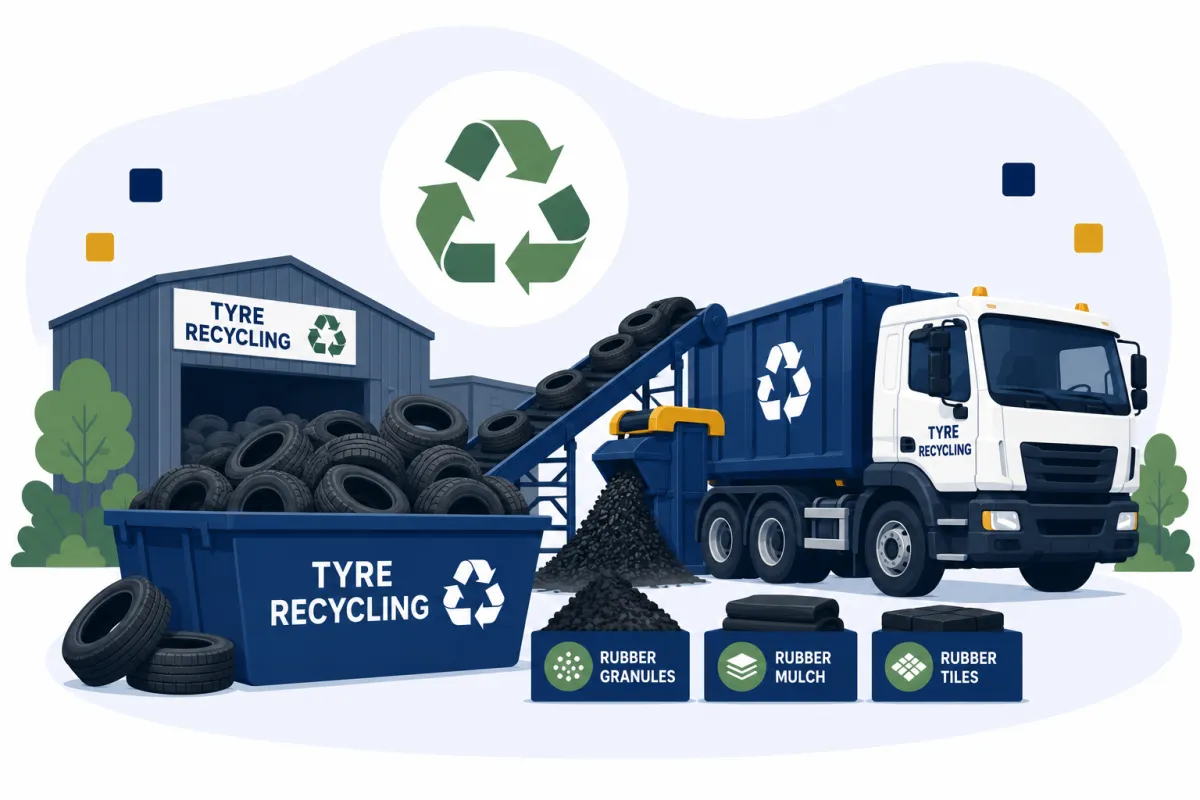
Tyre Recycling & Storage Insurance UK | Specialist Broker
Why does tyre recycling need specialist insurance treatment?
The UK generates around 50 million waste tyres a year — roughly 700,000 tonnes of a material that is bulky, awkward to store and notoriously difficult to extinguish once alight. Add a regulatory regime in the middle of a major overhaul, a well-publicised export scandal, and a fire profile so severe it is the stated reason the government is withdrawing the sector's main exemption, and you have a trade that most standard insurers simply will not write. Tyre recycling and storage is a specialist, hard-to-place risk — the exact lane Miller & Partner's waste and recycling insurance team works in.
This guide covers tyre recycling and storage insurance from a broker's chair: the covers that matter, what the removal of the T8 waste exemption means for your insurability, why fire dominates every underwriting conversation, and how to handle a claim when the worst happens. It sits alongside our guides to waste transfer station insurance, skip hire and waste carrier insurance and scrap metal dealer insurance — where this one is distinct is the regulatory cliff-edge the tyre sector is walking towards, and the uniquely catastrophic fire that drives it.
How does The Insurability Framework apply to a tyre site?
Placing a tyre recycler is exactly what The Insurability Framework™ was built for. A tyre site is rarely refused because the operator is careless — it is refused because the underwriter cannot see how the fire risk is controlled and how the regulatory transition is being managed. The framework is the structured method we use to turn a near-uninsurable tyre risk into one an insurer will write.
Underwriter Intelligence
We know the handful of markets still writing tyre storage and recycling, exactly what they fear (a stockpile fire and an exemption-to-permit gap), and the evidence that moves them: pile-size limits, fire breaks, water supply and a credible fire prevention plan.
Difficult Risk Expertise
Tyres are a sector generalists decline on sight. We specialise in placing sites others refuse — including operators mid-transition from a T8 exemption to a full environmental permit, and sites with a prior fire.
Risk Assessment
We surface the exposures that quietly wreck insurability: stockpiles over the limit, no separation distances, poor firewater containment, and duty-of-care gaps where tyres are exported. Finding these before the insurer does keeps cover in force.
Claims Advocacy
When a tyre fire hits — and they are severe — you get a broker who fights the claim with you, managing loss adjusters, the fire service and the Environment Agency, not a call centre.
Key facts at a glance
- The UK generates around 50 million waste tyres (≈700,000 tonnes) a year. End-of-life tyres are classed as controlled waste, so a legal duty of care applies to their storage, movement and disposal.
- The government has decided to remove the T8 waste exemption for mechanically treating end-of-life tyres — driven explicitly by fire risk. Affected operators must move to an environmental permit or cease those activities.
- Under T8, storage is capped at 40 tonnes of car tyres (60 tonnes of truck tyres) over any 7-day period, in piles no bigger than 10 tonnes with a fire break between each pile.
- Tyre fires are among the most catastrophic in the waste sector — they can burn for weeks, resist water, and release toxic pyrolytic oil and smoke.
- As of February 2026 there were 711 registered T8 facilities; an Environment Agency inspection campaign that began in November 2025 found a significant minority non-compliant.
- Larger tyre-shred and treatment operations need an Environment Agency environmental permit; storage awaiting recovery uses the separate S2 storage exemption (40 tonnes for three months).
- Most standard insurers decline tyre storage and recycling outright; cover is placed through specialist waste and recycling and Lloyd's markets.
Which covers does a tyre recycler actually need?
A tyre recycling or storage site bundles several very different exposures, and no single off-the-shelf policy fits it. The table below sets out the core covers we build into a typical tyre programme, why each matters for this trade specifically, and how essential it is. Use it as a checklist against your own schedule.
| Cover | Why it matters for a tyre site | Priority |
|---|---|---|
| Property & stock (fire) | The defining exposure — buildings, shredding/baling plant and the tyre stock itself against a fire that can consume the whole site. | Essential |
| Employers' Liability | Legally required if you employ anyone; heavy plant and manual handling make waste-sector EL heavily underwritten. See our business liability guide. | Legal |
| Public Liability | Visiting hauliers, producers and the public on a hazardous site with moving plant; often a contract and site requirement. | Essential |
| Environmental / pollution (EIL) | Firewater run-off and pyrolytic residues can contaminate land and watercourses; standard PL pollution wording is narrow. | Essential |
| Business interruption | After a major fire, EA clean-up and site reinstatement can run for many months; a long indemnity period protects income. | Essential |
| Plant & machinery / breakdown | Shredders, granulators and balers are business-critical; sudden damage and hired-in plant need specific cover. | Recommended |
| Goods in transit / haulage | If you collect tyres or move them between sites, loads in transit need cover — overlaps with waste carrier duties. | Recommended |
| Directors' & Officers | Personal exposure for permit and duty-of-care breaches and environmental prosecutions falls on named individuals. | Consider |
What does the T8 exemption removal mean for your cover?
For years, smaller tyre operators have relied on the T8 exemption to bale, shred, peel, shave or granulate end-of-life tyres without a full environmental permit — provided they stayed within the limits of 40 tonnes of car tyres (or 60 tonnes of truck tyres) over any seven-day period. In July 2025 the government announced it would remove the T8 exemption entirely, citing the fire risk from tyre storage and evidence that limits were being exceeded by significant amounts. Operators who relied on T8 will need to move to an environmental permit or stop those activities.
This matters for insurance because your regulatory status is part of your risk. An insurer writing a tyre site expects the permitting to match the activity. A business still trading on a withdrawn exemption, or one that has quietly exceeded the T8 limit, is carrying a compliance exposure that can invalidate assumptions in the policy. The operators who come through the transition well — permit in hand, stockpiles within limit, fire controls documented — are materially easier to place. Those who ignore it drift towards the refused-cover and adverse-risk end of the market.
What cover does my type of tyre operation need?
Pick the operation that best matches your business to see the cover priorities we would typically build in. This is a starting point for a conversation, not a quote — every site is rated on its own fire controls and permitting. For any of these, the route runs through our waste and recycling team.
Which compliance red flags make you uninsurable?
Tick each control you already have in place. The more you can honestly tick, the more markets will look at your site — and the better the terms. Unticked items are the ones underwriters ask about first.
How hard-to-place is my tyre risk?
Choose your two biggest factors for an indicative placement tier. This is guidance only — a proper assessment always looks at the whole site.
Why are tyre fires the defining underwriting concern?
Every other question an insurer asks about a tyre site ultimately comes back to fire. Tyres are energy-dense, they trap air, and once a stockpile ignites it becomes almost impossible to extinguish — large tyre fires can burn for weeks, reignite after being knocked back, and demand enormous volumes of water. The smoke is thick and toxic, and the heat generates pyrolytic oil that seeps into the ground. It is precisely this fire profile that the government cited when deciding to withdraw the T8 exemption.
Because the severity is so high, underwriters focus almost entirely on prevention and containment. The controls that move a tyre risk from "declined" to "quotable" are: capped pile sizes with genuine fire breaks between them; separation from buildings, boundaries and neighbours; a documented fire prevention plan with adequate water supply and fire-service access; and firewater containment so a blaze does not become a pollution incident as well. A site that can evidence these is a fundamentally different proposition from a stockpile with none. If you have already had a fire, the placement is harder but not hopeless — the disclosure and rebuild dynamics mirror our business insurance after a fire claim guidance.
Do you need an environmental permit or an exemption?
It depends on what you do and at what scale. Smaller operators historically used the T8 exemption to treat limited volumes without a permit, while storage awaiting recovery elsewhere used the S2 storage exemption (up to 40 tonnes for three months). Anything larger — commercial-scale shredding, granulating, or thermal treatment — needs a full Environment Agency environmental permit. With T8 being removed, more operators are being pushed into the permitting regime.
From an insurance standpoint, the golden rule is that your permitting must match your activity. An underwriter writing a shredding operation expects to see the permit that authorises it; a storage site expects to see volumes within the registered limit. Mismatches — a permit that does not cover what you actually do, or an exemption you have outgrown — are exactly the kind of undisclosed exposure that causes trouble at claim. Getting the permitting right is not just regulatory hygiene; it is a precondition of holding cover.
What pollution and land contamination risks apply?
Tyres themselves are relatively inert in storage, but a fire changes everything. Firewater run-off carries oils, heavy metals and combustion products into drains and watercourses, and pyrolytic residues can contaminate soil. Even in normal operation, sites handling shredded material, oils from associated activities, or thermal processes carry a pollution exposure that a standard public liability policy's narrow pollution wording will not fully answer.
This is why we build in Environmental Impairment Liability (EIL) for most storage and processing sites. It responds to gradual pollution and clean-up costs that PL excludes, and it is close to essential for any operation with a real fire load or thermal process. It sits alongside your HSE waste-sector duties and your environmental permit — the documents an insurer will cross-check the moment a pollution claim lands.
How does the export and duty-of-care risk affect cover?
Roughly half of the UK's waste tyres are exported, and the sector has been under intense scrutiny since a 2025 investigation exposed baled UK tyres reaching unlicensed overseas pyrolysis plants. End-of-life tyres are controlled waste, so the duty of care follows them: you are responsible for ensuring your waste reaches a legitimate, traceable destination, not just for handing it to the next party in the chain.
For insurers, weak duty-of-care records are a red flag on two fronts — the prosecution and enforcement risk, and the reputational risk of being linked to illegal disposal. Strong, documented traceability of where your tyres go is part of what makes a site insurable. It overlaps directly with the waste carrier and duty-of-care themes in our skip hire and waste carrier guide, and with the digital waste tracking reforms coming across the whole sector.
What drives the cost of tyre recycling insurance?
There is no meaningful "average premium" for a tyre site — the range is wide because the risks are. What matters is which factors below apply to you, and crucially, what you can evidence to mitigate each one. The mitigation column is where a good broker earns their keep: every documented control is a lever on the price.
| Rating factor | Why it pushes premium up | How to mitigate it |
|---|---|---|
| Stockpile size | Large tyre volumes mean a larger, longer, more severe potential fire. | Keep volumes within permitted limits; avoid over-accumulation. |
| Pile size & fire breaks | Large, closely packed piles let fire spread and jump. | Capped pile sizes with documented gaps between them. |
| Separation distances | Stock near buildings or boundaries risks total loss and third-party spread. | Mapped layout with stock set back from structures and neighbours. |
| Fire prevention plan | No detection, water or suppression plan makes any ignition catastrophic. | Written plan with detection, water supply and fire-service access. |
| Permit vs exemption status | Trading on a withdrawn or mismatched exemption is a compliance exposure. | Correct environmental permit matching the actual activity. |
| Processing type | Shredding, granulating and especially pyrolysis add heat and dust hazards. | Dust control, machinery guarding, thermal-process safeguards. |
| Firewater containment | Uncontained run-off turns a fire into a pollution claim too. | Bunding, sealed drainage and a spill/containment plan. |
| Claims & fire history | A prior fire is the single biggest hardener. | Evidence of improved controls since the loss; independent risk report. |
| Duty-of-care / export records | Poor traceability risks prosecution and reputational fallout. | Documented, legitimate onward destinations for all tyres. |
| Security & arson risk | Tyre sites are arson targets; unsecured sites invite deliberate fires. | Monitored CCTV, secure fencing, out-of-hours protection. |
| Business interruption period | Fire clean-up and reinstatement routinely exceed 12 months. | Set a 24–36 month indemnity period, not the 12-month default. |
| Sum insured accuracy | Underinsured plant and stock reduce claim payouts via average. | Regular revaluation of plant and realistic stock declarations. |
What do real tyre site claims look like?
The following three cases are composite, anonymised examples drawn from the types of tyre and waste claims we see. Figures are realistic and illustrate how a loss develops — and how cover, or the lack of it, decides the outcome.
Case 1 — Stockpile fire at a storage site (£2.1m)
A storage and baling site let its tyre volume drift above the exemption limit, with piles pushed close together to fit the extra stock. An ignition — never conclusively traced, but consistent with arson — took hold overnight and, with no meaningful fire breaks, spread across the yard. The fire burned for six days and firewater reached a nearby ditch. Property and stock loss came to about £1.3 million, business interruption over a 14-month reinstatement added £600,000, and pollution clean-up a further £200,000 — roughly £2.1 million in total. Because the site had exceeded its storage limit, the insurer initially reserved its position; the claim was ultimately paid at a reduced level after protracted negotiation, and cover was made conditional on strict pile limits and firewater containment. Renewal premium rose around 70%.
Case 2 — Shredder dust explosion and injury (£540,000)
A granulating line accumulated fine rubber dust that was not adequately extracted. A spark during maintenance triggered a flash fire that injured two operators and damaged the plant. The HSE investigated and prosecuted over inadequate dust control. The combined Employers' Liability settlement reached £360,000, HSE fine and defence costs added £180,000, for around £540,000 total. EL responded to the injuries; the fine fell on the business. The insurer required a full dust-extraction and hot-work review as a condition of continued cover, and EL premium rose about 45% at renewal.
Case 3 — Duty-of-care export prosecution (£140,000)
A tyre operator baled and sold whole tyres to a broker on paperwork stating they would be shredded and recycled abroad. The consignment was traced to an unlicensed overseas pyrolysis operation, and the Environment Agency pursued the operator for a duty-of-care failure. Fine, legal defence and remediation-related costs came to about £140,000, alongside significant reputational damage with contract customers. Legal expenses cover contributed to the defence, but the core penalty fell on the business. We re-placed the operator afterwards as an adverse claims-history risk, with tightened traceability controls that reassured the incoming market.
How should you handle a fire or claim at a tyre site?
When a fire or serious incident hits a tyre site, the first hours shape the whole claim. This is the sequence we walk clients through — and the one an insurer expects to see followed.
- Make people safe first. Evacuate, account for staff and visitors, and call the fire service. Never let anyone attempt to fight an established tyre fire — they reignite and produce toxic smoke.
- Warn neighbours and contain run-off. Alert adjacent sites downwind, and deploy containment to stop firewater reaching drains and watercourses where safe to do so.
- Notify your broker and insurer immediately. Early notification lets a loss adjuster and, if needed, a fire investigator attend while evidence is fresh.
- Report to the regulators. Notify the Environment Agency for any pollution, and the HSE under RIDDOR for a reportable injury. Prompt, documented reporting protects your position.
- Preserve the scene and evidence. Do not clear debris until the adjuster and investigator have released it; photograph everything and keep CCTV and weighbridge records.
- Pull your compliance records. Gather permits or exemptions, fire prevention plan, duty-of-care and export records, maintenance and training logs — these support both liability and property elements.
- Manage business continuity. Arrange alternative storage or processing, and start the business interruption claim promptly so cash flow is protected during reinstatement.
- Let your broker lead the negotiation. A specialist broker manages the adjuster, challenges reservations and drives the settlement — our Claims Advocacy pillar in practice, not a call centre.

John Miller — Director & Principal Broker
John has 13+ years placing adverse and hard-to-place commercial insurance, with direct access to the Lloyd's market and specialist waste and recycling schemes. He works hands-on with tyre operators standard insurers decline — storage and shredding sites, businesses mid-transition from the T8 exemption to a full permit, and sites with fire history — building placements that hold up at claim. Miller & Partner Limited is an Appointed Representative of Gauntlet Risk Management Ltd, which is authorised and regulated by the Financial Conduct Authority.
Tyre recycling insurance glossary
- End-of-life tyre (ELT)
- A tyre that has reached the end of its usable life and become controlled waste, subject to duty-of-care and environmental rules.
- T8 exemption
- A waste exemption that allowed limited mechanical treatment of end-of-life tyres (baling, shredding, granulating) without a permit — now being removed by government.
- S2 storage exemption
- An exemption allowing waste to be stored at a secure place awaiting recovery elsewhere, subject to volume and time limits.
- Environmental permit
- An Environment Agency authorisation required for larger-scale tyre storage, treatment or thermal processing.
- Duty of care
- The legal responsibility to ensure controlled waste is handled and disposed of correctly through its entire journey to recovery or disposal.
- Fire prevention plan (FPP)
- A documented plan setting out how a site prevents, detects and controls fire, including water supply and pile management.
- Fire break
- A gap kept between tyre piles and structures to stop a fire spreading across a site or to neighbours.
- Firewater run-off
- Contaminated water from firefighting that can pollute drains and watercourses, triggering clean-up liability.
- Pyrolysis
- Heating tyres in a low-oxygen environment to recover oil, carbon and steel — a high-hazard thermal process.
- Rubber crumb / granulate
- Size-reduced recycled tyre material used in surfaces, sport and construction; fine dust carries a fire and explosion risk.
- PAS 107 / PAS 108
- Publicly Available Specifications for size-reduced tyre materials (107) and tyre bales for construction (108).
- Environmental Impairment Liability (EIL)
- Cover for gradual pollution and clean-up costs excluded by standard public liability wording; near-essential for tyre sites.
- Business interruption (BI)
- Cover for lost income and continuing costs while a site cannot operate; needs a long indemnity period for fire reinstatement.
- Indemnity period
- The maximum time BI cover pays out following a loss — 24–36 months is prudent for a tyre site, not the 12-month default.
- Average (underinsurance) clause
- A clause reducing a claim proportionally if the sum insured is less than the true value at the time of loss.
- Adverse risk
- A business standard insurers decline — through fire history, sector, prior claims or compliance issues — requiring specialist placement.
Tyre recycling insurance: frequently asked questions
Employers' Liability is legally required if you employ anyone, and Public Liability is usually demanded by contracts and site owners. Holding the correct environmental permit or exemption is a separate legal requirement to operate. Property, stock, pollution and business interruption covers are not compulsory but are close to essential for a working tyre site.
Fire is the reason. Tyre fires are among the most catastrophic in the waste sector — they burn for weeks, resist water and cause serious pollution. Combined with a regulatory regime in transition, that makes tyres a risk most standard insurers will not write. Cover is placed through specialist waste and recycling and Lloyd's markets instead.
If you relied on T8 to treat end-of-life tyres without a permit, you will need to move to an environmental permit or stop those activities. For insurance, your permitting must match your activity — an insurer expects to see the right authorisation. Operators who get ahead of the transition are materially easier to place than those who ignore it.
Under the T8 exemption, treatment was limited to 40 tonnes of car tyres (or 60 tonnes of truck tyres) over any seven-day period, in piles no bigger than 10 tonnes with fire breaks between them. Storage awaiting recovery used the separate S2 exemption. With T8 being withdrawn, more operators will need a full environmental permit.
Capped pile sizes with genuine fire breaks, separation from buildings and boundaries, a documented fire prevention plan with adequate water supply and fire-service access, and firewater containment. A site that can evidence these is a very different proposition from a stockpile with none.
A prior fire is the single biggest hardener, but it does not make you uninsurable. Insurers want evidence of what changed since — improved pile limits, fire breaks, containment and detection. As a specialist adverse-risk broker we present that story to the markets that still write post-fire tyre risks.
For most storage and processing sites, yes. Firewater run-off and pyrolytic residues can contaminate land and water, and standard public liability pollution wording is narrow. EIL responds to gradual pollution and clean-up costs, and it is close to essential for any site with a real fire load or thermal process.
There is no meaningful average — the range is wide because the risks are. Cost is driven by stockpile size, pile management and fire breaks, permit status, processing type, claims history and security. The most effective way to control premium is to document every mitigating control before the risk goes to market.
Yes. End-of-life tyres are controlled waste, so you remain responsible for ensuring they reach a legitimate, traceable destination — not just for handing them on. Weak duty-of-care and export records are a prosecution and reputational risk, and insurers treat strong traceability as part of what makes a site insurable.
Not the 12-month default. Fire clean-up, Environment Agency involvement and site reinstatement routinely run past a year, so a 24–36 month indemnity period is prudent. Too short a period is a common and costly underinsurance error in this sector.
It is a very hard placement, but not impossible. Thermal treatment adds high-temperature process, explosion and pollution exposures on top of the base fire risk, so insurers demand the correct permit, robust process safeguards and strong containment. It sits firmly in specialist, adverse-risk territory.
Because tyres are a hard-to-place risk that most generalists decline. Miller & Partner approaches every placement through the Insurability Framework — underwriter intelligence, difficult-risk expertise, risk assessment and claims advocacy — and places tyre sites through specialist waste and recycling and adverse-risk markets, including sites refused elsewhere.






Instagram
LinkedIn