


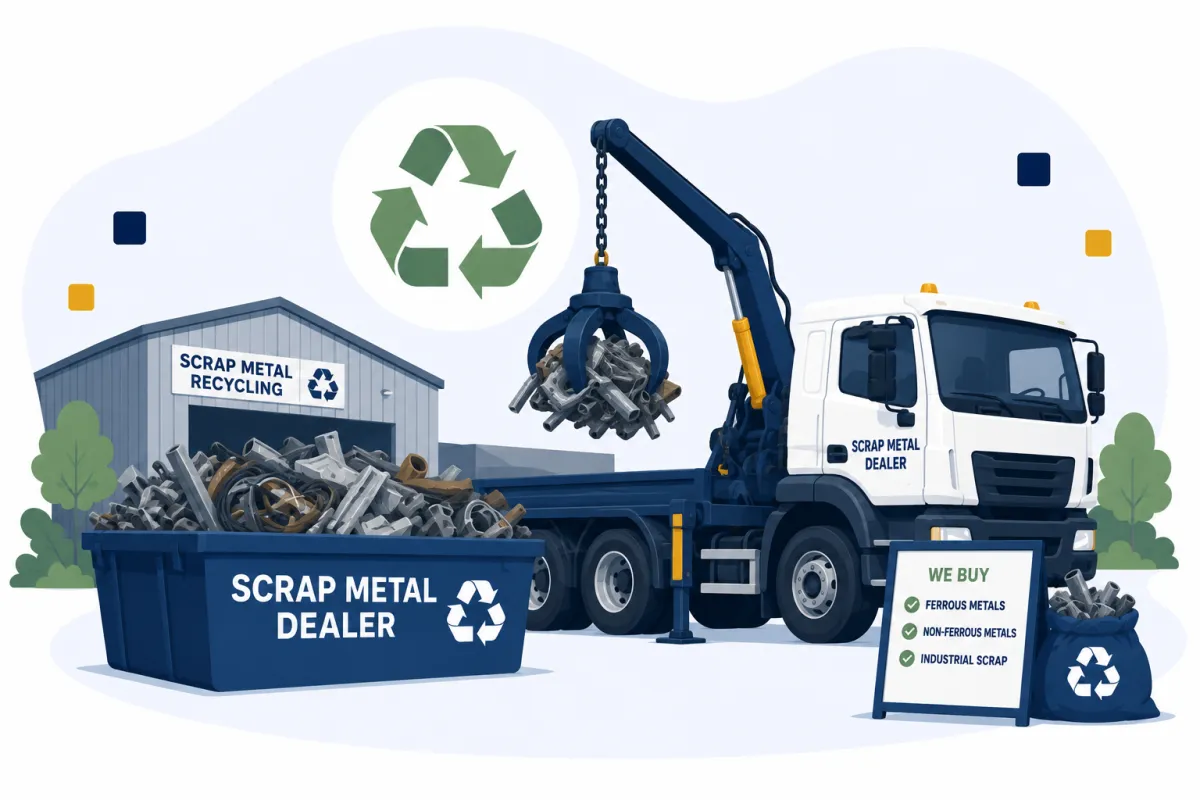
Scrap Metal & Scrap Yard Insurance UK | Dealers & Recyclers
Why do scrap yards and metal dealers need specialist insurance?
Scrap metal insurance, often called scrap yard insurance or scrap dealer insurance, is the package of covers a licensed metal dealer or recycler needs: liability, property and stock, pollution and business interruption. Few UK trades sit further outside a standard insurer's comfort zone than the scrap metal and metal recycling yard. You combine a licensed, heavily regulated activity with open-air stockpiles, hot cutting work, heavy mobile plant, high-value non-ferrous metal that is itself a magnet for theft, and a live regulatory obligation to prevent stolen material entering your yard. Any one of those would give an underwriter pause. Together, they push most metal recyclers into the specialist, hard-to-place market — which is where our waste and recycling insurance team places them.
This guide covers scrap metal dealer and metal recycling insurance from a broker's chair: the covers that matter, why the Scrap Metal Dealers Act 2013 licence sits at the centre of insurability, how fire and stolen-metal exposure drive pricing, and what to do when a claim lands. It is a sibling to our guides on waste transfer station insurance and skip hire and waste carrier insurance; where those focus on static waste sites and mobile carriers, this one focuses on the licensed metal yard and the compliance overlay that makes it uniquely adverse.
How does The Insurability Framework apply to a scrap yard?
Placing a metal recycler is exactly what The Insurability Framework™ was built for. A yard is rarely declined because it is "bad" — it is declined because the underwriter cannot see how the risk is controlled. The framework is the structured method we use to turn a hard-to-place metal operation into a risk an insurer will confidently write.
Underwriter Intelligence
We know which markets still write metal recyclers, what each one fears most (usually lithium-ion fire and stolen-metal handling), and the evidence that moves them from "decline" to "quote" — separation distances, quarantine, cashless records and a credible fire plan.
Difficult Risk Expertise
Scrap is a sector generalists avoid outright. We specialise in placing yards that have been refused elsewhere — including operations with a prior fire, a licence issue, or high non-ferrous stock values that trip standard theft limits.
Risk Assessment
We identify the exposures that quietly wreck insurability: undeclared torch-cutting, no battery-quarantine process, stock values that swing with the copper price, and pollution from oils and fluids. Surfacing these before the insurer does keeps cover in force.
Claims Advocacy
When a yard fire or theft hits, you get a broker who fights the claim with you — managing loss adjusters, the Environment Agency and the fire investigation — not a call centre reading from a script.
Key facts at a glance
- Every UK scrap metal dealer must hold a licence under the Scrap Metal Dealers Act 2013 — a site licence or a collector's licence — issued by the local authority. Trading without one is a criminal offence.
- Paying cash for scrap metal is illegal. Payment must be by traceable electronic transfer or crossed cheque, and you must verify and record the seller's ID on every transaction.
- Metal theft costs the UK economy an estimated £500 million a year, with losses of £4.3 billion over the past decade, according to a 2024 industry report.
- Lithium-ion batteries concealed in mixed scrap are described by the European Recycling Industries' Confederation (EuRIC) as an "existential" fire risk, with thermal events at facilities in 2025 averaging around €1.3m in damage each.
- The waste and recycling sector runs a fatal-injury rate roughly 15 times the all-industry average (HSE figures), so Employers' Liability underwriting is scrutinised hard.
- A basic DBS disclosure and an HMRC tax check are required to obtain or renew an SMDA licence — a compliance history the insurer will also weigh.
- Most standard commercial insurers decline scrap yards outright; cover is placed through specialist waste and recycling markets and Lloyd's schemes.
Which covers does a scrap metal dealer actually need?
A metal recycling yard is a bundle of very different exposures, and no single off-the-shelf policy fits it. The table below sets out the core covers we build into a typical scrap metal programme, why each matters for this trade specifically, and how essential it is. Treat it as a checklist for your own schedule.
| Cover | Why it matters for a scrap yard | Priority |
|---|---|---|
| Public Liability | Members of the public and trade sellers on a hazardous site with moving plant; often required by site owners and local authorities. | Essential |
| Employers' Liability | Legally required if you employ anyone; the waste sector's injury rate makes this heavily underwritten. See our business liability guide. | Legal |
| Property / stock (fire & theft) | Balers, shears, cranes, weighbridge and buildings — plus the metal stock itself, which is high-value and price-volatile. | Essential |
| Environmental / pollution (EIL) | Oils, fuels, brake fluids and firewater run-off can contaminate land and watercourses; standard PL pollution wording is narrow. | Essential |
| Plant & machinery / breakdown | A baler or shear breakdown halts the yard; sudden-and-unforeseen damage and hired-in plant need specific cover. | Recommended |
| Business interruption | After a fire, EA clean-up and rebuild can take many months; a long indemnity period protects income while you recover. | Essential |
| Goods in transit / haulage | If you collect scrap or move it between sites, loads in transit need cover — overlaps with waste carrier duties. | Recommended |
| Directors' & Officers | Personal exposure for licence breaches, environmental prosecutions and health-and-safety failings falls on named individuals. | Consider |
Do you need a Scrap Metal Dealers Act licence to be insurable?
In practical terms, yes. The Scrap Metal Dealers Act 2013 requires anyone carrying on business as a scrap metal dealer to hold a valid licence issued by their local council. There are two types: a site licence, for trading from a fixed premises, and a collector's licence, for a mobile collector who does not operate a site. You cannot hold both for the same local authority area, and trading without a licence is a criminal offence carrying a fine.
The licence is not a rubber stamp. Councils must be satisfied you are a "suitable person", and applications require a basic DBS disclosure certificate and an HMRC tax check at application and renewal. Because the licence records your compliance conduct — cashless trading, ID verification, record-keeping — underwriters treat it as a proxy for how well the business is run. A clean licence history helps a placement; a revocation or a conviction for handling stolen metal makes cover materially harder, which is where our adverse-risk placement work comes in.
What cover does my type of metal operation need?
Pick the operation that best matches your business to see the cover priorities we would typically build in. This is a starting point for a conversation, not a quote — every yard is rated on its own controls. For any of these, the placement route runs through our waste and recycling team.
Which compliance red flags make you uninsurable?
Tick each control you already have in place. The more you can honestly tick, the more markets will look at your yard — and the better the terms. Unticked items are the ones underwriters ask about first.
How hard-to-place is my scrap metal risk?
Choose your two biggest factors for an indicative placement tier. This is guidance only — a proper assessment always looks at the whole operation.
How does stolen-metal exposure affect cover?
This is the exposure that makes scrap genuinely different from every other waste trade. A skip hire firm or transfer station handles waste; a metal dealer buys a commodity from the public — and some of that commodity is stolen. Metal theft costs the UK economy an estimated £500 million a year, with £4.3 billion lost over a decade, and when metal prices are high, infrastructure, churches, railways and building sites are all being stripped. Every stolen load has to be sold somewhere, and the licensed yard is the front line.
The Scrap Metal Dealers Act 2013 exists precisely to break that chain — through licensing, mandatory cashless payment and seller ID verification. For the dealer, the insurance consequence is twofold. First, if you inadvertently buy stolen metal, you can face a police reclaim, loss of the stock you paid for, and — if your controls were poor — a prosecution that threatens your licence. Second, your own high-value stock is a theft target, so you carry the crime risk from both directions. A clean cashless and ID audit trail is the evidence that protects you on the first count and supports any claim on the second. Where a dealer has already had a licence or conviction issue, placement moves firmly into refused-cover territory.
Why is fire the single biggest underwriting concern?
Ask any insurer what keeps them out of the metal recycling sector and the answer is fire. Yards hold large volumes of combustible-adjacent material, run hot cutting processes, and — increasingly — receive lithium-ion batteries hidden inside mixed scrap and cable loads. The European Recycling Industries' Confederation (EuRIC) describes battery fires as an "existential" risk, with thermal events in 2025 costing around €1.3 million each on average. A concealed cell that survives the baler can ignite hours later, deep inside a stockpile, where it is almost impossible to extinguish.
Underwriters respond to three things above all: separation distances (keeping piles apart, and away from boundaries and buildings so a fire cannot spread or jump to a neighbour), a hot-works permit system (torch-cutting and grinding controlled with a fire watch), and a battery quarantine process (a documented method to spot, isolate and safely store lithium-ion cells). A yard that can evidence all three is a fundamentally different proposition from one that cannot. If you have already had a fire, the placement is harder but not hopeless — the parallels with our business insurance after a fire claim guidance are direct, and the same battery-fire dynamics drive our EV garage insurance work.
How is high-value non-ferrous stock rated?
Copper, brass, cable and other non-ferrous metal is where the money — and the theft risk — concentrates. Because scrap values track the commodity market, your stock figure can swing significantly between a quiet week and a full yard awaiting collection. Underinsurance is a live danger: if you insure to an average stock value but suffer a total loss when the yard is full and prices are high, average clauses can cut the payout sharply.
We rate this by declaring realistic peak stock values, not annual averages, and by matching the theft cover to your actual security — monitored CCTV, secure fencing, and out-of-hours protection. For most non-ferrous recyclers, security is a condition of the cover, not an optional discount. It is worth reading this alongside general commercial property insurance principles, because the same underinsurance traps apply — amplified by the price volatility unique to metal.
What pollution and land contamination risks apply?
Scrap yards handle oils, fuels, hydraulic and brake fluids, and — if they process end-of-life vehicles — refrigerants and battery acid. A leak, a spill, or firewater run-off after a blaze can contaminate soil and watercourses, triggering Environment Agency enforcement and clean-up liability that a standard public liability policy's narrow pollution wording will not fully answer.
This is why we build in Environmental Impairment Liability (EIL) for most fixed sites. It responds to gradual pollution and clean-up costs that PL excludes, and it is close to essential for any yard depolluting vehicles or storing fluids at volume. It sits alongside your HSE waste-sector duties and your environmental permit — the two things an insurer will cross-check when a pollution claim lands.
What drives the cost of scrap metal dealer insurance?
There is no meaningful "average premium" for a scrap yard — the range is enormous because the risks are. What matters is which of the factors below apply to you, and crucially, what you can evidence to mitigate each one. The mitigation column is where a good broker earns their keep: every control you can document is a lever on the price.
| Rating factor | Why it pushes premium up | How to mitigate it |
|---|---|---|
| Fire load & process | Torch-cutting, plasma and grinding are ignition sources. | Permit-to-work, fire watch, and declared hot-works procedures. |
| Lithium-ion exposure | Concealed batteries in mixed scrap are the top fire cause. | Documented battery quarantine and isolation process. |
| Separation distances | Densely packed piles let fire spread and jump boundaries. | Mapped stockpile layout with gaps from buildings and neighbours. |
| Peak stock value | High non-ferrous values when metal prices are high raise theft and fire severity. | Declare realistic peaks; avoid over-accumulation before collection. |
| Security & location | Urban or exposed sites with high-value stock attract organised theft. | Monitored CCTV, secure fencing, out-of-hours protection. |
| SMDA licence history | Revocations or convictions signal poor control to insurers. | Clean cashless/ID audit trail and licence conduct record. |
| Claims & fire history | A prior fire is the single biggest hardener. | Evidence of improved controls since the loss; independent risk report. |
| ELV / fluid handling | Depollution adds pollution and hazardous-material exposure. | Correct ATF authorisation, bunding, spill kits, EIL cover. |
| Employee numbers & plant | Waste-sector injury rates make EL exposure high. | Documented safe systems of work, plant maintenance, training. |
| Environmental permit status | Wrong or missing EA permit/exemption is an underwriting red flag. | Correct permit or registered exemption for the material handled. |
| Business interruption period | Fire clean-up and rebuild routinely exceed 12 months. | Set a 24–36 month indemnity period, not the 12-month default. |
| Proximity to sensitive receptors | Nearby homes, water or SSSI raise pollution and evacuation exposure. | Firewater containment, drainage controls, pollution plan. |
| Sum insured accuracy | Underinsured plant and stock reduce claim payouts via average. | Regular revaluation of plant and realistic stock declarations. |
Illustrative scrap yard claims
The following three cases are composite, anonymised examples drawn from the types of scrap and metal recycling claims we see. Figures are realistic and illustrate how a loss develops — and how cover, or the lack of it, decides the outcome.
Illustrative case 1 — Concealed lithium-ion battery fire (£1.4m)
A non-ferrous recycler took in a mixed load of electrical cable and small appliances. A concealed lithium-ion cell survived initial handling and ignited overnight deep in a baled stockpile. With no separation gap to the main building, the fire spread; the brigade fought it for two days, and firewater run-off reached a nearby drain. Property and stock loss came to about £900,000, business interruption over an 11-month rebuild added £380,000, and pollution clean-up a further £120,000 — roughly £1.4 million in total. Because the yard had a documented battery-quarantine process and a mapped stockpile layout, the claim was paid without an avoidance argument. Renewal premium rose around 55%, with a mandated increase in separation distances.
Illustrative case 2 — Baler operator crush injury (£620,000)
An employee reached into a baler to clear a jam without full isolation; the machine cycled and crushed his hand and forearm, causing permanent disability. The HSE investigated and prosecuted for an unsafe system of work. The Employers' Liability settlement reached £470,000, HSE fine and defence costs added £150,000, for around £620,000 total. EL cover responded to the injury claim, but the fine fell on the business. The insurer required a full review of machinery isolation and lock-off procedures as a condition of continued cover; EL premium rose about 40% at renewal.
Illustrative case 3 — Stolen-metal reclaim and licence challenge (£95,000)
A yard bought several loads of copper cable that were later traced as stolen from a telecoms network. Police reclaimed the material, the dealer lost the purchase money, and the local authority opened a licence-suitability review citing weak ID records on the transactions. Direct stock loss and legal defence costs came to about £95,000, and the licence review threatened the whole business. Because the dealer could evidence most — though not all — of the required cashless and ID audit trail, the licence was retained under conditions. The episode moved the yard into the specialist market at renewal; we re-placed it as an adverse claims-history risk with tightened purchasing controls.
How should you handle a claim at a metal recycling site?
When a fire, injury or major theft hits a scrap yard, the first hours shape the whole claim. This is the sequence we walk clients through — and the one an insurer expects to see followed.
- Make people safe first. Evacuate, account for staff and visitors, and call the emergency services. Never let anyone re-enter a burning stockpile — battery fires reignite.
- Contain what you safely can. Isolate plant, shut off fuel and power where safe, and deploy spill kits to limit firewater and fluid run-off toward drains and watercourses.
- Notify your broker and insurer immediately. Early notification lets a loss adjuster and, if needed, a specialist fire investigator attend while evidence is fresh.
- Report to the regulators. Notify the Environment Agency for any pollution, and the HSE under RIDDOR for a reportable injury. Prompt, documented reporting protects your position.
- Preserve the scene and evidence. Do not clear debris until the adjuster and investigator have released it; photograph everything and keep the CCTV and weighbridge records.
- Pull your compliance records. Gather the SMDA licence, cashless and ID logs, permits, maintenance and training records — these support both liability and property elements.
- Manage business continuity. Arrange alternative processing or storage, and start the business interruption claim promptly so cash flow is protected during the rebuild.
- Let your broker lead the negotiation. A specialist broker manages the adjuster, challenges reservations and drives the settlement — our Claims Advocacy pillar in practice, not a call centre.

John Miller — Director & Principal Broker
John has 13+ years placing adverse and hard-to-place commercial insurance, with direct access to the Lloyd's market and specialist waste and recycling schemes. He works hands-on with metal recyclers refused by standard insurers — yards with fire history, high non-ferrous stock values and SMDA licence complications — building placements that hold up at claim. Miller & Partner Limited is an Appointed Representative of Gauntlet Risk Management Ltd, which is authorised and regulated by the Financial Conduct Authority.
Scrap metal insurance glossary
- Scrap Metal Dealers Act 2013 (SMDA)
- The UK law requiring scrap metal dealers to hold a local-authority licence, pay cashlessly and verify seller identity, introduced to combat metal theft.
- Site licence
- An SMDA licence permitting a dealer to trade from a fixed premises within a local authority area.
- Collector's licence
- An SMDA licence for a mobile scrap collector who does not operate from a site; cannot be held alongside a site licence in the same area.
- Cashless payment
- The legal requirement to pay for scrap by traceable electronic transfer or non-transferable crossed cheque, never cash.
- Ferrous / non-ferrous
- Ferrous metals contain iron (steel, cast iron); non-ferrous metals (copper, brass, aluminium, cable) are higher-value and higher theft-risk.
- Environmental Impairment Liability (EIL)
- Cover for gradual pollution and clean-up costs excluded by standard public liability wording; near-essential for scrap and ELV sites.
- Hot works
- Cutting, grinding or torching that produces heat or sparks — a leading ignition source, controlled by a permit-to-work.
- Battery quarantine
- A documented process to identify, isolate and safely store lithium-ion cells found in incoming scrap, reducing fire risk.
- Separation distance
- The gap kept between stockpiles, buildings and boundaries to stop fire spreading or jumping to neighbours.
- End-of-life vehicle (ELV)
- A vehicle being scrapped; depollution (removing fluids, batteries and refrigerants) requires an Authorised Treatment Facility.
- Authorised Treatment Facility (ATF)
- A site permitted by the Environment Agency to depollute and treat end-of-life vehicles.
- Business interruption (BI)
- Cover for lost income and continuing costs while the yard cannot trade; needs a long indemnity period for fire rebuilds.
- Indemnity period
- The maximum time BI cover pays out following a loss — 24–36 months is prudent for a scrap yard, not the 12-month default.
- Average (underinsurance) clause
- A clause reducing a claim proportionally if the sum insured is less than the true value at the time of loss.
- Firewater run-off
- Contaminated water from firefighting that can pollute drains and watercourses, triggering clean-up liability.
- Adverse risk
- A business standard insurers decline — through fire history, prior claims, licence issues or sector — requiring specialist placement.
Scrap metal dealer insurance: frequently asked questions
Employers' Liability is legally required if you employ anyone, and Public Liability is usually demanded by site owners and local authorities. The Scrap Metal Dealers Act 2013 licence is a separate legal requirement to trade at all. Property, stock, pollution and business interruption covers are not compulsory but are close to essential for a working yard.
Fire risk (especially concealed lithium-ion batteries), high-value theft-prone stock, hot cutting work, heavy plant injuries and pollution exposure combine into a risk most standard insurers will not touch. Cover is placed through specialist waste and recycling markets and Lloyd's schemes instead.
A site licence covers trading from a fixed premises; a collector's licence covers a mobile collector with no site. You cannot hold both in the same local authority area. Which you need depends on whether you operate a yard or collect only — and it materially affects how the insurance is structured.
Paying cash for scrap has been illegal since December 2012. Beyond the legal risk, your cashless and seller-ID records are the audit trail an insurer relies on if you face a stolen-metal reclaim or a theft claim. Weak records can undermine both your licence and a claim, so good record-keeping is effectively part of your risk management.
A prior fire is the single biggest hardener, but it does not make you uninsurable. What insurers want is evidence of what changed since — improved separation distances, a battery quarantine process, hot-works permits. As a specialist adverse-risk broker we present that story to markets that still write post-fire scrap risks.
They are the top fire concern. Insurers do not expect you to catch every concealed cell, but they strongly reward a documented process to spot, isolate and quarantine batteries found in incoming scrap. A yard that can evidence this pays materially less than one that cannot.
There is no meaningful average — the range is wide because the risks are. Cost is driven by your processes (cutting, ELV depollution), fire controls, peak stock values, security, claims history and licence conduct. The most effective way to control premium is to document every mitigating control before the risk goes to market.
For most fixed sites, yes. Oils, fuels and firewater run-off can contaminate land and water, and standard public liability pollution wording is narrow. EIL responds to gradual pollution and clean-up costs, and it is close to essential for any yard depolluting vehicles or storing fluids in volume.
Not the 12-month default. Fire clean-up, Environment Agency involvement and rebuild routinely run past a year, so a 24–36 month indemnity period is prudent. Too short a period is a common and costly underinsurance error in this sector.
Declare realistic peak stock values rather than annual averages, and review them at renewal — scrap values move with the commodity market. If you insure to an average and suffer a total loss when the yard is full and copper is high, an average clause can cut the payout sharply.
Insurance cannot make stolen-goods losses disappear — police can reclaim the material and you lose what you paid. What protects you is your compliance: a full cashless and ID audit trail. Good records defend your licence and support any related claim; weak records expose you on both fronts.
Because scrap is a hard-to-place risk that most generalists decline. Miller & Partner approaches every placement through the Insurability Framework — underwriter intelligence, difficult-risk expertise, risk assessment and claims advocacy — and places metal recyclers through specialist waste and recycling and adverse-risk markets, including yards refused elsewhere.






Instagram
LinkedIn