


EV Garage Insurance UK | Electric Vehicle Repair Cover
Why do EV garages need specialist insurance?
The garage trade is in the middle of the biggest technical shift in its history. With more than two million electric vehicles on UK roads and adoption still accelerating, independent workshops are encountering EVs and hybrids every week — but the risk profile of working on them is nothing like servicing a petrol or diesel car. High-voltage systems running at 400–800 volts, lithium-ion batteries that can catch fire in ways water won't put out, and a national shortage of properly qualified technicians have combined to make EV repair a genuine specialist risk.
Insurers have responded by tightening up — and in some cases stepping back. The headline development of 2026 is stark: independent garages are being refused motor trade cover if they work on high-voltage vehicles without an EV-qualified technician on site. What was once seen as a way to future-proof a business has become, for many, essential simply to stay insurable. A standard motor trade policy rated for conventional work is no longer a safe assumption once EVs come through the door.
This guide explains what EV garage insurance covers, why cover is being declined, and how underwriters assess the risk — so you can keep trading and stay protected. It builds on our motor trade insurance guidance and our guide for choosing a motor trade broker.
How we place EV garage risk: The Insurability Framework™
An EV workshop is exactly the kind of difficult risk standard markets are now wary of — high-voltage exposure, lithium fire potential, and a skills gap insurers actively price against. We approach every placement through four pillars rather than firing your details at a panel and hoping.
Underwriter Intelligence
We know what an insurer needs to see before they will write an EV garage — qualified technicians, safe-isolation procedures, battery quarantine — and how to evidence it so a decline becomes a quote.
Difficult Risk Expertise
When standard motor trade markets exclude or decline high-voltage work, we place it through specialist motor and Lloyd's-backed facilities built for emerging and elevated risk.
Risk Assessment
We surface the exposures that bite at claim time: thin fire protection for lithium-ion storage, gaps in technician qualification, and customer-vehicle values that outstrip the sums insured.
Claims Advocacy
If a battery fire, a high-voltage injury or a faulty-repair claim lands, you deal with real people who fight your corner — coordinating insurers, loss adjusters and experts.
Key facts at a glance
- As of 2026, UK independent garages are being refused insurance cover where they work on high-voltage vehicles without a qualified EV technician on site.
- EV systems typically run at 400–800 volts, posing a serious electric-shock risk — technicians need a recognised qualification such as the IMI TechSafe™ standard to work safely.
- The Institute of the Motor Industry has warned of a "catastrophic" skills gap; in early 2025, fewer than a quarter of UK bodyshop technicians were qualified for high-voltage work.
- A damaged lithium-ion battery can enter thermal runaway — a self-sustaining fire that is hard to extinguish, can burn for hours and may reignite.
- EV work needs insulated tools, diagnostic equipment and a designated battery quarantine area — investment many smaller garages have yet to make.
- A replacement EV battery pack can cost £15,000–£25,000+, often more than the used value of the car — pushing up both repair and total-loss exposure.
- EV garage cover is now a specialist motor trade placement, best arranged with a broker who understands high-voltage risk.
What this guide covers
- Why do EV garages need specialist insurance?
- What does EV garage insurance actually cover?
- Why are garages being refused cover without an EV technician?
- What cover does your EV garage need?
- Is your EV workshop insurable?
- How high-risk is your EV work to an underwriter?
- Why is lithium-ion battery fire the hard-market driver?
- What qualifications and controls do insurers expect?
- What drives the cost of EV garage insurance?
- What do real EV garage claims look like?
- How should you handle an EV garage insurance claim?
- Glossary of key terms
- EV garage insurance FAQs
- Related guides
What does EV garage insurance actually cover?
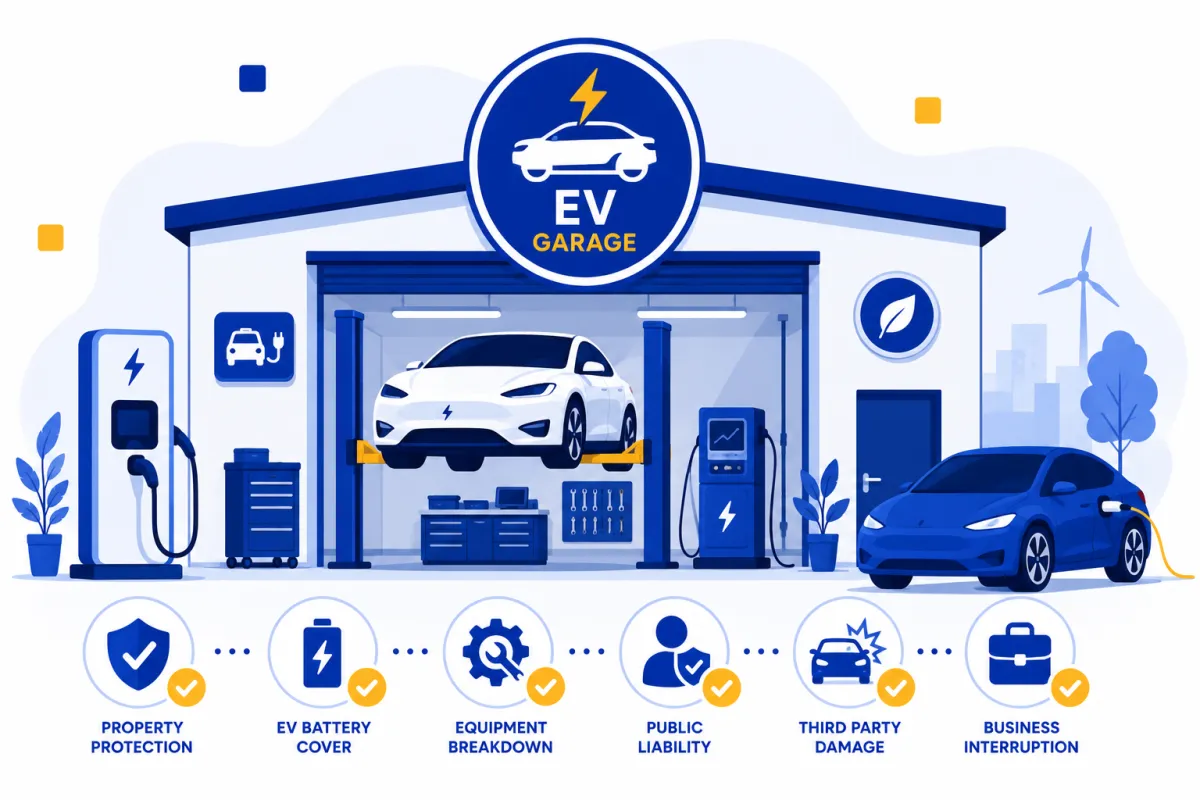
EV garage insurance is motor trade cover built around high-voltage work. The structure is familiar — road risks, premises, liability — but the rating and the conditions change once EVs are involved, and the fire and injury exposures step up sharply. Here is how the core covers fit together.
| Cover | What it protects against | Why an EV garage needs it |
|---|---|---|
| Road Risks | Driving customers' and trade vehicles on the road | Core. Rated higher where high-value EVs are driven. |
| Property & Contents | Fire, theft, damage to premises, tools and equipment | Essential. Lithium-ion fire risk makes this central. |
| Customers' Vehicles | Damage to vehicles in your custody and control | Essential. EV repair/replacement values are high. |
| Public & Products Liability | Injury/damage to third parties and faulty-repair claims | Essential. A faulty HV repair carries serious consequences. |
| Employers' Liability | Injury or illness to staff, incl. high-voltage shock | Legally required if you employ anyone (£5m minimum). |
| Business Interruption | Lost income after a fire or insured event | Strongly recommended. A battery fire can close a workshop for months. |
| Tools & Equipment | Insulated tools, diagnostics, charging equipment | Recommended. EV-specific kit is a significant investment. |
Why are garages being refused cover without an EV technician?
Because, from an underwriting perspective, a garage working on high-voltage vehicles without appropriately trained technicians is a significantly elevated risk — and in 2026 insurers started acting on it. There has already been at least one real case of an independent garage being declined cover specifically because it had no qualified EV technician on site. The shift is that EV competence is moving from a commercial nice-to-have to a baseline condition of insurability.
The logic is straightforward. High-voltage systems can kill or seriously injure an untrained technician; an incorrectly handled battery can ignite; and a botched repair can put a dangerous vehicle back on the road. Each is a large, hard-to-price exposure. The route through is to evidence competence and controls — qualified technicians, safe-isolation procedures, proper tools and battery storage — which is exactly the territory of a specialist adverse-risk broker. If you have already been refused cover, it is very often re-placeable once the risk is presented properly.
The conversations I'm having now with garage owners have changed completely in the last year. It used to be "should we get into EV work?" Now it's "our insurer is asking whether we have an EV-qualified technician, and what happens if we don't?" The honest answer is that the ground has moved — for a workshop already seeing EVs, the qualification and the controls around it aren't just good practice any more, they're increasingly what keeps you insurable.
What cover does your EV garage need?
The right package depends on how much EV work you do and how deep it goes. Select the closest match to see the cover we would build — and where the high-voltage gap usually sits. For tailored terms, start an EV garage quote.
Cover Checker
Independent garage adding EV work
EV / hybrid specialist workshop
Bodyshop / accident repair
Mobile EV technician
EV battery / diagnostics specialist
Dealership / approved repairer
Is your EV workshop insurable?
Qualifications, controls and disclosure are what an underwriter looks at first. Tick the controls you already have — each strengthens your application; each red flag is a question an insurer will raise before quoting (or a reason they decline).
EV insurability & safety checklist
- ✓At least one IMI TechSafe™ / Level 3–4 EV-qualified technician on site.Red flag if missing
- ✓A documented safe-isolation / de-energising procedure for high-voltage work.Red flag if missing
- ✓Insulated tools and high-voltage PPE are provided and used.
- ✓A designated battery quarantine / damaged-vehicle storage area is in place.Red flag if missing
- ✓Fire detection and suppression appropriate to lithium-ion risk are fitted.
- ✓EV diagnostic equipment is available for safe assessment.
- ✓Risk assessments and method statements cover high-voltage work.
- ✓You have told your insurer that you carry out EV/high-voltage work.Red flag if missing
How high-risk is your EV work to an underwriter?
This assessor mirrors how a specialist motor underwriter triages an EV garage. Choose how deep your high-voltage work goes and how mature your qualifications and controls are for an indicative risk tier.
Risk Assessor
Why is lithium-ion battery fire the hard-market driver?
If one factor explains why insurers are cautious about EV garages, it is the lithium-ion battery. EV fires are not more frequent than petrol-car fires, but they are fundamentally different — and much harder to manage. A damaged or faulty battery can enter thermal runaway, a self-sustaining chemical reaction that produces intense heat, resists water-based extinguishing, can burn for hours and may reignite long after it appears to be out. In a workshop full of vehicles, fuel and equipment — and often sharing a building with other units — that is a catastrophic-loss exposure, not a routine fire.
The economics make it worse. A replacement EV battery pack can cost £15,000–£25,000 or more, frequently exceeding the used value of the car, and a damaged pack currently has little salvage value. So the loss potential from a single battery event is high and the recovery is low — exactly the shape of risk that makes underwriters nervous and pushes EV work into specialist territory. The same fire principles drive cover for battery storage facilities and EV charging installers.
What qualifications and controls do insurers expect?
The good news is that the things that make an EV workshop safe are the same things that make it insurable — and they are well-defined. On qualifications, insurers expect to see recognised high-voltage training such as the IMI TechSafe™ standard, because untrained work on 400–800-volt systems is a genuine electrocution risk. The Institute of the Motor Industry has warned for years of a "catastrophic" skills gap, which is precisely why the presence of a qualified technician now carries so much underwriting weight.
On controls, the expectations are practical: a documented safe-isolation procedure before any high-voltage work, insulated tools and PPE, a designated quarantine area for damaged or suspect batteries, fire detection and suppression suited to lithium-ion risk, and risk assessments and method statements for high-voltage tasks. Health-and-safety duties under the Health and Safety at Work etc. Act 1974 sit behind all of this. Evidence these well and an EV garage moves from a risk insurers hesitate over to one they can write.
What drives the cost of EV garage insurance?
There is no flat rate — premiums are built from how much high-voltage work you do and how well it is controlled. These are the factors that move the figure most, with the practical steps that bring it down.
| Rating factor | Why it affects your premium | How to mitigate it |
|---|---|---|
| Depth of EV work | Battery handling rates far higher than diagnostics. | Match cover to the work; limit pack-opening where possible. |
| Technician qualifications | No qualified EV tech is a leading reason for declines. | Hold IMI TechSafe™ / Level 3–4 EV qualifications on site. |
| Safe-isolation procedure | Undocumented HV procedures worry underwriters. | Document and follow a safe-isolation process. |
| Battery quarantine & storage | Poor storage of damaged packs raises fire risk. | Designate a quarantine area away from other vehicles. |
| Fire detection & suppression | Lithium-ion fires demand appropriate protection. | Fit suitable detection and suppression. |
| Premises & fire spread | Shared or combustible premises raise total-loss risk. | Confirm compartmentation; review construction. |
| Customer-vehicle values | High-value EVs raise custody exposure. | Set customers'-vehicle sums insured realistically. |
| Insulated tools & PPE | Lack of HV equipment signals elevated risk. | Provide and record insulated tools and PPE. |
| Employees / EL exposure | HV electrocution raises employers'-liability risk. | Train staff; maintain safe-systems-of-work records. |
| Products / faulty repair | A faulty HV repair carries serious consequences. | Follow manufacturer procedures; keep traceability. |
| Claims history | Prior claims raise pricing. | Disclose fully — see our claims-history guide. |
| Disclosure | Undisclosed EV work can void a claim. | Tell your insurer you carry out high-voltage work. |
What do real EV garage claims look like?
These fictionalised but realistic examples show how EV garage claims unfold — and what made the difference.
The thermal runaway overnight
An accident-damaged EV awaiting assessment was left in the main workshop overnight. Its battery entered thermal runaway, and the resulting fire — difficult for the fire service to control — destroyed much of the workshop and spread to an adjoining unit. The garage was closed for months while it rebuilt.
The shock that wasn't isolated
A technician began work on a high-voltage system that had not been correctly de-energised and suffered a serious electric-shock injury. The investigation focused on whether the technician was qualified and whether a safe-isolation procedure had been followed.
The repair that came back
A high-voltage repair was not carried out to the correct procedure, and a fault later developed in the customer's vehicle, causing damage and a liability claim against the garage. Products and faulty-workmanship cover responded to the defence and settlement.
How should you handle an EV garage insurance claim?
If a battery fire, a high-voltage injury or a faulty-repair claim hits, the first steps shape everything that follows. This is the order we walk clients through.
- Make the workshop safe. Deal with any fire, injury or high-voltage hazard immediately; isolate or quarantine the vehicle or battery and evacuate if needed.
- Call the fire service early if there's a battery fire. Lithium-ion fires are hard to extinguish and can reignite — don't tackle a serious one alone.
- Notify your insurer at once. Report the incident or claim promptly, before evidence is lost.
- Preserve evidence. Keep job records, technician qualifications, isolation records, the vehicle or battery, and any fire-service report.
- Do not admit liability. Be cooperative with customers and authorities, but avoid admissions of legal fault until insurers advise.
- Address the regulatory dimension. Consider HSE and any reporting obligations for a high-voltage injury, coordinated with your advisers.
- Support the loss adjuster and experts. Help insurer-appointed adjusters and technical experts assess causation and quantify the loss.
- Close the safety gap. Once resolved, strengthen qualifications, isolation, storage and fire controls so the exposure cannot recur.

John Miller
John has 13+ years' specialist commercial insurance experience, with direct access to the Lloyd's market and specialist motor schemes. He places motor trade and EV-specialist garage risks — including high-voltage workshops, bodyshops and battery specialists — where standard markets are tightening requirements or declining cover. Read more about John.
Glossary of key terms
- EV (electric vehicle)
- A vehicle powered wholly or partly by a high-voltage battery and electric motor.
- High-voltage (HV) system
- The 400–800-volt electrical system in an EV or hybrid, carrying a serious shock risk.
- IMI TechSafe™
- An Institute of the Motor Industry standard recognising technicians qualified to work safely on EV systems.
- Safe isolation
- The procedure for de-energising a high-voltage system before work begins.
- Thermal runaway
- A self-sustaining battery reaction producing intense, hard-to-extinguish heat and fire.
- Lithium-ion battery
- The rechargeable battery type used in most EVs, central to their fire risk.
- Battery quarantine
- A designated area for storing damaged or suspect batteries away from other vehicles.
- Motor trade insurance
- Cover for businesses that sell, service, repair or handle vehicles.
- Road risks
- The part of a motor trade policy covering driving customers' and trade vehicles.
- Customers' vehicles
- Cover for vehicles in the garage's custody and control.
- Products liability
- Cover for harm caused by faulty parts or repairs after the vehicle leaves.
- Business interruption
- Cover replacing lost income when an insured event stops you trading.
- Salvage value
- The recoverable value of a damaged vehicle or part — typically low for EV batteries.
- Bodyshop
- A workshop carrying out accident and bodywork repair, including damaged EVs.
- Disclosure
- Telling your insurer the material facts — including that you do EV work.







Instagram
LinkedIn