


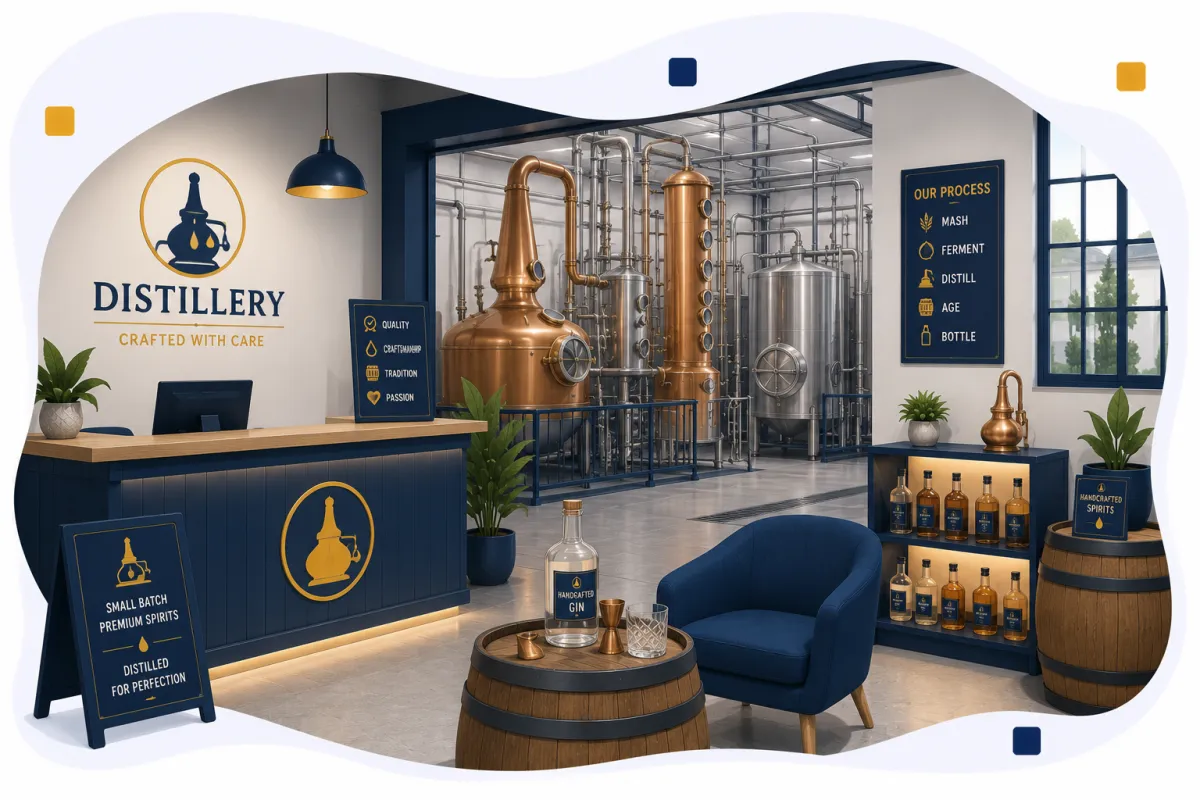
Distillery Insurance UK | Specialist Spirits Broker
Why does a distillery need specialist insurance treatment?
A distillery combines several of the exposures underwriters find hardest to price into a single business — and it does so in a sector booming faster than the insurance market has adapted to. Distilling spirits means producing and storing large volumes of highly flammable, high-strength alcohol; it means accumulating enormous value in slowly maturing stock that can take years to become saleable; and it means carrying a spirits-duty liability to HMRC that can exceed the physical value of the stock itself. Layer on product-contamination risk, expensive bespoke stills, and a stream of visitors on tours around a hazardous process, and you have a business that generalist insurers routinely underprice, exclude, or decline outright.
This is the territory Miller & Partner works in. As a specialist broker for adverse and hard-to-place risks, we place cover for spirit producers the standard market finds difficult — including distilleries that have been refused cover elsewhere or hit with a fire-driven renewal shock. This guide explains why fire and explosion is the exposure that defines a distillery, why maturing stock is the hardest thing to insure correctly, how spirits duty creates a hidden liability, and how to present a distillery so specialist underwriters price it fairly. Our guides to craft brewery insurance and brewery insurance cover the closest adjacent drinks-production sectors.
How does The Insurability Framework™ apply to distilleries?
Underwriter Intelligence
We know which specialist property and Lloyd's markets write distilleries, and what drives their terms — DSEAR compliance and hazardous-area classification, fire detection and separation, maturing-stock valuation, duty exposure and visitor management. We present that evidence before the underwriter has to ask.
Difficult Risk Expertise
High-proof spirit production is a class many insurers shy away from. Our specialist MGA and Lloyd's access reaches the underwriters with genuine appetite for distilleries — including start-ups, whisky operations with long stock tails, and businesses non-renewed after a fire.
Risk Assessment
We audit the distillery the way a fire engineer and an HMRC officer will: hazardous-area zoning, ignition control, stock accumulation and valuation, duty-suspended exposure and business-interruption indemnity periods — the things that decide both premium and whether a claim is paid in full.
Claims Advocacy
A distillery claim — a still-house fire, a warehouse loss, a contamination recall — is complex, high-value and slow to resolve. When it happens, you deal with a named broker who fights your corner, not a call centre.
Key facts at a glance
- Cask-strength spirit at around 70% ABV has a flash point near 23°C — meaning a distillery is a genuine fire and explosion risk that ordinary property insurers treat with caution.
- Distilleries are potentially explosive atmospheres governed by the DSEAR 2002 regulations and ATEX hazardous-area classification.
- Since February 2025, producing spirits requires HMRC's Alcoholic Products Producer Approval (APPA), which replaced the old distiller's licence.
- Most insurers require spirits stock to be insured as a separate item from other stock, because of its high theft and duty value.
- Because whisky and aged spirits mature for years, business interruption cover often needs a 24–36 month indemnity period, not the standard 12.
- Spirits duty is suspended while stock sits in a bonded warehouse — but the duty can crystallise as a liability to HMRC if stock is lost, stolen or diverted.
- The number of gin distilleries has grown around 273% in five years, so the sector — and its claims exposure — is expanding fast.
What must a distillery policy include that a standard policy won't?
Distilleries are often sold a generic commercial or manufacturing package, and it's rarely the right shape. A standard policy is built for a low-hazard workshop with ordinary stock — not for a business making and storing high-strength flammable spirit, sitting on years of maturing casks, and carrying a duty liability to HMRC. The gaps show up in exactly the places a distillery is most exposed: fire and explosion rating, how stock is valued and insured, duty exposure, and the length of the business-interruption indemnity period. The comparison below shows where a standard policy falls short and what a specialist distillery programme does differently.
| Exposure | Standard commercial policy | Specialist distillery programme |
|---|---|---|
| Fire & explosion | Rated as ordinary property; high-hazard nature underpriced or excluded | Rated for high-proof spirit, DSEAR zoning and separation |
| Maturing stock | Lumped with general stock; accumulation ignored | Spirits stock insured as a separate item at proper value |
| Spirits duty | Not contemplated | Duty exposure on lost/stolen duty-suspended stock addressed |
| Business interruption | Default 12-month indemnity — too short | 24–36 month (or longer) indemnity for the maturation cycle |
| Product liability & recall | Basic; contamination/recall not sized | Products liability and recall for a consumable spirit |
| Stills & plant | Standard machinery cover | Bespoke-still breakdown and long-lead reinstatement |
| Visitors & tours | Generic PL | Public liability sized for tours around a hazardous process |
Why is fire and explosion the exposure that defines a distillery?
If one thing defines distillery insurance, it is fire and explosion. Distilling concentrates ethanol to high strength, and cask-strength spirit at around 70% ABV has a flash point near 23°C — close to room temperature — so it readily gives off vapour that forms a flammable, potentially explosive atmosphere. The distillation, fermentation and maturation stages all create this hazard, and even the "angels' share" — spirit evaporating through cask staves in the warehouse — raises the concentration of flammable vapour around thousands of barrels. Grain milling adds combustible dust. In short, a distillery contains, by design, all three ingredients of an explosion: fuel, vapour and potential ignition sources.
The sector's history makes the point. The Cheapside Street bonded warehouse fire in Glasgow in 1960 took a week to extinguish and claimed the lives of 19 fire-service personnel; the Langley gin distillery fire in 2012 drew 100 firefighters. These are catastrophic, total-loss events, and they are why property and fire underwriters scrutinise a distillery so closely. Compliance with the Dangerous Substances and Explosive Atmospheres Regulations 2002 (DSEAR) and ATEX hazardous-area classification — proper zoning, explosion-rated equipment, ignition-source control, ventilation, fire detection and physical separation of the still house and warehouse — is not just a legal duty under the HSE's regime; it is the single biggest thing that determines whether, and at what price, a distillery can be insured at all. The high-risk public liability dimension runs alongside it.
Why is maturing stock the hardest thing to insure correctly?
A distillery's stock is unlike almost any other manufacturer's. Whisky must mature for at least three years before it can legally be called whisky, and many spirits age far longer — so a distillery accumulates, year on year, an ever-growing inventory of casks that represent enormous locked-up value but cannot be sold yet. This creates two insurance problems at once. First, the value is constantly rising, which makes it dangerously easy to underinsure: stock insured at last year's figure, or at production cost rather than current value, leaves a huge gap. Second, the stock is irreplaceable in the short term — if a warehouse of ten-year-old casks burns, you cannot simply buy or make more; the aged stock, and the future revenue it represented, is gone for a decade.
That's why specialist insurers treat spirits stock differently. Most require it to be insured as a separate item from general stock, reflecting its high theft and duty value, and they want to see how it's valued, stored and protected. Getting the sum insured right — reviewed annually, reflecting current value and duty — is the single most important number in a distillery's policy, because underinsurance here triggers the condition of average and cuts the claim proportionately at the worst possible moment. Alongside it, the way maturing stock drives the length of your business interruption cover is covered below.
From recent placement conversations
Two things come up on almost every distillery call. The first is fire: an operator who's been quoted an eye-watering premium — or declined altogether — because a generalist saw "70% alcohol" and panicked, without ever asking about the DSEAR zoning, fire detection and separation the distillery had actually invested in. The second is stock valuation. More than once I've seen a whisky operation insuring maturing casks at roughly what the spirit cost to produce, with no allowance for the years of added value or the duty sitting behind it — a fire would have exposed a six-figure underinsurance gap they never knew they had.
The distilleries we place best treat their fire-safety and stock records as their pitch. A DSEAR assessment, hazardous-area classification, a fire-detection and separation strategy, a properly valued and separately insured stock schedule, and a business-interruption indemnity period matched to the maturation cycle — hand a specialist spirits underwriter that package and a risk they'd otherwise decline becomes writable at a sensible price. In this trade, the evidence you present is the difference between a policy that protects you and no policy at all.
How does spirits duty create a hidden insurance exposure?
Spirits carry some of the highest excise duty of any product in the UK, and the way that duty works creates an exposure most distillers underestimate. While spirits sit in an approved bonded warehouse, the duty is suspended — not yet payable. But the duty doesn't disappear; it hangs over the stock. If duty-suspended spirit is lost, stolen or diverted from the warehouse, the duty point can crystallise and the distiller becomes liable to pay HMRC the duty on it — on top of losing the physical stock. Because duty on spirits is so high, that duty liability can rival or exceed the production value of the stock itself.
For insurance, this means a distillery's true exposure on its stock is often much larger than the physical value suggests — and a policy that insures only the material value of the spirit leaves the duty exposure uncovered. A well-structured distillery programme addresses the duty dimension explicitly, and the distiller's Alcoholic Products Producer Approval (APPA) — HMRC's producer authorisation that replaced the old distiller's licence in February 2025 — together with warehouse approval and security, sits at the centre of how that risk is managed and underwritten. Getting the duty exposure understood and reflected in the sums insured is one of the most valuable, and most overlooked, parts of insuring a distillery properly.
What insurance covers does a distillery need?
A distillery programme is genuinely combined, and the covers must be structured together so a single event — a fire will usually hit property, stock, duty and income at once — doesn't fall between sections. The core structure looks like this:
Property, plant & stills (fire & explosion)
Buildings, stills and equipment against fire, explosion and damage — the core, and the hardest, cover to place. Bespoke stills carry long reinstatement lead times that must be reflected.
Spirits stock (separate item, with duty)
Maturing and finished stock insured as a separate item at current value including duty exposure — reviewed annually to avoid underinsurance.
Business interruption (long indemnity)
Lost income after an insured event, with a 24–36 month (or longer) indemnity period for the maturation cycle. See business interruption insurance.
Public & products liability
Third-party injury and property damage — visitors and tours — plus products liability for a consumable spirit, with product recall for contamination. See high-risk public liability.
Employers' liability, transit & management liability
Legally required EL for staff working around a hazardous process; goods-in-transit and cargo for UK and export shipments; and directors' & officers' / management liability for the business's leadership.
Cover checker: what does your distillery need?
Select the profile closest to your operation. Tags show what's legally required, essential, or worth considering. Every distillery should be built individually — this checker maps the starting point. Our guide to high-risk public liability covers the liability core.
- CRITICALProperty & fire cover rated for DSEAR-zoned spirit production; specialist placement if you've been refused elsewhere.
- CRITICALSpirits stock insured as a separate item.
- LEGALEmployers' liability (£10m) for production staff.
- ESSENTIALPublic & products liability for retail and market sales.
- RECOMMENDEDGoods in transit for distribution.
- CRITICALMaturing-stock valuation & duty — years of accumulating cask value is the defining exposure.
- CRITICALLong-indemnity business interruption (24–36m+) for the maturation cycle.
- LEGALEmployers' liability (£10m).
- ESSENTIALBonded-warehouse fire & security reflected in cover.
- ESSENTIALDuty exposure addressed in the sums insured.
- CRITICALPublic liability sized for tours around a hazardous process.
- CRITICALProperty & fire for production and visitor areas.
- LEGALEmployers' liability (£10m) incl. tour guides.
- ESSENTIALRetail shop & stock cover for the visitor shop.
- RECOMMENDEDVisitor risk assessment evidenced to insurers.
- CRITICALLiquor liability & PL — serving spirits on-site adds a hospitality exposure.
- CRITICALProperty & fire across production and hospitality.
- LEGALEmployers' liability & premises licence obligations.
- ESSENTIALProducts liability for spirits served and sold.
- CONSIDERAssault & late-hours exposure if a licensed bar.
- CRITICALFire cover from day one — a micro still is still a high-hazard risk.
- CRITICALAPPA approval & DSEAR assessment in place before production.
- LEGALEmployers' liability if you employ anyone.
- ESSENTIALPublic & products liability for markets and events.
- CONSIDERSmall-business structure — see small business insurance.
- CRITICALProducts liability & recall — producing for third-party brands raises contamination exposure; see product recall.
- CRITICALProperty, fire & stock for held client spirit.
- LEGALEmployers' liability (£10m).
- ESSENTIALCare of others' stock and duty clearly addressed.
- ESSENTIALContractual liability reviewed against client terms.
Why are product liability and contamination a core exposure?
A distillery makes a consumable product that people ingest, which puts products liability at the centre of the risk. If a spirit is contaminated, mislabelled as to strength, or improperly distilled — badly made spirit can contain harmful levels of methanol — the consequences range from illness claims to a full product recall. Even without harm, a labelling or quality failure can force a costly recall and destroy hard-won brand trust. Products liability and product recall insurance respond to these events, covering third-party injury, the cost of withdrawing affected product, and the associated defence and reputation-management costs.
Selling to retailers, exporting, or supplying bars and festivals typically makes products liability a contractual requirement, not just a prudent cover — large buyers won't stock a spirit without it. The exposure grows with distribution: the wider a spirit is sold, the larger a recall becomes. A distillery that can evidence robust quality control, batch traceability and testing is both reducing the risk of a contamination event and presenting a stronger risk to underwriters. This is a core cover for any distillery moving product beyond its own door, and it dovetails with the wider drinks-production considerations in our brewery insurance guide.
How do tours, tastings and visitors change your cover?
Many distilleries have become visitor destinations — tours, tastings, shops and events are now a core revenue stream, especially for gin and craft operations. But bringing members of the public onto a working production site, around stills, hazardous areas and high-proof spirit, sharply increases the public liability exposure. A visitor slipping, being injured near equipment, or being affected by an incident in a hazardous area is a live claim, and the presence of the public also raises the stakes of any fire or explosion event. Serving spirits on-site adds a hospitality and liquor-liability dimension on top.
For insurance, this means your public liability has to be sized for genuine footfall around a hazardous process, and underwriters will want to see how visitors are managed — controlled tour routes, barriers around hazardous areas, trained guides, and clear separation between the public and the working plant. A distillery that runs tours as an afterthought, without a visitor risk assessment, presents a materially worse risk than one that manages footfall properly. Getting the visitor exposure disclosed and well-controlled is part of presenting a complete, credible risk that a specialist market will price fairly.
Why does business interruption need a long indemnity period?
Business interruption is where distilleries most often get their cover dangerously wrong, and the reason is the maturation cycle. A standard BI policy carries a 12-month indemnity period — the maximum time the insurer will pay for lost income after an insured event. For most businesses that's enough to rebuild and recover. For a distillery it can be nowhere near enough: if a fire destroys your stills and maturing stock, twelve months won't rebuild a bespoke still, won't replace years of aging inventory, and won't restore the revenue stream that depended on stock that took a decade to create. You could be trading at a fraction of capacity for years.
That's why specialist distillery programmes recommend a 24–36 month indemnity period, and often longer for whisky operations with long maturation tails. The indemnity period has to reflect how long it would realistically take to return to the earnings you'd have had — including the lead time on replacement stills and the years of lost maturation. Getting this number right is as important as the sum insured itself: a generous property limit paired with a too-short indemnity period still leaves the business exposed to exactly the slow, grinding loss a distillery fire produces. Our business interruption insurance guide explains how indemnity periods are set.
Red-flag checklist: would an underwriter worry about your distillery?
Tap each statement that is currently true of your business. These are the things that make a spirits underwriter nervous — the more that light up, the harder (and pricier) your placement becomes. The first two are, on their own, potentially decisive.
Risk assessor: how will an underwriter score your distillery?
What regulations and duties apply to distilleries?
A distillery sits under an unusually dense mix of fire-safety, excise and product regulation, and each strand feeds directly into how the risk is underwritten and how a claim is defended.
Fire & explosive atmospheres
The Dangerous Substances and Explosive Atmospheres Regulations 2002 (DSEAR) require distilleries to assess and control the risk from flammable spirit and vapour, classify hazardous areas (ATEX zoning), and use appropriately rated equipment. They sit under the Health and Safety at Work etc. Act 1974, enforced by the HSE.
Excise & duty
Producing spirits requires HMRC's Alcoholic Products Producer Approval (APPA), which replaced the distiller's licence in February 2025. Stock held in an approved bonded warehouse is duty-suspended, and the duty can crystallise if stock is lost, stolen or diverted. Wholesaling may also require Alcohol Wholesaler Registration Scheme (AWRS) approval.
Product & consumer safety
Spirits are food products subject to FSA food-safety and labelling law, including accurate ABV declaration and compositional standards. Product defects can trigger recall and products-liability exposure.
Employment & environment
The Employers' Liability (Compulsory Insurance) Act 1969 applies to staff; environmental duties cover effluent (pot ale, spent lees) and emissions. Serious incidents may be HSE- or Environment Agency-reportable.
What drives the cost of distillery insurance?
There is no meaningful "average premium" for a distillery — the spread between a well-controlled gin producer and a whisky operation with a large maturing-stock tail and a prior fire is enormous. What every operator can do is understand the rating factors and work the ones within their control:
| Rating factor | Why it moves your premium | Mitigation |
|---|---|---|
| DSEAR & fire controls | Fire and explosion is the catastrophic exposure | DSEAR assessment, hazardous-area zoning, rated equipment |
| Fire detection & separation | Early detection and separation limit total-loss severity | Hazard-rated detection; separate still house and warehouse |
| Maturing-stock value | Accumulating value drives the biggest sum insured | Value at current worth incl. duty; review annually |
| Duty exposure | Duty can exceed the physical stock value | Reflect duty in sums insured; secure bonded storage |
| BI indemnity period | Maturation makes recovery slow | Set 24–36m+ to match rebuild and maturation lead times |
| Still value & lead time | Bespoke stills take many months to replace | Reinstatement values and lead times documented |
| Spirit strength & volume | Higher ABV and larger volumes raise fire severity | Sensible storage limits and layout; vapour control |
| Visitor activity | Public on a hazardous site raises PL exposure | Controlled routes, barriers, trained guides, risk assessment |
| Product distribution | Wider sales enlarge a recall | Batch traceability, testing, quality control |
| Security | Spirits are a high-theft, high-duty target | Intruder alarms, access control, stock records |
| Claims history | Prior fire/stock claims reprice cover heavily | Evidence remediation; see our claims history guide |
| Continuity of cover | Lapses and non-renewals are decline red flags | Start renewal early; never let cover gap |
What do real distillery claims look like?
These three fictionalised but market-realistic case studies show how distillery losses actually unfold — and where the decisions made at placement decided the outcome.
Case study 1: The still-house fire — £2.4m property, stock & interruption claim
A vapour release during a spirit run ignited in the still house, and the fire spread before it could be contained, destroying two stills, damaging the building, and reaching part of the adjoining stock. A production worker suffered burns escaping the area.
The numbers: around £900,000 in property and still reinstatement, £700,000 in destroyed stock, £700,000 in business interruption across an extended indemnity period, and a separate employers'-liability settlement of £100,000 for the injured worker — roughly £2.4m in total. The bespoke stills took over a year to replace, which the 30-month indemnity period was designed to cover.
The lesson: fire is the catastrophic distillery exposure, and it hits property, stock, income and staff at once. The claim was survivable because the distillery held a long-indemnity BI matched to the still lead time; a 12-month indemnity period would have left it trading at a fraction of capacity with no cover for the shortfall.
Case study 2: The duty-suspended stock theft — £180,000 stock & duty claim
Thieves broke into a distillery's bonded warehouse overnight and removed a quantity of maturing and finished spirit. Because the stock was duty-suspended, the loss triggered not only the physical stock value but a duty liability to HMRC on the diverted spirit.
The numbers: around £70,000 in physical stock value and £110,000 in crystallised duty — £180,000 total, met because the programme had been structured to reflect the duty exposure, not just the material value of the spirit.
The lesson: a distillery's true exposure on its stock is often far larger than the physical value, because of duty. A policy insuring only the spirit's production value would have left the £110,000 duty liability uncovered. Understanding and insuring the duty dimension is one of the most overlooked parts of getting distillery cover right.
Case study 3: The contamination recall — £160,000 products liability & recall claim
A labelling and blending error meant a batch of gin left the distillery at a higher strength than stated, and a separate quality issue affected flavour and safety. Once identified, the distillery had to recall the affected batch from retailers and export customers across several markets.
The numbers: £160,000 covering the cost of the recall, replacement, customer compensation, and reputation-management support — met under the products liability and recall sections of the policy.
The lesson: a distillery makes a consumable product, and a contamination or labelling failure becomes a multi-market recall once the spirit is widely distributed. Products liability and recall cover — plus batch traceability and testing — are essential the moment a distillery sells beyond its own door. The wider a spirit is sold, the larger the recall exposure becomes.
What if your distillery has been refused cover?
Refusal, non-renewal, or a punitive fire-driven renewal are common in this sector — usually because a generalist insurer took fright at "high-proof alcohol" or exited the class after a market-wide fire loss, rather than because the distillery is badly run. It carries less stigma with specialist markets than operators fear, provided it's handled correctly. Every future proposal asks whether you've been refused cover, and the duty of fair presentation makes the answer permanent, so scattergun applications that rack up declines are the worst approach. The workable path is the one we set out in our guides to insurance for businesses refused cover and business insurance refused elsewhere: disclose everything, evidence your DSEAR and fire controls, stock valuation, duty management and security, and approach the specialist spirits market through a broker who can frame the risk on its merits. If a prior claim is the issue, our guide to business insurance with a claims history explains how competitive terms are rebuilt — present the claim and what changed, once, properly.
How do you manage a serious distillery incident?
Distillery incidents — a fire, an explosion, a stock loss, a contamination — are managed, and claims are won or lost, in the first hours. This is the sequence we run with clients:
- Get people to safety and raise the alarm. Life safety first: evacuate, account for everyone, and call the fire service. A spirit fire spreads fast and must never be tackled beyond the capacity of trained staff and safe systems.
- Make the area safe and prevent escalation. Isolate ignition sources and, where safe, shut down processes and isolate stock areas to limit spread — the domino effect between vessels and warehouses is the severity driver.
- Preserve the scene and evidence. Once safe, do not disturb the area — insurers and the HSE will need to examine it. Preserve records, DSEAR assessments and maintenance logs.
- Secure the site and remaining stock. Protect undamaged spirit and casks from further loss and theft, and secure the bonded warehouse — remember the duty exposure on any missing stock.
- Notify your broker the same day. Late notification breaches policy conditions. Your broker triggers notification across property, stock, business interruption, liability and any duty element engaged.
- Report to the authorities. A fire, explosion or dangerous occurrence may be RIDDOR-reportable to the HSE; stock loss must be reported to HMRC for duty purposes; a product issue may require FSA and recall notification.
- Control communications. One spokesperson; no admissions of liability to third parties, staff, the press or on social media — statements made now surface in the claim and any investigation later.
- Fix the root cause and evidence it. Whatever the investigation finds — ignition control, separation, security, quality — correct it and document the change. It protects your people and your next renewal.

About the author — John Miller
John Miller is Director & Principal Broker at Miller & Partner Limited (FS Register FRN 1029698), with over 13 years' specialist commercial insurance experience and direct access to the Lloyd's Market and specialist MGA schemes. John specialises in adverse and hard-to-place risks — including distilleries and other high-hazard production businesses the standard market underprices or declines — placing fire, maturing-stock, duty, product and business-interruption cover for producers others have refused. He was previously the #1 Account Executive at Brown & Brown and #1 Salesperson at AXA.
Read more about John · Office: Vivian House, Roman Bridge Close, Mumbles, Swansea SA3 5BG · 01792 001350
Glossary of distillery insurance terms
- DSEAR
- The Dangerous Substances and Explosive Atmospheres Regulations 2002 — the rules requiring a distillery to assess and control fire and explosion risk from flammable spirit and vapour.
- ATEX / hazardous-area classification
- The zoning of areas where explosive atmospheres may occur, dictating where explosion-rated equipment must be used.
- Flash point
- The lowest temperature at which a liquid gives off enough vapour to ignite — around 23°C for cask-strength spirit, making it a serious fire hazard.
- Angels' share
- The spirit that evaporates through cask staves during maturation — a source of flammable vapour in warehouses as well as a stock loss.
- APPA
- Alcoholic Products Producer Approval — HMRC's authorisation to produce spirits, which replaced the distiller's licence in February 2025.
- Duty suspension
- The arrangement whereby excise duty on spirits is deferred while stock is held in an approved bonded warehouse.
- Duty point
- The moment duty becomes payable — which can crystallise as a liability to HMRC if duty-suspended stock is lost, stolen or diverted.
- Bonded warehouse
- An HMRC-approved facility for storing duty-suspended goods, with security and record-keeping conditions.
- Maturing stock
- Spirit aging in cask, accumulating value over years — a distillery's largest and hardest-to-value insured asset.
- Business interruption indemnity period
- The maximum time an insurer pays for lost income after a claim — for a distillery, often 24–36 months or more to match maturation and rebuild.
- Products liability
- Cover for injury or illness caused by a defective or contaminated spirit, including harmful methanol levels or mislabelled strength.
- Product recall
- Cover for the cost of withdrawing an affected batch from the market — larger the wider a spirit is distributed.
- Condition of average
- The clause that proportionately reduces a claim where stock or property is insured below its true value.
- Equipment breakdown
- Cover for the failure of stills and plant — significant given bespoke stills' long replacement lead times.
- Fair presentation
- The duty under the Insurance Act 2015 to disclose every material circumstance — fire controls, stock value, duty, losses and refused cover.






Instagram
LinkedIn