
FS Register FRN 1029698

Five Star Rated on Google

13+ years specialist broking experience

General information, not advice. Written for general guidance and drawing on external sources as well as our own experience. It isn't a personal recommendation and doesn't take account of your circumstances — full disclaimer and sources.

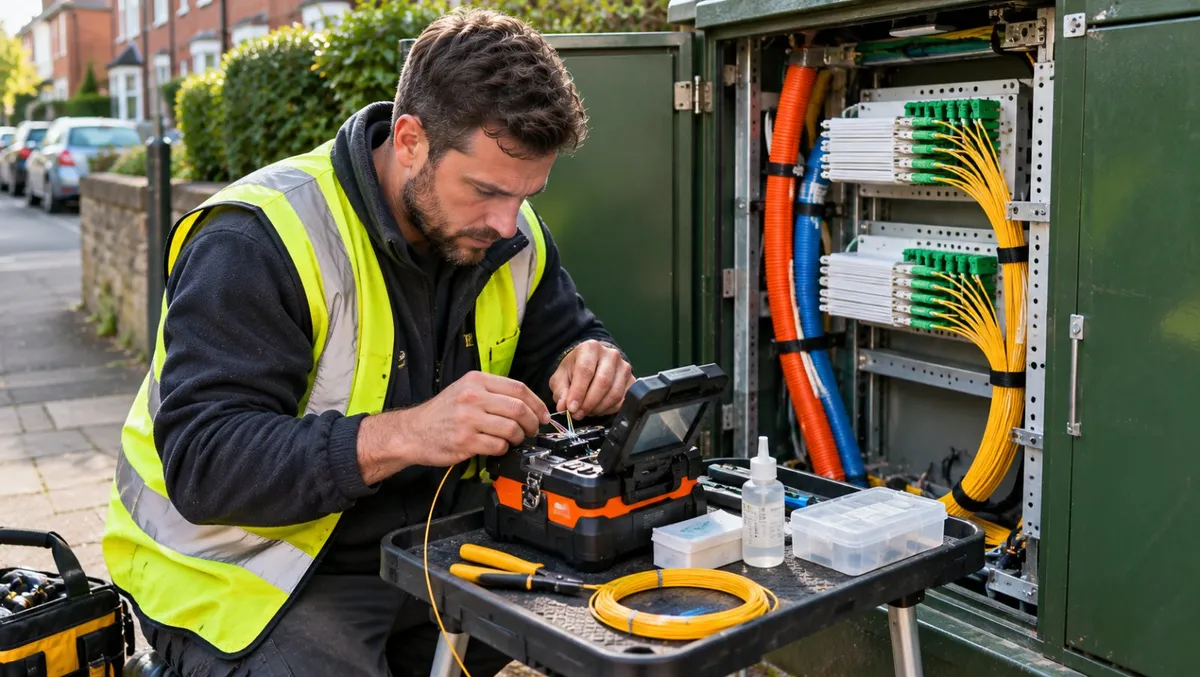
Fibre engineer splicing optical fibres at an open street cabinet, illustrating fibre splicing subcontractor insurance

Fibre Splicing & Jointing Subcontractor Insurance UK

November 04, 2026

Published: 4 November 2026 | Reading time: 7 minutes | Category: Contractors | Author: John Miller, Miller & Partner

Last reviewed by John Miller, Director & Principal Broker — 4 November 2026
FS Register FRN 1029698 13+ years specialist commercial broking Lloyd's & specialist MGA market access Independent UK broker

Fibre splicing and jointing subcontractors usually need public liability, tools and equipment cover for splicing and test kit, and employers' liability if anyone works under their direction. The right mix depends on how you are engaged. A sole trader working labour-only for a main contractor may sit under that contractor's employers' liability, while a bona fide subcontractor running their own jobs needs a full set of covers in their own name. Splicing work also raises specific questions: damage to the live network or a customer's premises, entry into chambers and cabinets, and the reliability of test results you sign off. If you certify links or issue test reports, professional indemnity may be worth adding. Main contractors and network operators commonly set minimum liability limits in their subcontract terms, so check the onboarding pack before arranging cover, and make sure your declared activities, wageroll and kit values reflect how you actually work day to day.

Need fibre splicing subcontractor insurance?

Liability and splicing kit cover. Get a quote online or speak to a specialist broker directly.

Key facts at a glance

  1. Status changes cover. Labour-only and bona fide subcontractors are insured differently.
  2. Declare kit properly. Splicers and OTDRs at full replacement value, with serial numbers.
  3. Network damage is a wording question. Property being worked on may be limited or excluded.
  4. Chambers can be confined spaces. Expect questions on training and gas monitoring.
  5. Test results carry risk. Certification may call for professional indemnity.

What insurance does a fibre splicing subcontractor need?

Most splicing subcontractors need public liability and tools and equipment cover as a minimum. Employers' liability is needed if you employ or direct anyone, including labour-only operatives. Professional indemnity is worth considering if you certify test results. Vehicles are insured separately under motor policies.
CoverWhy a splicer needs it
Public liabilityThird-party injury and damage, such as to a customer's premises.
Employers' liabilityRequired for most employers, including labour-only operatives.
Tools and equipmentSplicers, cleavers, OTDRs and power meters, on site and in transit.
Contract worksJoints and enclosures installed but not yet handed over.
Professional indemnityFinancial loss from errors in test results or certification.

Our main guide to fibre and telecoms contractor insurance shows how these fit together.

Are you labour-only or a bona fide subcontractor?

A labour-only subcontractor works under the main contractor's direction, using their materials, and is usually treated as an employee for employers' liability. A bona fide subcontractor controls how the work is done, supplies their own kit and materials, and carries their own insurance. Both contract and site reality matter.

Insurers look at substance: who directs you, who supplies consumables, and whether you can send a substitute.

The employers' liability trap If you pay other self-employed jointers to work under your direction, insurers will generally treat them as your employees. Declare no wageroll and a claim from one of them could be disputed. Declare labour-only payments and hold certificates for bona fide subcontractors.

If you are labour-only for a larger contractor, confirm in writing whether their employers' liability covers you and whether you still need your own public liability.

How do you insure fusion splicers, OTDRs and splicing kit?

Use a tools and equipment section that lists high-value items individually at full replacement value, with serial numbers. Check the single article limit, cover while kit is in a vehicle overnight, and theft conditions. Standard tradesman tools limits are often too low for a modern splicer and test set.

Losing your splicer can stop work for days. Check that:

  • The single article limit covers your most expensive item.
  • Cover applies on site, in transit and in your vehicle.
  • Overnight vehicle conditions are realistic for how you work.
  • Accidental damage is included, as kit gets dropped in chambers.
  • Hired-in or loaned test equipment is covered.

The same principles appear in our guide to tools insurance for subcontractors.

What if you damage the network or a customer's property?

Public liability covers damage to third-party property, but many wordings limit or exclude damage to the specific property you are working on, and pure financial losses such as service outages. If you work in live joints or customer premises, check how your wording treats both, and whether the contract asks for more.

For example, re-entering a live joint could break fibres serving other customers. The repair may be covered; the operator's wider losses may not. Check the subcontract's indemnity clause too.

Does working in chambers and cabinets affect your cover?

It can. Entry into chambers and manholes may be classed as confined space work under the Confined Spaces Regulations 1997, depending on the risk assessment. Insurers will ask whether you enter chambers, what training you hold, how you monitor gas and what rescue arrangements are in place. Declare it accurately.

Carriageway work may need street works accreditation and Chapter 8 traffic management; see street works and civils insurance for fibre rollout. If you joint aerial fibre on poles, see our telegraph pole and overhead line worker guide.

Do you need professional indemnity for testing and certification?

You may. If you produce OTDR traces, loss budgets or test certificates that a client relies on to accept a network, an error could cause a financial loss without any physical damage. Public liability does not cover that. Professional indemnity is designed for claims arising from your advice, reports and certification.

Declare testing and certification as activities. See professional indemnity insurance.

What do main contractors ask splicing subcontractors for?

Expect requests for insurance certificates at or above the contractual minimum limits, confirmation of your subcontractor status, training records, risk assessments and method statements, and sometimes confined space and street works evidence. Getting this together before you bid saves delays when a new contract starts.
  1. Read the insurance clause. Send the covers, limits and indemnity wording to your broker.
  2. Confirm your status in writing. Labour-only or bona fide, and who provides employers' liability.
  3. Gather your records. Training, risk assessments and method statements.
  4. Request matching certificates. Ask your broker for certificates that fit the contract.

Frequently asked questions

Often yes. Even where the main contractor's employers' liability covers you, many still require your own public liability. Check the subcontract and confirm in writing.

They can be, if your tools policy includes theft from vehicles and you meet its security conditions. Some exclude overnight theft unless kit is removed.

It depends on the wording. Many policies limit damage to property being worked on and exclude pure financial losses such as outages.

If you work alone, you may not, though some contractors still ask for it. If you pay other jointers to work under your direction, you are likely to need it.

It can be, depending on the risk assessment, under the Confined Spaces Regulations 1997. Declare chamber work and keep training and gas monitoring records.

No. Vans and other road vehicles are insured separately under motor policies.

Related guides from Miller & Partner

Splicing or jointing on fibre networks? Tell us how you are engaged and what kit you carry.

John Miller, Director and Principal Broker at Miller & Partner, specialist broker for fibre splicing and jointing subcontractors
Written and reviewed by John Miller Director & Principal Broker, Miller & Partner Over 13 years of specialist commercial insurance experience, formerly with Brown & Brown and AXA. Places hard-to-place commercial risks through Lloyd's syndicates and specialist MGAs, including fibre and telecoms contractors, splicing subcontractors and high-risk trades.
Our regulatory status Miller & Partner Limited (FRN 1029698) is an Appointed Representative of Gauntlet Risk Management Ltd (FRN 308081), which is authorised and regulated by the Financial Conduct Authority. Miller & Partner Limited is registered in England and Wales (company number 16206282) and trades from Vivian House, Roman Bridge Close, Mumbles, Swansea SA3 5BG. This article is general information, not a personal recommendation or an offer of cover. Cover is subject to insurer acceptance and the full terms, conditions and exclusions of the policy issued. Insurance status is not the same as tax status.
Back to Blog
About this article General information, not advice. Published for general guidance and drawing on external sources as well as our own experience. It is not a personal recommendation, a quotation, or an offer of cover, and it doesn't take account of your circumstances. Read more + Close −

Where the information comes from

Our articles are compiled from a range of sources: regulators and public bodies such as the FCA, the Civil Aviation Authority, the Health and Safety Executive and Companies House; government publications and legislation; industry and trade bodies; insurer and market documentation; and published research and news reporting. Not everything stated originates from Miller & Partner. Where information comes from a third party we believe it to be accurate at the date of publication, but we haven't independently verified every external source and we don't warrant its accuracy or completeness. Where a point matters to a decision you're making, go to the original source and check it.

Figures, examples and case studies

Premium ranges, cost figures, limits and worked examples are illustrative only. They are not quotations, not offers of cover, and no cover is provided or implied on the basis of them. What you're actually charged depends on underwriting, and what you're actually covered for depends on the policy wording issued to you. Where an article includes a claim example, scenario or case study, it is illustrative unless we say otherwise — such examples are typically composites written to show how a policy section responds, and they don't describe an identifiable client, claim or settlement.

Interactive tools

Any calculators, cover checkers, risk assessors or similar tools on our site produce general guidance from the small number of answers you give them. They can't see your business, and their output is not a personal recommendation, an assessment of your actual risk, or a quotation.

Rules and market conditions change

Law, regulation, tax treatment, insurer appetite and policy wordings all change, sometimes at short notice. Content is accurate to the best of our knowledge on the date shown on the article and we don't undertake to update it as things move. An article you're reading some time after publication may be out of date.

Third parties and external links

References to insurers, underwriters, trade bodies, software, training providers or other organisations are for information only. They don't imply endorsement, recommendation, partnership or affiliation in either direction unless stated. We're not responsible for the content of external websites we link to.

Not legal, tax or accounting advice

Nothing here is legal, tax, accounting or regulatory advice. Where an article discusses statutory duties, contract terms or compliance obligations, take advice from an appropriately qualified professional on your own position before acting.

How we write these

We use AI tools in researching and drafting our published content. Every article is reviewed and signed off by a named, accountable person at Miller & Partner before it is published, and responsibility for what appears here rests with us.

Our regulatory status

Miller & Partner Ltd is an Appointed Representative of Gauntlet Risk Management Ltd, which is authorised and regulated by the Financial Conduct Authority (FRN 308081). Miller & Partner Ltd is entered on the FCA Register under reference 1029698. Registered in England and Wales, company number 16206282. Registered office: Vivian House, Roman Bridge Close, Mumbles, Swansea, SA3 5BG.

Spotted something wrong?

We'd rather know. Email [email protected] or call 01792 001350 and we'll review and correct it.

For advice on your own insurance arrangements, speak to us directly — that's when we can take your circumstances into account and give you a recommendation.

Ready to protect your business?
Get expert advice and a tailored commercial insurance quote today.

✔ Independent broker
✔ Access to leading UK insurers
✔ Fast turnaround

[Request a quote]

[[email protected]]
[Call 01792 001350]

Exclusive Offer

Free Insurance Review
& Zero Broker Fee

Let us review your current insurance and see if we can improve your cover while reducing the cost.

✓
Free no-obligation insurance review tailored to your business
£
Zero broker fee on all new policies
⚡
Fast response from a real insurance specialist

You're in 🎉

Thanks for requesting your free review. We'll be in touch shortly.

🔒 No spam, ever. Your details are safe with us.

We're an Appointed Representative of Gauntlet Risk Management Ltd, which is authorised and regulated by the FCA. You can check our entry on the FCA Register.

MEET THE Director

Hey, I'm John!

I started Miller & Partner with the aim to bring back personable, approachable broking to UK businesses who were tired of large corporate brokers and feeling like they were just another number.

I have built this brokerage up with no pushy sales techniques or big business tactics, just honest, approachable and professional relationships with my clients.

Over 13 years experience in business insurance

Client first approach

5* rated broker on Google

Office: Vivian House, Roman Bridge Close, Mumbles, Swansea, SA3 5BG

Miller & Partner Ltd is an Appointed Representative of Gauntlet Risk Management Ltd, which is authorised and regulated by the Financial Conduct Authority (FRN 308081). Miller & Partner Ltd is entered on the Financial Services Register under firm reference number 1029698. You may check this on the Financial Services Register by visiting the FCA website at https://www.fca.org.uk/firms/financial-services-register or by contacting the FCA on 0800 111 6768. Miller & Partner Ltd is registered in England & Wales, company number 16206282. Registered office: 20 Vivian House, Roman Bridge Close, Swansea, SA3 5BG.