


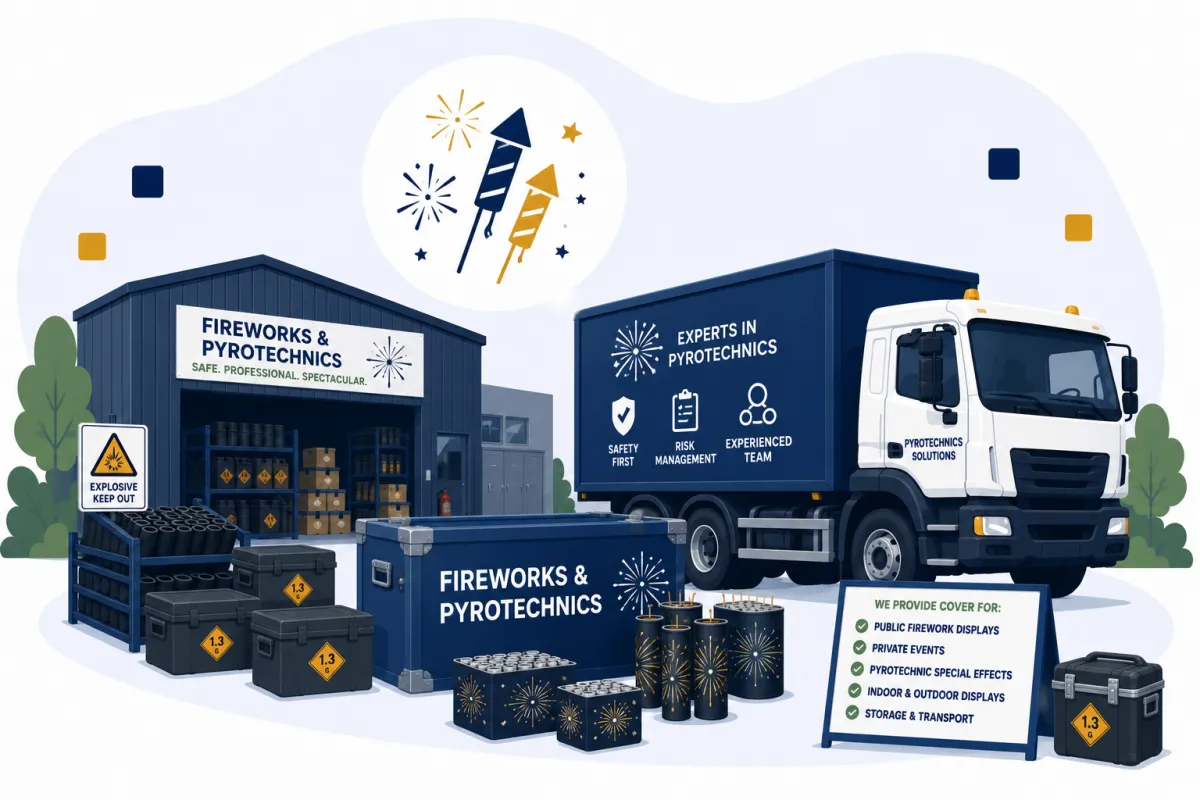
Fireworks & Pyrotechnics Insurance UK | Specialist Cover
Why do fireworks businesses need specialist insurance treatment?
Fireworks and pyrotechnics sit in one of the narrowest, most genuinely hard-to-place categories in the whole UK commercial insurance market. The combination of explosive material handling, large public crowds, catastrophic severity potential and a stack of overlapping regulation means the risk profile simply does not fit the standard contractor, entertainment or events policy — most of which specifically exclude fireworks and explosive operations altogether. A generalist broker running your details through a standard panel will usually get a decline, a referral, or a quote riddled with exclusions that leave the biggest exposures uninsured.
That is exactly the space Miller & Partner works in. Whether you are a professional display company firing category F4 aerial shells, a theatrical pyrotechnics supplier working indoor arena shows, a fireworks retailer holding stock under a storage licence, or an importer placing products on the GB market, the cover has to be built by hand and placed with insurers who actually understand the work — often at Lloyd's or through specialist MGA schemes rather than the high street. This guide sets out, in full, what that cover looks like in 2026, what the regulator requires, and how underwriters decide whether you are a risk they will write.
The Insurability Framework™
Placing an explosives risk that standard markets decline is exactly what the Insurability Framework was built for. Here is how each pillar applies to a fireworks and pyrotechnics business.
Underwriter Intelligence
We know which insurers and Lloyd's syndicates have appetite for F4 display, theatrical T2/P2 and firework stock — and precisely what they need to see: BPA-qualified operators, EIG guidance adherence, method statements, storage licence, and a clean firing record. We present your risk the way underwriters want to read it.
Difficult Risk Expertise
Fireworks are a decline on most standard schemes. We place explosive-handling businesses every day, including operators who have been refused elsewhere, run indoor proximate effects, import product, or have a prior incident on their record.
Risk Assessment
We identify the exposures generalists miss — the "morning after" dud-shell products gap, transit under carriage-of-dangerous-goods rules, storage separation distances, spectator drop-zone liability and cancellation for adverse weather — before they become an uninsured loss.
Claims Advocacy
When a shell misfires or an event is cancelled, you deal with a named broker who understands pyrotechnics and HSE investigation — not a call centre. We manage the claim, the insurer and the regulator interface so you can focus on the business.
Key facts at a glance
- Professional display operators using category F4 fireworks, T2 theatrical or P2 pyrotechnic articles must, by product safety law, hold public liability insurance covering their use — it is not optional.
- Councils and venues almost universally demand £5m public liability as a minimum, rising to £10m for local-authority land or high-attendance events.
- Storing more than 50kg of fireworks needs a storage licence from your local authority (up to 2,000kg) or the HSE (over 2,000kg) under the Explosives Regulations 2014.
- Standard events and contractor policies exclude fireworks and explosive operations — this is a specialist placement, usually at Lloyd's.
- The highest-risk moment is often the morning after: unexploded shells and delayed ignitions make products/completed-operations cover essential.
- Fireworks are classed as explosives (UN 0333–0337, mostly hazard division 1.3G/1.4G); transporting them triggers carriage-of-dangerous-goods (ADR) obligations.
- Employers' liability is compulsory under the 1969 Act — and rated as a high-hazard occupation because crews face burn, blast and hearing exposure.
Which covers does a fireworks or pyrotechnics business actually need?
No two fireworks businesses carry the same exposure — a display contractor, a retailer and an importer each need a different combination. The table below sets out the core building blocks and how essential each one is. Note that several of the biggest exposures (products liability and stock) are the ones standard policies quietly leave out.
| Cover | What it protects against | Priority |
|---|---|---|
| Public liability | Spectator injury, property damage and third-party loss from a display or misfire | LEGAL (F4/T2/P2) |
| Products / completed operations | Dud shells, delayed ignition and post-event injury — the "morning after" exposure | CRITICAL |
| Employers' liability | Burns, blast, hearing damage and injury to crew, loaders and firing team | LEGAL |
| Stock / inland marine | Fireworks in the magazine, in transit and staged on site — usually excluded by property policies | ESSENTIAL |
| Goods in transit (ADR) | Loss or damage to explosives during carriage under dangerous-goods rules | ESSENTIAL |
| Storage buildings & contents | Fire, theft and explosion at the licensed store or magazine | ESSENTIAL |
| Event cancellation / adverse weather | Non-appearance, postponement and abandonment costs | RECOMMENDED |
| Product recall | Costs of withdrawing defective imported product from the market | CONSIDER |
| Professional indemnity | Advice, choreography and display-design negligence claims | CONSIDER |
Why is public liability a legal requirement, not a nice-to-have?
For most trades, public liability is a commercial demand rather than a statutory one. Fireworks are different. Under UK product safety law, professional display operators using category F4 fireworks, T2 theatrical pyrotechnics or P2 pyrotechnic articles are required to have public liability insurance in place covering their use. In practice, the market has settled on £5m as the floor, with councils, venues and landowners routinely specifying £5m and stepping up to £10m for local-authority land, town-centre displays or high-attendance events. Trade bodies such as the British Pyrotechnists Association also make PL a condition of membership.
The catch for the uninitiated: many event and public-liability policies you might buy off the shelf carry a blanket fireworks exclusion. Holding a certificate is not the same as holding a certificate that actually responds to a firework claim. This is the single most common gap we correct when an operator comes to us from a generalist.
What is the "morning after" products liability trap?
A firework display does not stop being dangerous when the finale ends. Unexploded shells, smouldering debris and delayed ignitions can cause injury or fire hours — sometimes days — later, often when a cleanup crew or a member of the public wanders into the fallout zone. Claims arising from this are products/completed-operations claims, and they are not automatically included in a standard commercial general liability form written for a non-explosive trade. If your policy responds only to injuries occurring "during" the display, the morning-after dud is uninsured. We make sure completed-operations cover is written in explicitly, not assumed.
The most avoidable losses I see are operators who bought "public liability with fireworks noted" online and assumed that was the job done. It rarely is. When we read the wording back to them, the products/completed-operations trigger is missing, transit is excluded, and the stock in their magazine isn't covered at all. On an explosives risk, the wording is the product — and it has to be built, not bought.
How are firework stock and transit covered?
Standard property policies cover a building and its ordinary contents but almost always exclude the pyrotechnic materials themselves. Your stock — often the single most valuable and volatile asset in the business — needs specific stock or inland-marine cover that follows the goods from the magazine, through transit, to on-site staging and back. Because fireworks are explosives (UN numbers 0333–0337), moving them is a carriage-of-dangerous-goods activity: the vehicle, driver ADR training and packaging all sit inside the transit exposure, and the underwriter will want to see they are handled properly.
Tool 1 — Cover Checker: what does my type of firework business need?
Select your business type to see the cover set we typically build. This is a specialist placement — see our adverse & specialist risk hub for how hard-to-place cover works.
Tool 2 — Underwriting readiness check: which red flags make you hard to insure?
Tap each item you can genuinely evidence today. The green ticks are what makes an underwriter comfortable; the gaps are what triggers a decline or loading.
- BPA-qualified or demonstrably experienced operators fire every F4 display
- Written method statements & site-specific risk assessments for each display
- Displays fired in line with the EIG "Working Together on Firework Displays" guidance
- Valid storage licence for your magazine (LA up to 2,000kg / HSE above)
- DSEAR risk assessment recorded and reviewed
- Explosives transported under ADR with trained drivers and correct packaging
- Documented misfire / dud-shell recovery procedure
- Spectator drop-zone distances calculated for wind and shell size on the night
- No undisclosed prior incident, HSE enforcement or previous policy decline
- Products / completed-operations cover confirmed in your current wording
Tool 3 — Risk Assessor: how high is my display risk profile?
A quick indicative read on how underwriters are likely to view your operation. Not a quote — an orientation.
Which regulations govern fireworks and pyrotechnics in the UK in 2026?
Underwriters price a fireworks risk against the regulatory backdrop, so it pays to understand which rules bite where. The framework is a stack of overlapping statutes, and compliance with each is, in effect, a condition of insurability.
The Explosives Regulations 2014 (ER 2014)
The core regime for manufacturing and storing explosives, supported by the HSE's Approved Code of Practice L150. It governs licensing, separation distances and security. You generally need a storage licence once you hold more than the small licence-exempt quantities: your local authority licenses stores up to 2,000kg (net explosive quantity), and the HSE licenses anything above 2,000kg. You do not normally need a storage licence to keep fireworks at a display site for less than three days. The full text sits on legislation.gov.uk.
The Pyrotechnic Articles (Safety) Regulations 2015 (PASR 2015)
The product-safety regime. It sets the categories marked on individual products — F1 to F4 for fireworks, T1/T2 for theatrical pyrotechnics and P1/P2 for other pyrotechnic articles — and controls who may be supplied. Category F4 fireworks may only be used by professional display operators. Crucially for cover, PASR is the source of the rule that professional operators using F4, T2 or P2 articles must hold public liability insurance covering their use.
The Fireworks Regulations 2004 & the Fireworks Act 2003
These control the times of year fireworks may be supplied and the night-time hours they may be set off (generally an 11pm curfew, extended on Bonfire Night, New Year, Diwali and Chinese New Year). Retailers supplying outside the permitted periods need an additional all-year supply licence from the local authority.
DSEAR 2002, ADR carriage rules & the Employers' Liability Act 1969
The Dangerous Substances and Explosive Atmospheres Regulations 2002 require a recorded risk assessment for anywhere explosives are stored or handled. Transporting fireworks — classed as explosives, UN 0333–0337, mostly hazard division 1.3G or 1.4G — is a carriage-of-dangerous-goods activity under the ADR framework, driving vehicle, driver-training and packaging requirements. And under the Employers' Liability (Compulsory Insurance) Act 1969, employers' liability cover is compulsory — rated as high-hazard because crews face burn, blast and hearing exposure.
What drives the cost of fireworks and pyrotechnics insurance?
There is no meaningful "average premium" for this class — an occasional retailer and a national F4 display contractor are different worlds. What matters is understanding the levers underwriters pull, because most of them are within your control. The table below sets out the main rating factors and how to move each one in your favour.
| Rating factor | Why it matters | How to improve it |
|---|---|---|
| Firework category (F1–F3 vs F4) | F4 professional-use product carries far greater severity | Keep scope precise; don't over-declare activities you don't do |
| Indoor / proximate pyrotechnics | Close-to-audience and combustible-venue exposure is rated separately | Evidence venue risk assessments and effect-testing regime |
| Number of displays / turnover | Frequency of exposure scales the premium | Accurate declarations; avoid buying limits you never use |
| Maximum crowd size | Catastrophe potential rises with attendance | Document crowd-management & drop-zone planning |
| Operator qualifications | BPA-trained operators reduce misfire frequency | Hold and evidence current operator training records |
| Claims & incident history | Prior losses are the strongest predictor of future ones | Full, honest disclosure with root-cause & remediation notes |
| Storage quantity & licence tier | Larger magazines carry greater fire/explosion loss potential | Right-size stock; maintain the correct LA/HSE licence |
| Transit / ADR arrangements | Explosives in transit is a distinct, movable exposure | ADR-trained drivers, compliant packaging & routing |
| Import / manufacture activity | Placing product on the GB market adds products liability | Batch traceability, testing & recall procedures |
| Method statement & RA discipline | Documentation is the underwriter's proxy for competence | Site-specific, dated, retained method statements for every job |
| Products / completed-ops limit | The morning-after exposure needs its own adequate limit | Confirm the trigger is written in and the limit is realistic |
| PL limit required (£5m / £10m) | Higher limits mean more premium but are often mandatory | Match the limit to the toughest venue/council you serve |
| Prior declines / adverse history | A hard-to-place flag narrows the market | Use a specialist broker to present rather than shop blindly |
| Cancellation / weather cover | Optional but can dominate revenue-loss risk seasonally | Buy early; most insurers need a lead time before the event |
How do real firework claims play out?
The three claims below are fictionalised composites built from the patterns we see in this class. The figures are realistic and the lessons are the ones that separate an insurable operator from an uninsurable one.
The Bonfire Night mortar failure
At a town-centre display for around 4,000 spectators, a mortar tube split on firing and a shell functioned at low level, injuring three people in a viewing area that a late wind shift had brought within the fallout zone. Two suffered burns; one a serious eye injury. The organiser's landowner and the display company were both pursued.
The morning-after dud shell
The day after a village display, a grounds contractor clearing the field struck an unexploded shell with a strimmer. It functioned, causing a hand injury and hearing damage. The injury occurred nearly 18 hours after the display had "ended" — squarely a completed-operations claim.
The magazine fire
A fire of undetermined cause took hold in a display company's storage magazine out of season, destroying stock and spreading to an adjoining commercial unit. Fire-water run-off carried perchlorate residues into a nearby watercourse, adding an environmental clean-up dimension.
How should I handle a firework display claim?
What you do in the first hours after an incident shapes both the safety outcome and the insurance result. This is the eight-step process we walk our clients through.
- Make the scene safeSecure the firing and fallout area, stop all firing, and prevent access. Preserve life first — unexploded devices remain live.
- Call emergency services and record injuriesGet medical help to anyone hurt and log names, injuries and times. Ensure fire and ambulance attend where needed.
- Notify your broker and insurer immediatelyReport the incident straight away, even before full facts are known. Early notification protects both the claim and the policy.
- Preserve the devices and packagingOnce safe, retain misfired shells, tubes, firing equipment and product packaging with batch numbers for investigation.
- Gather your documentationCollect the site-specific risk assessment, method statement, storage licence, crew qualifications and firing log.
- Cooperate with the HSE or investigating authorityEngage constructively with any HSE or fire-authority investigation, guided by your broker and legal advisers.
- Do not admit liabilityAvoid statements accepting fault to third parties, media or on social media. Facts first — liability is for insurers to determine.
- Work through the claim and remediationLet your broker manage the insurer relationship, agree remediation, and prepare the renewal presentation to protect future terms.

John Miller
John has 13+ years placing adverse and hard-to-place commercial risks, with direct access to the Lloyd's market and specialist MGA schemes. He works regularly with explosives-handling businesses — professional display operators, theatrical pyrotechnics suppliers, retailers and importers — building fireworks-inclusive wordings that respond where standard event and contractor policies exclude. If you have been declined elsewhere, that is exactly the conversation he wants to have. More about John.
Fireworks insurance glossary
- Category F1–F4
- Product-safety categories under PASR 2015 marking increasing hazard; F4 may only be used by professional display operators.
- Hazard Type HT1–HT4
- Storage-licensing classification of explosives; HT1 is most dangerous, most consumer fireworks are HT4.
- Category T1/T2
- Theatrical pyrotechnic articles; T2 is for professional stage/arena use and triggers the compulsory-PL rule.
- Category P1/P2
- Other pyrotechnic articles; P2 requires specialist knowledge and, in professional use, compulsory PL.
- ER 2014
- Explosives Regulations 2014 — the core licensing, storage and security regime, supported by ACOP L150.
- PASR 2015
- Pyrotechnic Articles (Safety) Regulations 2015 — the product-safety regime and source of the compulsory-PL requirement.
- DSEAR 2002
- Dangerous Substances and Explosive Atmospheres Regulations — requires a recorded risk assessment wherever explosives are handled.
- ADR
- The European agreement governing carriage of dangerous goods by road, which applies when transporting fireworks.
- NEQ
- Net Explosive Quantity — the mass of explosive content used to determine storage licensing and separation distances.
- Separation distance
- The minimum distance between an explosives store and occupied buildings, set by quantity and hazard type.
- Magazine
- A licensed store used to keep explosives securely between uses.
- EIG
- The Explosives Industry Group of the CBI, whose "Working Together on Firework Displays" guidance is the recognised display standard.
- BPA
- The British Pyrotechnists Association, which provides operator training and requires PL as a membership condition.
- Products / completed operations
- Liability cover for injury or damage caused after a display ends — the "morning after" dud-shell exposure.
- Proximate pyrotechnics
- Close-proximity or indoor effects where audience and combustible surroundings change the risk profile.
- Storage licence
- A licence to store explosives — from the local authority up to 2,000kg NEQ, or the HSE above that.
- Explosives certificate
- A police-issued certificate required to acquire or keep certain "relevant" explosives.







Instagram
LinkedIn