


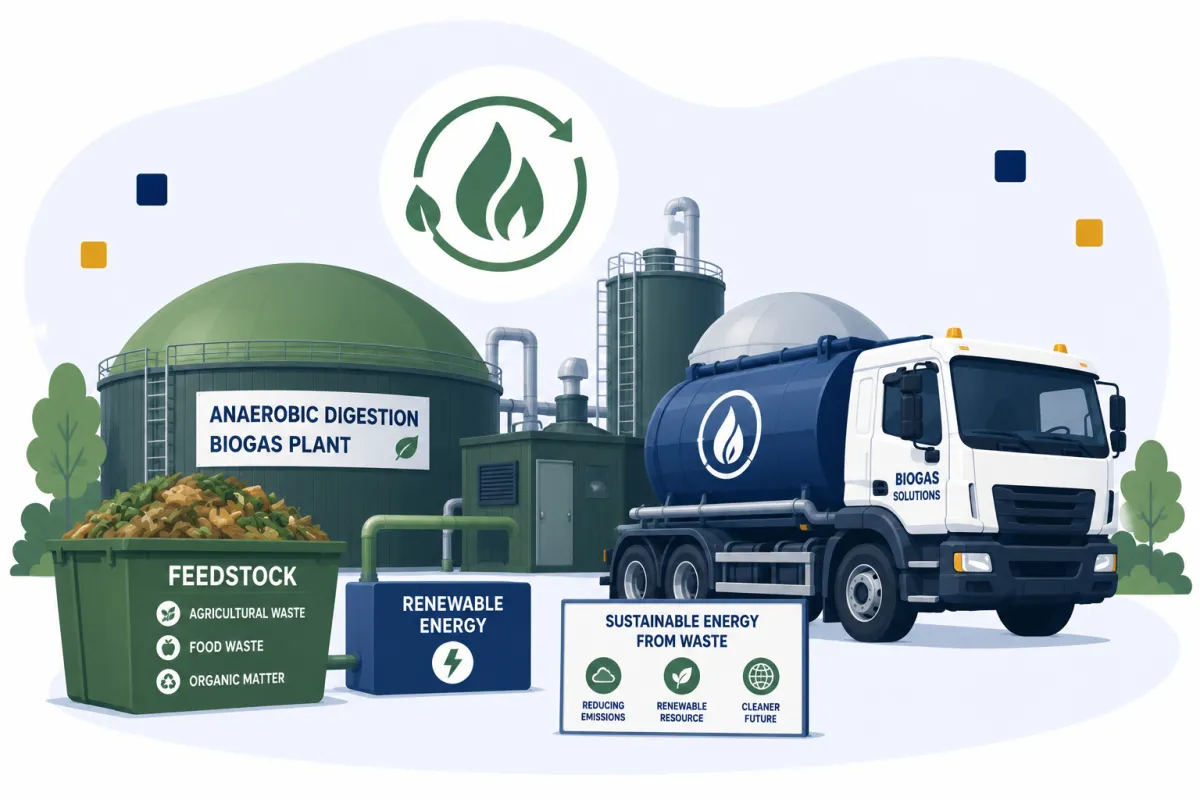
Anaerobic Digestion & Biogas Plant Insurance UK | Specialist
Why does anaerobic digestion need specialist insurance treatment?
An anaerobic digestion plant is two hard-to-place risks welded together. It is a waste operation — taking in slurry, food waste or energy crops — and simultaneously a renewable energy generator, producing flammable biogas that is burned in a combined heat and power (CHP) unit or upgraded for the gas grid. That combination of a live explosive atmosphere, high-value engineered plant, a pollution exposure from feedstock and digestate, and a demanding process-safety regime is exactly why most standard insurers will not write AD. It is a specialist placement — the lane Miller & Partner's waste and recycling insurance team works in every week.
This guide covers anaerobic digestion and biogas plant insurance from a broker's chair: the covers that matter, why DSEAR and explosion safety sit at the heart of insurability, how CHP fire and digestate pollution drive pricing, and what to do when an incident occurs. It is a sibling to our guides on waste transfer station insurance and tyre recycling insurance, and it overlaps the renewable-energy world of battery storage facilities — but where AD is distinct is the process-safety regime around explosive biogas, and the dual waste-and-energy identity that shapes every placement.
How does The Insurability Framework apply to a biogas plant?
Placing an AD plant is exactly what The Insurability Framework™ was built for. A biogas site is rarely refused because it is careless — it is refused because the underwriter cannot see how the explosion risk is engineered out and how the process is controlled. The framework is the structured method we use to turn a technically complex, hard-to-place biogas risk into one an insurer will confidently write.
Underwriter Intelligence
We know the markets that still write AD and biogas, exactly what they scrutinise (DSEAR/ATEX compliance, CHP fire and gas-holder integrity), and the evidence that moves them: a current DSEAR assessment, hazardous area classification and a clean HSE inspection record.
Difficult Risk Expertise
Biogas is a sector generalists decline on sight. We specialise in placing plants others refuse — farm-based digesters, merchant food-waste sites and biomethane-to-grid operations, including those with a prior incident or an enforcement history.
Risk Assessment
We surface the exposures that quietly wreck insurability: missing or outdated DSEAR zoning, non-ATEX equipment in classified areas, gas-holder membrane wear, H2S build-up and digestate storage that risks pollution. Finding these before the insurer does keeps cover in force.
Claims Advocacy
When an explosion, CHP fire or pollution incident hits, you get a broker who fights the claim with you — managing loss adjusters, the HSE and the Environment Agency across a joint investigation, not a call centre.
Key facts at a glance
- The UK has around 740 operational anaerobic digestion facilities (ADBA, 2024), ranging from small farm-based plants to large merchant sites processing 50,000–200,000 tonnes of feedstock a year.
- Biogas is flammable and potentially explosive; AD sites are regulated for explosion safety under the Dangerous Substances and Explosive Atmospheres Regulations 2002 (DSEAR), applying the ATEX regime, with larger sites also under COMAH.
- Every AD site must complete a DSEAR risk assessment and Hazardous Area Classification, zoning explosive atmospheres and using ATEX-rated equipment within them.
- The core AD hazards are fire, explosion, asphyxiation or toxic gas release (including hydrogen sulphide), and pollution from biogas or digestate.
- An HSE inspection programme found that around half of the industrial and food-waste AD plants inspected required some form of HSE intervention, from advice to enforcement.
- Real precedent: in 2024 an AD operator was fined £304,500 plus costs after an explosion seriously injured two workers, breaching health-and-safety and environmental-permit law.
- Because an AD plant is both a waste operation and an energy generator, most standard insurers decline it; cover is placed through specialist waste, energy and Lloyd's markets.
Which covers does a biogas plant actually need?
An AD plant bundles process-industry, waste and energy exposures, and no single off-the-shelf policy fits it. The table below sets out the core covers we build into a typical biogas programme, why each matters for this trade specifically, and how essential it is. Use it as a checklist against your own schedule.
| Cover | Why it matters for a biogas plant | Priority |
|---|---|---|
| Property & plant (fire/explosion) | Digesters, gas holder, CHP unit, pipework and buildings against fire and explosion — the defining exposure. | Essential |
| Employers' Liability | Legally required if you employ anyone; explosive atmospheres and confined spaces make EL heavily underwritten. See our business liability guide. | Legal |
| Public Liability | Feedstock deliveries, visiting hauliers and neighbours exposed to gas, odour and off-site incident risk. | Essential |
| Machinery breakdown (CHP) | The CHP engine is the revenue heart of the plant; breakdown halts generation and income. | Essential |
| Business interruption | Loss of generation revenue and continuing costs after an incident, often over a long reinstatement period. | Essential |
| Environmental / pollution (EIL) | Digestate spills, feedstock run-off and gas release can pollute land, air and watercourses. | Essential |
| Loss of revenue / subsidy | Tariff and export income (e.g. grid revenue) can be protected where generation is interrupted. | Recommended |
| Directors' & Officers | Personal exposure for DSEAR, permit and safety failings falls on named individuals. | Consider |
Why is DSEAR the centre of biogas insurability?
Biogas is roughly 60% methane — flammable, and explosive when mixed with air within a certain range. That single fact drives the whole regulatory and insurance picture. Under the Dangerous Substances and Explosive Atmospheres Regulations 2002 (DSEAR), every AD operator must assess where explosive atmospheres can occur, carry out a Hazardous Area Classification to zone those areas, and ensure only appropriately ATEX-rated equipment is used within them. Larger sites also fall under COMAH. This is not optional: operating without a compliant DSEAR assessment is a breach of law in itself.
For insurers, DSEAR compliance is the single clearest signal of how well a plant is run. A current, credible DSEAR risk assessment with proper zoning tells an underwriter the explosion risk is understood and engineered against; a missing or stale one tells them the opposite. The HSE has run targeted inspection programmes of AD sites precisely because compliance has been patchy — and a clean inspection record is one of the strongest assets you can bring to a placement. A poor one pushes you towards the refused-cover market.
What cover does my type of AD operation need?
Pick the operation that best matches your plant to see the cover priorities we would typically build in. This is a starting point for a conversation, not a quote — every site is rated on its own process safety and permitting. For any of these, the route runs through our waste and recycling team.
Which compliance red flags make you uninsurable?
Tick each control you already have in place. The more you can honestly tick, the more markets will look at your plant — and the better the terms. Unticked items are the ones underwriters ask about first.
How hard-to-place is my biogas risk?
Choose your two biggest factors for an indicative placement tier. This is guidance only — a proper assessment always looks at the whole plant.
Why do explosion and gas hazards dominate underwriting?
Every serious biogas incident tends to trace back to the same root: an uncontrolled explosive atmosphere meeting an ignition source. Methane is explosive across a defined concentration range, so a leaking gas holder, a poorly ventilated tank, or maintenance work that disturbs the gas envelope can create the conditions for a blast. The consequences are severe — an AD explosion can throw a tank into the air, cause life-changing injuries and, in the worst cases, fatalities. Records show a cluster of UK explosions during commissioning specifically, when systems are first filled and tested.
Underwriters therefore focus almost entirely on how the explosion risk is engineered out and managed. The controls that move a biogas risk from "declined" to "quotable" are: a current DSEAR assessment with proper zoning; ATEX-rated equipment in classified areas; gas detection at both high and low level; over-pressure protection and gas-holder integrity checks; and rigorous permit-to-work and confined-space procedures for maintenance. Hydrogen sulphide adds a toxic-gas and corrosion dimension on top of the explosion risk. A plant that can evidence this control set is a fundamentally different proposition from one that cannot — and if you have already had an incident, the disclosure and rebuild dynamics mirror our business insurance after a fire claim guidance.
How are CHP, gas holders and plant breakdown covered?
The combined heat and power engine is the commercial heart of most AD plants — it converts biogas into electricity and heat, and it is where much of the revenue comes from. It is also hard-worked, high-value and a common ignition source, so engine-room fire and mechanical breakdown are two of the most frequent AD claims. Machinery breakdown cover is close to essential: a CHP failure not only costs to repair but stops generation, which is where business interruption and loss-of-revenue cover become critical.
The gas holder — often a flexible membrane over a digester — is another focal point. Membrane failure has caused explosions and large gas releases, so insurers look for an inspection and maintenance regime and over-pressure protection. Because CHP downtime and plant reinstatement can run for many months, the business interruption indemnity period should reflect real lead times on specialist components. The parallels with high-value energy plant are close, which is why we cross-reference the battery storage facility and farm energy-storage markets when placing AD.
What pollution and digestate risks apply?
AD is a pollution risk from end to end. Feedstock reception and storage can produce leachate and odour; the process itself can release biogas if containment fails; and digestate — the nutrient-rich residue — must be stored and spread under strict controls or it can contaminate soil and watercourses. A digestate lagoon breach or an over-application to land is a classic Environment Agency enforcement scenario, and several AD prosecutions have combined a safety failing with an environmental-permit breach.
This is why we build in Environmental Impairment Liability (EIL) for essentially every AD plant. It responds to gradual and sudden pollution and the associated clean-up costs that standard public liability wording excludes. It sits alongside your environmental permit and your digestate management plan — the documents an insurer and the regulator will both examine when a pollution claim lands.
How does AD's dual identity as a waste and energy site affect cover?
This is the wrinkle that catches operators out. An AD plant is a waste site in the eyes of the Environment Agency and a power generator in the eyes of the energy market — and insurers approach those two worlds differently. Place it purely as a waste risk and you may miss the machinery breakdown, loss-of-generation-revenue and delay-in-start-up covers that an energy insurer would treat as standard. Place it purely as an energy risk and you may miss the pollution and waste-permit exposures.
Getting the balance right is precisely where specialist broking earns its keep. We structure AD placements to answer both identities — the waste and pollution exposures on one side, the generation, revenue and process-plant exposures on the other — drawing on both the waste and the sustainability and renewable-energy markets. It is the same dual-lens thinking behind the whole adverse-risk approach.
What drives the cost of anaerobic digestion insurance?
There is no meaningful "average premium" for an AD plant — the range is wide because the risks are. What matters is which factors below apply to you, and crucially, what you can evidence to mitigate each one. The mitigation column is where a good broker earns their keep: every documented control is a lever on the price.
| Rating factor | Why it pushes premium up | How to mitigate it |
|---|---|---|
| DSEAR / ATEX status | Missing or stale explosion-risk assessment is the biggest single red flag. | Current DSEAR assessment, HAC zoning and ATEX-rated equipment. |
| Plant scale & values | Larger digesters, gas holders and CHP mean higher values and severity. | Accurate reinstatement valuations; phased risk improvement. |
| CHP condition & maintenance | A hard-worked engine is a fire and breakdown exposure. | Manufacturer servicing schedule and condition monitoring. |
| Gas holder integrity | Membrane failure can cause explosion and large gas release. | Inspection regime and over-pressure protection. |
| Gas detection & ventilation | Poor detection of a gas that can pool low is a serious hazard. | High- and low-level methane and H2S detection; adequate ventilation. |
| Feedstock type | Mixed food waste and contaminants raise fire, H2S and pollution risk. | Feedstock screening and consistent, declared inputs. |
| Digestate management | Storage and spreading is a leading pollution exposure. | Compliant storage, spreading plan and containment. |
| Commissioning phase | A high share of AD explosions occur during commissioning. | Staged commissioning with erection-all-risks and delay-in-start-up cover. |
| HSE / enforcement history | Improvement or enforcement notices signal poor control. | Resolve notices and evidence corrective action. |
| Claims & incident history | A prior explosion or fire is a major hardener. | Independent risk report showing what changed since the loss. |
| Business interruption period | Specialist component lead times make reinstatement long. | Set a 24–36 month indemnity period reflecting real lead times. |
| Location & receptors | Nearby homes, water or SSSI raise pollution and off-site exposure. | Containment, buffer distances and an emergency plan. |
What do real biogas plant claims look like?
The following three cases are composite, anonymised examples drawn from the types of AD and biogas claims we see. Figures are realistic and illustrate how a loss develops — and how cover, or the lack of it, decides the outcome.
Case 1 — Digester explosion during maintenance (£3.2m)
A mid-size food-waste plant carried out maintenance on a digester without fully isolating the gas system or updating its DSEAR assessment for the changed conditions. An ignition source met an explosive atmosphere; the resulting blast destroyed the tank, seriously injured two workers and damaged the adjacent CHP building. Property and plant loss came to about £1.9 million, business interruption over a 16-month reinstatement added £1.0 million, and injury settlements a further £300,000 — roughly £3.2 million in total. Because the site could show a broadly compliant DSEAR framework and that the failing was a specific procedural lapse rather than systemic neglect, the property and BI claim was paid, though the HSE pursued a separate prosecution. Renewal premium rose around 65%, conditional on a full DSEAR re-assessment.
Case 2 — CHP engine fire and lost generation (£820,000)
A hard-worked CHP engine developed a fault that ignited an oil leak, causing an engine-room fire. The unit was destroyed and, with a long replacement lead time on the specialist engine, the plant lost generation revenue for nine months. Plant damage came to about £420,000 and business interruption a further £400,000, for around £820,000 total. Machinery breakdown and BI cover responded, but the operator had set the indemnity period at 12 months — only just long enough. The insurer required enhanced engine-room fire suppression and condition monitoring as a renewal condition; premium rose about 35%.
Case 3 — Digestate lagoon breach and pollution (£190,000)
Heavy rain and an under-maintained bund led to a digestate lagoon overtopping, releasing nutrient-rich liquid into a nearby watercourse and causing a fish kill. The Environment Agency pursued the operator for the pollution and a permit breach. Clean-up, remediation and legal costs came to about £190,000, alongside a permit review that threatened continued operation. Environmental Impairment Liability cover responded to the clean-up; the permit penalty fell on the business. We re-placed the plant afterwards as an adverse claims-history risk, with upgraded containment that reassured the incoming market.
How should you handle an incident at a biogas plant?
When an explosion, fire or pollution incident hits an AD plant, the first hours shape the whole claim — and often trigger a joint HSE and Environment Agency investigation. This is the sequence we walk clients through.
- Make people safe first. Evacuate, account for staff and visitors, and call the emergency services. Treat any gas release as potentially explosive and toxic — keep people clear and upwind.
- Isolate and contain where safe. Shut down and isolate the gas system and CHP if it is safe to do so, and deploy containment to stop digestate or firewater reaching watercourses.
- Notify your broker and insurer immediately. Early notification lets a loss adjuster and specialist investigators attend while evidence is fresh.
- Report to the regulators. Notify the HSE under RIDDOR for a reportable injury or dangerous occurrence, and the Environment Agency for any pollution. Prompt, documented reporting protects your position.
- Preserve the scene and evidence. Do not disturb the plant until investigators have released it; photograph everything and keep control-system and monitoring data.
- Pull your compliance records. Gather the DSEAR assessment, hazardous area classification, permits, maintenance and permit-to-work records, and training logs — these support both liability and property elements.
- Manage business continuity. Assess generation downtime, arrange temporary measures where possible, and start the business interruption claim promptly to protect revenue.
- Let your broker lead the negotiation. A specialist broker coordinates the adjuster, challenges reservations and manages the interaction between the property claim and any regulatory investigation — our Claims Advocacy pillar in practice, not a call centre.

John Miller — Director & Principal Broker
John has 13+ years placing adverse and hard-to-place commercial insurance, with direct access to the Lloyd's market and specialist waste and energy schemes. He works hands-on with biogas operators standard insurers decline — farm-based digesters, merchant food-waste plants and biomethane-to-grid sites, including those with an incident or enforcement history — building placements that answer both the waste and energy sides of the risk. Miller & Partner Limited is an Appointed Representative of Gauntlet Risk Management Ltd, which is authorised and regulated by the Financial Conduct Authority.
Anaerobic digestion insurance glossary
- Anaerobic digestion (AD)
- A process in which micro-organisms break down organic material without oxygen, producing biogas and digestate.
- Biogas
- The flammable gas (largely methane and carbon dioxide) produced by anaerobic digestion; explosive when mixed with air in a certain range.
- Digestate
- The nutrient-rich residue left after digestion, used as fertiliser but a significant pollution risk if stored or spread poorly.
- CHP (combined heat and power)
- An engine that burns biogas to generate electricity and heat — the revenue heart of most AD plants and a common ignition source.
- Biomethane-to-grid
- Upgrading biogas to near-pure methane for injection into the gas network, adding gas-processing and grid-revenue exposures.
- DSEAR
- The Dangerous Substances and Explosive Atmospheres Regulations 2002, the UK regime governing explosion safety at biogas sites.
- ATEX
- The equipment and protective-system standards for use in potentially explosive atmospheres, applied in the UK via DSEAR.
- Hazardous Area Classification (HAC)
- The process of identifying and zoning areas where explosive atmospheres may occur, to select appropriate equipment.
- COMAH
- The Control of Major Accident Hazards Regulations, applying to larger sites holding significant quantities of dangerous substances.
- Hydrogen sulphide (H2S)
- A toxic and corrosive gas produced in digestion; a poisoning, corrosion and detection concern.
- Gas holder
- The vessel or membrane storing biogas before use; membrane failure is a known explosion and release cause.
- Environmental Impairment Liability (EIL)
- Cover for gradual and sudden pollution and clean-up costs excluded by standard public liability wording; near-essential for AD.
- Machinery breakdown
- Cover for sudden and unforeseen damage to plant such as the CHP engine, and the resulting loss of generation.
- Business interruption (BI)
- Cover for lost income and continuing costs while a plant cannot operate; needs a long indemnity period for AD reinstatement.
- Indemnity period
- The maximum time BI cover pays out following a loss — 24–36 months is prudent for an AD plant given component lead times.
- Adverse risk
- A business standard insurers decline — through hazard, sector, incident history or complexity — requiring specialist placement.
Anaerobic digestion insurance: frequently asked questions
Employers' Liability is legally required if you employ anyone, and Public Liability is usually demanded by contracts and grid or offtake agreements. Holding the correct environmental permit and a compliant DSEAR assessment are separate legal requirements to operate. Property, machinery breakdown, business interruption and pollution covers are not compulsory but are close to essential for a working plant.
Because an AD plant combines an explosive atmosphere, high-value engineered plant, a demanding process-safety regime and a pollution exposure — and it is simultaneously a waste site and an energy generator. That mix is beyond most standard insurers, so cover is placed through specialist waste, energy and Lloyd's markets.
DSEAR is the Dangerous Substances and Explosive Atmospheres Regulations 2002 — the regime requiring you to assess, zone and control explosive atmospheres and use ATEX-rated equipment. For insurers, a current, credible DSEAR assessment is the clearest signal that the explosion risk is understood and managed. A missing or stale one is the single biggest red flag.
The scale is smaller, but the core hazards — explosive biogas, CHP fire, pollution — are the same, and DSEAR applies regardless of size. HSE has specifically targeted farm-based digesters for inspection. So a farm plant still needs property, liability, DSEAR compliance, pollution and business interruption cover, sized to the site.
A current DSEAR assessment and hazardous area classification, ATEX-rated equipment in zones, high- and low-level gas detection, gas-holder integrity checks and over-pressure protection, permit-to-work and confined-space procedures, and a clean HSE inspection record. A plant that evidences these is far easier to place.
It needs specific cover. A high proportion of AD explosions occur during commissioning, when systems are first filled and tested, so a plant being built or commissioned needs erection-all-risks and often delay-in-start-up cover — distinct from an operational policy. This is specialist territory and should be arranged before commissioning begins.
Through machinery breakdown cover for sudden and unforeseen damage, alongside property cover for fire. Because the CHP is the revenue engine, business interruption and loss-of-generation cover are just as important — a CHP loss can stop income for months given specialist replacement lead times.
For essentially every AD plant, yes. Feedstock, biogas release and especially digestate storage and spreading carry a real pollution exposure, and standard public liability pollution wording is narrow. EIL responds to gradual and sudden pollution and clean-up costs, and it is close to essential in this sector.
There is no meaningful average — the range is wide because the risks are. Cost is driven by DSEAR status, plant scale and values, CHP condition, gas-holder integrity, feedstock, digestate management and incident history. The most effective way to control premium is to document every mitigating control before the risk goes to market.
Both, which is exactly why it needs specialist handling. Placed purely as waste, you can miss machinery breakdown and loss-of-generation cover; placed purely as energy, you can miss pollution and waste-permit exposures. We structure AD placements to answer both identities, drawing on waste and renewable-energy markets.
A prior incident is a major hardener, but it does not make you uninsurable. Insurers want evidence of what changed since — a re-done DSEAR assessment, corrective actions, and independent risk verification. As a specialist adverse-risk broker we present that story to the markets that still write post-incident AD risks.
Because AD is a technically complex, hard-to-place risk that most generalists decline. Miller & Partner approaches every placement through the Insurability Framework — underwriter intelligence, difficult-risk expertise, risk assessment and claims advocacy — and places biogas plants through specialist waste and recycling and adverse-risk markets, including plants refused elsewhere.






Instagram
LinkedIn