


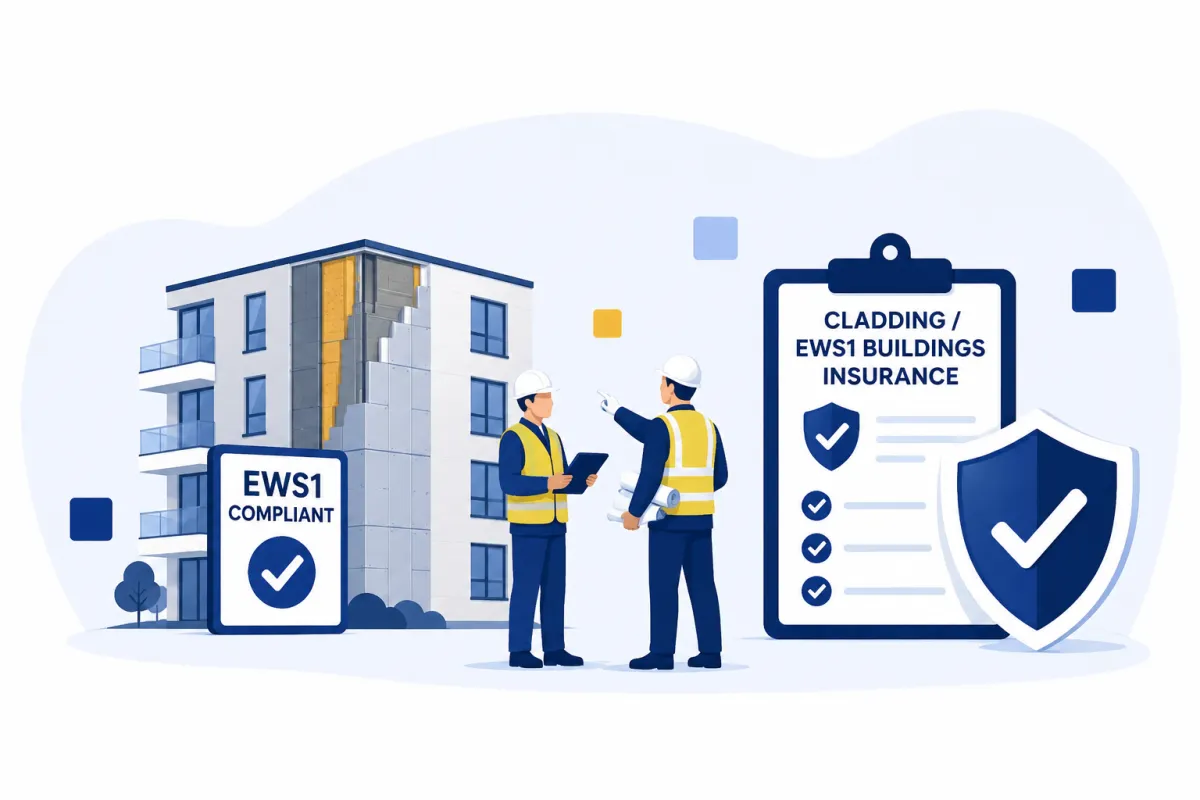
Cladding & EWS1 Buildings Insurance: Blocks Refused Cover
Why do blocks with cladding or fire-safety defects need specialist insurance?
Almost a decade after Grenfell, the buildings insurance market for residential blocks with combustible cladding or unresolved fire-safety defects is still one of the hardest placements in UK commercial insurance. If you are a freeholder, a Resident Management Company (RMC) director, a Right to Manage (RTM) company, a managing agent or a property investor responsible for a multi-occupancy block, you have probably already felt it: insurers declining at renewal, premiums multiplying, terms loaded with restrictions, and brokers who simply cannot find a market that will write the risk.
This is not ordinary property cover. A block with an EWS1 B2 rating or an outstanding External Wall System concern sits firmly in adverse-risk territory — the same territory as a business refused cover elsewhere or one carrying a difficult claims history. The standard markets that quote a clean block in seconds will not touch it. Placing it takes a broker who understands the fire-safety evidence underwriters want to see, knows which specialist and Lloyd's markets retain appetite, and can present the risk so that an underwriter says yes rather than reaching for the decline stamp.
At Miller & Partner we place exactly these risks. This guide explains how cladding affects your buildings insurance in 2026, what the Building Safety Act 2022 changed about who pays, why underinsurance is quietly the biggest danger on an affected block, and how to get an affordable, compliant placement when the mainstream market has closed its doors.
A block with combustible cladding is the textbook case the Insurability Framework was built for — a fundamentally sound asset that standard insurers decline on a single risk factor. Here is how each pillar applies to placing your block.
Key cladding insurance facts at a glance
- The FCA found average premiums for buildings with identified flammable cladding rose 187% between 2016 and 2021 — from a mean of £26,300 to £75,600 per block.
- Multi-occupancy building premiums overall rose 125% over the same period (£6,800 to £15,300 mean), as insurers cut capacity and left the market.
- The Building Safety Act 2022 protects qualifying leaseholders in "relevant buildings" — those at least 11 metres tall or 5 storeys, with at least two dwellings.
- An EWS1 B2 rating means combustible material is present and remediation is required — this is the rating that typically halts mortgage lending and triggers insurer decline.
- The Local Government Association estimates remediation at roughly £2 million per block, with some individual flats facing costs up to £100,000.
- EWS assessments themselves cost between £6,000 and £28,000, depending on building size and how much intrusive testing is needed.
- RICS published a second edition of its EWS1 valuation guidance in May 2026, effective 1 November 2026 — the framework is still actively evolving.
What is an EWS1 form and how does it affect your buildings insurance?
The External Wall System form — almost always called the EWS1 — was introduced by RICS in December 2019 to give lenders and buyers proof that a residential building's external walls had been assessed for fire safety by a suitably qualified professional. It is not, strictly, a legal requirement, but in practice it has become the single document that decides whether a block can be mortgaged, sold and insured at a sensible price.
The form has two pathways. Option A covers buildings where the external wall materials are unlikely to burn; Option B covers buildings where combustible materials are present. Within those sit the ratings that matter to your insurer:
- A1, A2, A3 — external wall materials are low-risk (A3 may need a costed plan for combustible balconies or attachments). Generally acceptable to mainstream lenders and insurers.
- B1 — combustible material is present, but the fire risk is low enough that no remedial work is required. Usually treated much like an A rating.
- B2 — combustible material is present and the fire risk is high enough that remediation is required. This is the rating that halts lending, collapses valuations and sends standard property insurers running.
For insurance, a B2 rating — or simply the absence of any EWS1 on a building that needs one — pushes your block out of the standard market. Underwriters read it as an open fire-safety exposure they cannot price with confidence, so they decline or quote a deliberately punitive premium. A balcony or insulation defect can independently trigger an assessment even on shorter blocks the wall system alone would not have caught. Version 3 of the form is fully electronic, creating an audit trail of how many times a building has been assessed and by whom — which underwriters now scrutinise.
The pattern I see most often is an RMC that receives a B2 EWS1, watches its renewal premium triple overnight, and is told by its existing broker that "the market just won't write it." That is rarely true. It is almost always a presentation problem, not an insurability problem. When we re-present the same block — with the FRAEW report, the interim fire measures and the funded remediation timeline packaged the way underwriters actually assess them — a market that declined on Monday will frequently quote by Friday. The building did not change. The submission did.
How does standard buildings insurance differ from cladding-affected cover?
The gap between a clean block and an affected one is not a matter of a slightly higher premium. It is a different market, a different evidence burden and a different policy structure. This is what separates the two:
| Feature | Standard block of flats | Cladding / EWS1 B2 affected block |
|---|---|---|
| Market appetite | Broad — most property insurers quote | Narrow — specialist & Lloyd's markets only |
| Evidence required | Schedule of values, claims history | EWS1, FRAEW, fire risk assessment, remediation plan, interim measures |
| Typical premium movement | Tracks inflation | Historically up to 187% above pre-2017 levels |
| Policy conditions | Standard fire & perils | Fire-safety warranties, waking-watch conditions, remediation milestones |
| Rebuild value risk | Indexed sum insured | Acute underinsurance risk — remediation inflates true rebuild cost |
| Leaseholder transparency | Light-touch | FCA multi-occupancy rules apply — disclosure & fair-value duties |
| Placement time | Same day to days | Weeks — requires structured submission to multiple markets |
If your renewal invitation has landed with a steep increase or a decline, the practical question is whether your current broker can actually reach the markets in the right-hand column. Many cannot. A specialist commercial property broker with Lloyd's access can.
Which buildings are caught by the Building Safety Act 2022?
The Building Safety Act 2022 is the legislation that determines who pays when a building has historic safety defects, and its leaseholder protections apply to a defined class of "relevant buildings": residential buildings of at least 11 metres in height or at least five storeys, containing at least two dwellings. That 11-metre threshold is the line most insurers now use to decide whether full fire-safety evidence is mandatory.
The most important concept for anyone managing such a block is the qualifying lease. A lease qualifies where, on 14 February 2022, it was a long lease (granted for more than 21 years), the leaseholder paid a service charge, the building was at least 11 metres or 5 storeys, and the flat was the leaseholder's only or principal home (or they owned no more than three UK dwellings in total). Where a lease qualifies, no service charge whatsoever can be passed on for cladding remediation, and contributions for non-cladding defects are capped — £10,000 outside London and £15,000 inside, spread over ten years.
Why did premiums for cladding-affected blocks rise so steeply?
The FCA's 2022 review into multi-occupancy buildings insurance gave the clearest picture of what happened. Between 2016 and 2021, insurers reduced the supply of cover for residential blocks: some left the market entirely and others cut their appetite for new business as the line became less profitable. With fewer insurers competing, prices climbed. Across all multi-occupancy buildings the mean premium rose 125%, from £6,800 to £15,300. For buildings with identified flammable cladding, the mean premium rose 187% — from £26,300 to £75,600.
Three forces compounded the rise. First, genuine risk re-rating: post-Grenfell, underwriters priced external-wall fire spread as a live, severe exposure. Second, capacity withdrawal: when only a handful of markets will write a risk, scarcity alone lifts price. Third, rebuild-cost inflation: construction costs and the true cost of a compliant reinstatement both jumped, pushing sums insured — and therefore premiums — upward. The result is a market where an affected block can pay several multiples of an identical clean building next door.
Cover checker: what does your building type need?
Select the role that best describes you. Cover needs differ sharply between a freeholder, an RMC and a managing agent — and where you see "specialist placement needed," that is exactly the work a specialist property broker does for you.
- LEGAL Buildings insurance to the full reinstatement value — a lease obligation and a lender condition.
- ESSENTIAL Property owners' liability for the common parts and structure.
- CRITICAL A rebuild sum insured that reflects compliant reinstatement — specialist placement needed to avoid underinsurance on an affected block.
- RECOMMENDED Loss of rent / alternative accommodation cover if a fire displaces residents.
- CONSIDER Terrorism and engineering inspection for lifts and plant.
- LEGAL Buildings insurance covering the whole structure per the lease.
- CRITICAL Directors & officers cover for RMC directors — personal exposure for decisions on remediation and insurance is real and rising.
- ESSENTIAL Property owners' liability and fidelity cover for service-charge funds.
- RECOMMENDED Legal expenses for disputes with freeholders, developers or contractors.
- CONSIDER Specialist placement needed where the block carries a B2 EWS1.
- LEGAL Arrange compliant buildings cover on behalf of the client per the FCA multi-occupancy rules.
- CRITICAL Professional indemnity for advice given on insurance placement and fire safety.
- ESSENTIAL Fair-value & disclosure compliance — leaseholders are now policy stakeholders.
- RECOMMENDED A specialist broker partner for affected blocks rather than retail panels.
- CONSIDER Cyber cover for held leaseholder data.
- LEGAL Full reinstatement buildings cover across the affected portfolio.
- CRITICAL Portfolio-level placement — specialist needed where multiple blocks carry B2 ratings simultaneously.
- ESSENTIAL Property owners' liability and employers' liability.
- RECOMMENDED Business interruption / loss of rent across tenanted units.
- CONSIDER Engineering and contract-works cover during phased remediation.
- CRITICAL Contract works / contractors' all-risks over the remediation programme.
- ESSENTIAL Buildings cover that remains in force during occupied remediation.
- LEGAL Public and employers' liability for the works.
- RECOMMENDED Latent defects / structural warranty on completed remediation.
- CONSIDER Specialist placement needed to keep the block insured while work proceeds.
- LEGAL Combined buildings cover spanning residential and commercial units.
- CRITICAL Specialist placement needed — mixed-use plus cladding narrows the market further still.
- ESSENTIAL Liability cover reflecting commercial footfall on the ground floor.
- RECOMMENDED Business interruption for the commercial tenants.
- CONSIDER Separate terrorism and engineering sections.
What does buildings insurance for a cladding-affected block actually cover?
A common and dangerous misconception is that the buildings policy pays to fix the cladding. It does not. Buildings insurance responds to sudden, accidental insured events — fire, escape of water, storm, impact, subsidence — not to the cost of remediating a pre-existing construction defect. Remediation is funded through the Building Safety Act regime, developer obligations or government schemes, not your annual premium.
What the policy does cover on an affected block is the reinstatement of the structure after an insured loss, property owners' liability, loss of rent or alternative accommodation while the building is uninhabitable, and the common parts. The critical point is that after a serious fire, reinstatement must be to current building and fire-safety standards — which is precisely why the sum insured on an affected block must be calculated with remediation-grade rebuild costs in mind. Get that figure wrong and the condition of average can cut your claim payment proportionately.
Red-flag check: is your placement at risk?
Tick each item that is true of your block. Each ticked box is a flag an underwriter will price — or decline — on. The more you tick, the more your renewal needs a specialist submission rather than a retail panel.
Insurability assessor: how does your block rate?
Choose two factors below for an indicative read on how the specialist market will view your block. This is guidance, not a quote.
How does the Building Safety Act 2022 change who pays for remediation?
The Building Safety Act 2022 fundamentally redrew the question of who funds the fixing of historic fire-safety defects — and understanding it is essential to placing the insurance correctly, because it determines what your annual policy is, and is not, expected to do.
For qualifying leaseholders in relevant buildings, the Act removes service-charge liability for cladding remediation entirely and caps non-cladding contributions. Where the original developer or building owner can be made to fund the works, the Act and the associated developer remediation contracts press them to do so. Where they cannot, the government has committed roughly £5.1 billion in public funding — including the Building Safety Fund — to address life-safety fire risks on higher-rise blocks. Leaseholders can apply for a Remediation Order through the First-tier Tribunal (Property Chamber) to compel a responsible party to act.
None of this is buildings insurance. The Act is a funding and liability regime for the defect; your policy is the annual contract that responds if the building burns, floods or is damaged in the meantime. The two run in parallel, and a good specialist broker keeps them aligned — for example, making sure the sum insured reflects the compliant reinstatement the Act will ultimately require, and that any developer or contractor working on the block carries its own contractors' cover. The interaction with the Defective Premises Act 1972, whose limitation period the 2022 Act extended, also shapes who can be pursued for the original defect.
What is the Fire Safety Reinsurance Facility and does it help?
One of the FCA's central 2022 recommendations was a cross-industry pool to spread the risk that individual insurers face on buildings with flammable cladding, with the aim of bringing premiums down. The insurance industry responded with a collective reinsurance arrangement — the Fire Safety Reinsurance Facility — designed to share the fire-related element of the risk across multiple insurers so that no single carrier bears the full exposure of an affected block.
The practical effect for a freeholder or RMC is that, over time, more capacity is available for affected blocks than at the depth of the crisis, and pricing on some risks has eased from its 2021 peak. But the facility is not a magic switch: it does not automatically lower your premium, it does not remove the need for full fire-safety evidence, and access still runs through insurers and brokers who participate. The building still has to be presented properly to benefit. This is where broker capability, not just market mechanism, determines the outcome.
How do the FCA's multi-occupancy insurance rules protect leaseholders?
Following its review, the FCA introduced rules that changed the relationship between the buildings policy and the leaseholders who ultimately pay for it through their service charge. The headline changes treat leaseholders as stakeholders in the policy: those arranging the insurance must act in leaseholders' best interests, share key policy information with them, demonstrate the cover represents fair value, and stop paying certain commissions to parties — such as managing agents — who are not doing genuine insurance-related work.
For freeholders, RMCs and managing agents, this means the days of placing a block's insurance opaquely and passing on whatever premium and commission resulted are over. You now have to be able to show how the premium was reached, what the leaseholders are getting, and that the placement was fair. A specialist broker who documents the market exercise — which insurers were approached, why the chosen terms were selected, what the remuneration is — makes that compliance straightforward rather than a source of dispute. It also protects RMC directors personally, whose decisions in this area can attract directors' and officers' liability.
Why is underinsurance the hidden danger on cladding-affected blocks?
Of all the risks on an affected block, the one most likely to turn a covered loss into a financial catastrophe is underinsurance. After a serious fire, a building must be reinstated to current building and fire-safety standards — which on a post-2017 block means rebuilding with compliant, non-combustible external walls and modern fire-stopping. That compliant rebuild can cost dramatically more than the figure on an old schedule of values that was set before the cladding issue was understood.
If the declared sum insured is materially below the true reinstatement cost, the condition of average allows the insurer to scale down the claim payment in proportion to the shortfall. A block insured for £8 million that actually costs £12 million to reinstate compliantly is 33% underinsured — and a £2 million partial-loss claim could be cut by roughly a third. On a total loss, the gap is ruinous. The fix is a current, professional reinstatement-cost assessment that factors in compliant reinstatement, ideally paired with day-one reinstatement cover to absorb build-cost inflation between valuations. Getting this number right is one of the most valuable things a specialist broker does on these risks.
What drives the cost of cladding-affected buildings insurance?
Premiums on affected blocks are built from a stack of rating factors, several of which you can actively improve. The table below sets out the main drivers underwriters weigh and the mitigation that moves each one in your favour.
| Rating factor | Why it matters | Mitigation that lowers premium |
|---|---|---|
| EWS1 rating | B2 signals an open, severe fire exposure | Obtain and share the form; evidence any path to a higher rating |
| Building height | Over 18m = higher-risk building, fewer markets | Cannot change height — but present height-specific fire measures clearly |
| Cladding / insulation type | ACM and certain HPL/PIR systems rate worst | Material test evidence; FRAEW report identifying actual products |
| Remediation status | An open defect with no plan is the worst case | A funded, dated remediation programme materially improves terms |
| Interim fire measures | Waking watch / common alarm reduce loss likelihood | Document them; a common fire alarm often beats a waking watch on cost |
| Sum insured accuracy | Under-declaration risks average; over-declaration wastes premium | Current professional reinstatement-cost assessment |
| Claims history | Prior fire or escape-of-water losses load the rate | Evidence remedial action taken since each loss |
| Balconies & attachments | Combustible balconies add an independent exposure | Survey and, where possible, remediate timber decking |
| Occupancy & tenure | Social, student or short-let raises the profile | Clear occupancy declaration and management standards |
| Fire risk assessment | An out-of-date FRA signals weak management | Keep the FRA and any FRAEW current and act on findings |
| Management quality | Underwriters back well-run blocks | Professional managing agent, clear records, responsive RMC |
| Excess level | Higher voluntary excess trims premium | Take a considered excess the service-charge fund can absorb |
Three real cladding insurance claim case studies
These fictionalised but realistic cases reflect the loss patterns we see on affected blocks — and the difference that correct placement makes when a claim hits.
How do you make a buildings insurance claim on a cladding-affected block?
A claim on an affected block is more complex than on a clean building because reinstatement standards, fire-safety evidence and leaseholder interests all come into play. Follow these steps to protect the claim.
- Make the building safe and call emergency services. Life safety first — evacuate per the block's fire strategy and ensure the brigade has attended before anyone re-enters.
- Notify your broker and insurer immediately. On affected blocks, early notification lets the broker bring the insurer and loss adjuster in before decisions are made that could prejudice the claim.
- Document everything before clean-up. Photograph and video the damage, the affected external wall system and the wider building while evidence is intact.
- Preserve fire-safety and remediation records. Gather the EWS1, FRAEW, fire risk assessment and any remediation correspondence — adjusters will want to understand the building's pre-loss condition.
- Protect the property from further damage. Take reasonable steps — board up, make safe, prevent water ingress — and keep receipts; reasonable mitigation costs are usually recoverable.
- Engage a surveyor on reinstatement standards. Establish early that reinstatement must meet current fire-safety standards, as this drives the true cost and prevents an under-scoped settlement.
- Manage leaseholder communication and displacement. Coordinate alternative accommodation or loss-of-rent cover and keep leaseholders informed, consistent with the FCA fair-treatment expectations.
- Let your broker negotiate the settlement. A specialist broker challenges any attempt to settle on pre-defect rebuild costs and ensures the figure reflects compliant reinstatement in full.

John has 13+ years' specialist commercial insurance experience and direct access to the Lloyd's market and specialist MGA schemes. He places hard-to-insure residential blocks — including buildings carrying EWS1 B2 ratings and unresolved combustible-cladding defects — for freeholders, RMCs, RTM companies, managing agents and housing associations across the UK. More about John →
Cladding insurance glossary
- ACM (Aluminium Composite Material)
- A panel type, certain forms of which were central to the Grenfell fire; ACM systems rate among the worst for fire-spread risk.
- Building Safety Act 2022
- The Act governing who pays to remediate historic fire-safety defects and setting out leaseholder protections in relevant buildings.
- Condition of average
- A policy mechanism that proportionately reduces a claim payment where the sum insured is below the true reinstatement cost.
- EWS1 form
- The External Wall System review form introduced by RICS in 2019, certifying a fire-safety assessment of a building's external walls.
- FRAEW
- Fire Risk Appraisal of External Walls — the detailed external-wall fire assessment that underpins an EWS1 rating.
- Freeholder
- The owner of the building's freehold, usually responsible for arranging buildings insurance under the leases.
- Higher-risk building
- Under the Building Safety Act, broadly a residential building of at least 18 metres or seven storeys, subject to the strictest regime.
- Qualifying lease
- A lease meeting the 14 February 2022 conditions that unlock full leaseholder protections against remediation costs.
- Relevant building
- A residential building at least 11 metres tall or 5 storeys with two or more dwellings — the class covered by leaseholder protections.
- Remediation Order
- A First-tier Tribunal order compelling a responsible party to fix relevant defects within a set period.
- RMC / RTM company
- Resident Management Company / Right to Manage company — leaseholder-controlled bodies that may be responsible for the block's insurance.
- Reinstatement cost assessment
- A professional valuation of the cost to rebuild a property to current standards — the basis for an accurate sum insured.
- Waking watch
- An interim measure of trained staff patrolling a building to detect fire where the alarm system is inadequate, pending remediation.
- Schedule of values
- The breakdown of sums insured for a property, which must be kept current to avoid underinsurance.






Instagram
LinkedIn