


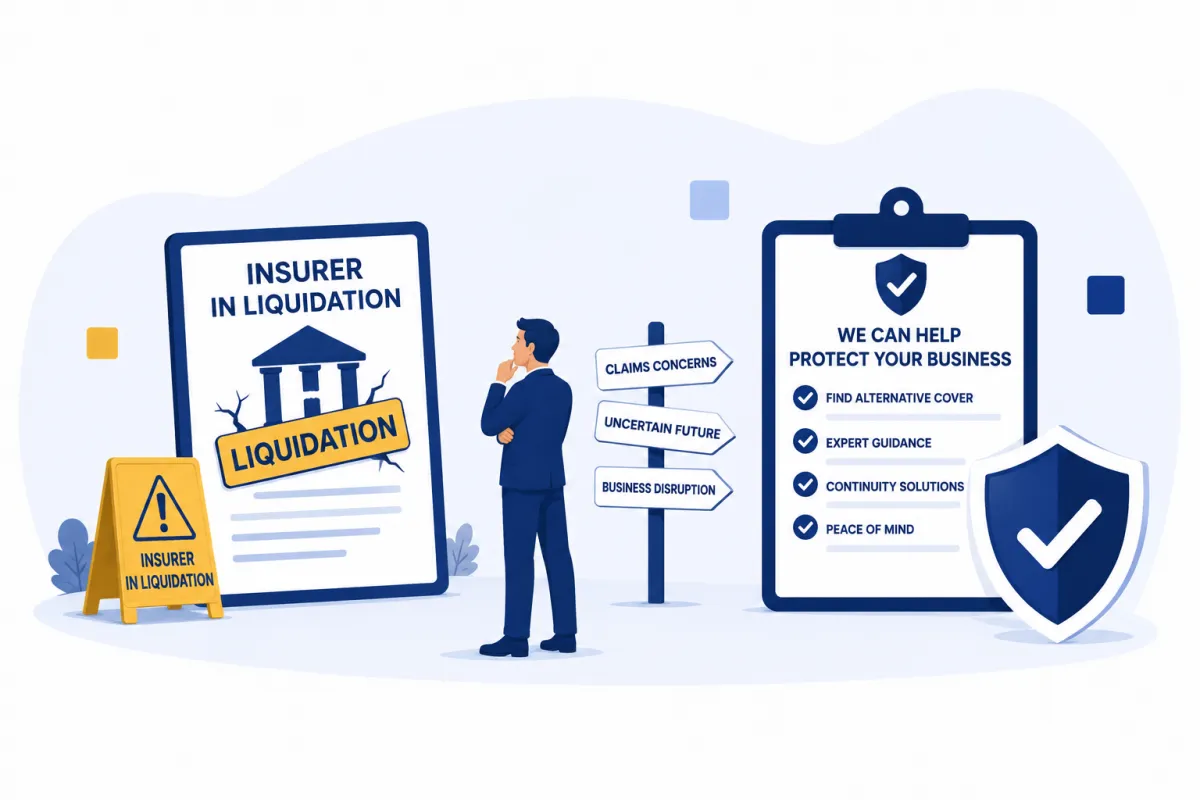
Insurer in Liquidation UK | Failed Insurer & FSCS Guide
What happens if your insurer goes into liquidation?
It is one of the most unsettling things that can happen to a business: you open a letter telling you that the insurance company behind your policy has gone into administration or liquidation. Suddenly the cover you have paid for is in question — and if you have an open claim, so is the money you were counting on. The good news is that, for most small businesses, the situation is recoverable. The bad news is that the safety net has hard edges, and some businesses fall straight through them.
When a regulated UK insurer fails, your policy is usually still valid until you are told otherwise, and the Financial Services Compensation Scheme (FSCS) steps in to protect eligible policyholders. But "eligible" is doing a lot of work in that sentence. The FSCS protects individuals and small businesses — and the moment your turnover crosses £1 million, you generally lose protection for most general insurance. Add in the extra danger of unrated insurers — the cheap, often offshore companies that fail far more often — and you have a problem that sits squarely in adverse-risk territory.
At Miller & Partner we help businesses through exactly this: re-placing cover urgently when an insurer collapses mid-term, navigating the FSCS and the insolvency practitioner when a claim is open, and — most importantly — making sure it never happens again by placing you with financially secure, rated insurers. This guide explains what the FSCS does and does not cover, why unrated insurers fail, the £1 million eligibility cliff that catches larger businesses, and exactly what to do if your insurer has failed. This is distinct from cover for a business that has itself become insolvent — for that, see our guide to insurance after insolvency or liquidation and our business insurance after insolvency placement page. If an insurer failure has left you with a gap in cover history or an unpaid premium dispute on your credit file, business insurance with a CCJ covers how that is presented to the next underwriter.
Insurer failure is an adverse event that is largely preventable with the right placement — and fully recoverable with the right broker when it does strike. Here is how each pillar applies.
Key facts if your insurer fails, at a glance
- When a regulated UK insurer enters administration or liquidation, an insolvency practitioner takes over and your policy is usually still valid until you are told otherwise.
- The FSCS protects most general insurance at 90% (with no upper limit) and compulsory cover, professional indemnity and life at 100%.
- FSCS protection is limited to individuals and small businesses with turnover under £1 million — larger businesses are generally NOT protected for general insurance.
- The FSCS cannot arrange replacement cover for you — you must re-place through a broker, often urgently.
- Unrated insurers (no AM Best, S&P or Moody's rating, often offshore) are cheaper but fail far more often — and FSCS backing is not guaranteed for overseas-regulated failures.
- In 2025 the FSCS declared Gibraltar-based Premier Insurance in default, ending cover for over 16,000 UK motor policyholders.
- A business too large for FSCS, insured with an unrated insurer that fails, can be left with an unpaid claim and no compensation.
What does the FSCS actually protect when an insurer fails?
The FSCS is the statutory safety net for customers of failed, regulated financial firms — including insurers authorised by the Prudential Regulation Authority. When an insurer becomes insolvent, the FSCS can do three things: pay towards replacement cover, fund a refund of the unused premium, or pay valid claims. How much you get depends entirely on the type of insurance.
The split is the single most important thing to understand. Compulsory insurance — third-party motor and employers' liability — is protected at 100%, as is professional indemnity insurance, life cover, and claims arising from death or incapacity. Most other general insurance — commercial property, business interruption, contents, public liability, pet, travel, home — is protected at 90%, with no upper limit. Where a policy is not transferred to a new insurer and a premium refund is due, the FSCS usually repays 90% of the unused premium element only, not every fee you paid at the outset.
Rated vs unrated insurer — what's the real difference?
Every quote you receive is backed by an insurer, and not all insurers are equally secure. The difference between a rated and an unrated insurer is the difference between a company whose financial strength has been independently assessed and one whose has not — and it is the difference that decides whether your cover survives a hard year.
| Feature | Rated insurer | Unrated insurer |
|---|---|---|
| Financial strength rating | Assessed by AM Best, S&P or Moody's | None — strength not independently graded |
| Typical premium | Market rate | Often noticeably cheaper |
| Failure risk | Lower; capital scrutinised | Higher; most UK insurer failures are unrated |
| Domicile | Usually UK / strong jurisdictions | Often offshore (Gibraltar, EU) |
| FSCS backing | Generally clear for UK risks | Uncertain for overseas-regulated failures |
| Claims-paying confidence | High | Variable — the cheap premium has a cost |
| Lender / contract acceptance | Widely accepted | Often rejected by lenders and principals |
An unrated insurer is not automatically a bad insurer — some are perfectly sound, and for certain hard-to-place risks an unrated market may be the only option. But you should always know when you are on unrated paper, understand the trade-off, and never end up there by accident because a broker chased the cheapest premium. That is a core part of specialist adverse-risk broking.
The calls that stay with me are from businesses that never knew they were on unrated paper until the insurer collapsed. They took what looked like a great deal at renewal, nobody explained the security behind it, and the first they heard of "rated versus unrated" was the day the administrator's letter arrived. A cheap premium that doesn't pay a claim is the most expensive insurance there is. When we quote, we tell you exactly who is carrying your risk and how strong they are — because that information is the whole point of using a broker.
Is your business eligible for FSCS protection?
This is where many businesses get an unwelcome surprise. For general insurance, FSCS protection is limited to individuals and small businesses with an annual turnover of less than £1 million. Cross that threshold and, for most of your policy, the safety net is gone — if your insurer fails, there is no FSCS to fall back on for your property, business interruption or public liability cover. Only the compulsory and long-term classes (employers' liability, professional indemnity, life) remain protected regardless of size.
This is the trap that catches growing businesses. A company that was comfortably FSCS-eligible when it set up its insurance can quietly cross £1 million in turnover, keep renewing the same policy with the same unrated insurer, and have no idea its safety net has disappeared. For these businesses, insurer security is not a nice-to-have — it is the only protection they have, which makes placing with rated insurers essential rather than optional.
Why do unrated insurers fail more often?
Unrated insurers fail more often because the thing that makes them cheap is often the same thing that makes them fragile. Without a published financial-strength rating, there is less external discipline on capital adequacy, reserving and pricing. Some chase market share with premiums that are too low to cover the claims that follow, and when a bad year arrives — a spike in claims, an adverse court ruling, a reserving shortfall — there is no buffer. Many are domiciled offshore, where the regulatory regime and the compensation scheme may differ from the UK's.
The UK has seen a steady stream of these failures, and they cluster in price-sensitive lines like motor, taxi and property where buyers chase the cheapest quote. The lesson from every one is the same: the premium saving is real until the insurer cannot pay, at which point the saving is dwarfed by the loss. A specialist broker's job is to make sure you are never the policyholder left holding an unpaid claim.
Situation checker: what should you do right now?
Select the situation that fits you. Each gives the immediate priorities — and where you see "specialist placement needed," that is exactly the work a specialist broker does for you.
- CRITICAL Confirm whether your policy has been disclaimed or is still valid — do not assume you are uninsured or covered.
- LEGAL If any compulsory cover (EL, motor) is affected, arrange replacement before it lapses — trading or driving uninsured is an offence.
- ESSENTIAL Find the insolvency practitioner and run-off agent details (insurer's site / FSCS).
- RECOMMENDED Engage a broker immediately to re-place cover — specialist placement needed if your risk is hard to insure.
- CONSIDER Keep all paperwork and premium records for any FSCS refund claim.
- CRITICAL Find out who actually carries your risk and whether they are rated — ask your broker in writing.
- ESSENTIAL Assess your FSCS eligibility (turnover under £1m?) so you know your fallback.
- RECOMMENDED Where possible, move to rated security at renewal — specialist placement needed if the risk is why you're on unrated paper.
- CONSIDER Check whether lenders or principals require rated insurers in your contracts.
- LEGAL Confirm compulsory classes sit with secure carriers.
- CRITICAL Contact the run-off agent / claims handler assigned by the insolvency practitioner — your claim continues through them.
- ESSENTIAL Check whether the claim is 90% or 100% protected (compulsory/PI = 100%).
- RECOMMENDED Use a broker to advocate on quantum and eligibility through the FSCS process.
- CONSIDER Budget for the 10% gap on general-insurance claims.
- LEGAL Preserve all claim documentation and correspondence.
- CRITICAL Above £1m turnover you have NO FSCS protection for general insurance — insurer security is your only safeguard. Specialist placement needed.
- ESSENTIAL Move every class possible to rated, secure insurers.
- RECOMMENDED Document insurer ratings on your schedule for board / lender assurance.
- CONSIDER D&O cover — directors can face questions over insurer-security decisions.
- LEGAL Compulsory classes (EL) remain FSCS-protected regardless of size.
- CRITICAL Time is short — get a broker building a submission immediately to avoid a gap in cover.
- LEGAL Bridge any compulsory cover first so you stay lawful to trade.
- ESSENTIAL Gather your schedule, claims history and risk details for a fast re-quote.
- RECOMMENDED Specialist placement needed if the original risk was hard to insure.
- CONSIDER Short-term cover while a full programme is arranged.
- ESSENTIAL Insist your broker confirms the rating and security of every insurer they propose.
- RECOMMENDED Set a minimum acceptable rating (e.g. A- or better) as a placement rule.
- CRITICAL Review security annually — ratings and appetite change.
- CONSIDER Accept a slightly higher premium for materially better security.
- LEGAL Ensure compulsory classes never sit on weak paper.
How do you re-place cover urgently when your insurer fails mid-term?
When an insurer disclaims your policy mid-term, the priority is avoiding a gap in cover — especially for compulsory classes, where a lapse can stop you trading or put you on the wrong side of the law. The FSCS will not arrange replacement cover for you; that is the broker's job, and speed matters. A good specialist broker can take your schedule, claims history and risk details and have rated terms in front of you quickly, bridging compulsory cover first and then rebuilding the full programme on secure paper.
If your risk is hard to place — which is often why it ended up with an unrated insurer in the first place — the re-placement needs the specialist market, not a retail panel. This is the same craft we apply to any business refused cover elsewhere: present the risk properly to markets with appetite, on rated security, before the gap opens.
Red-flag check: are you exposed to insurer failure?
Tick each item that is true. Each is a sign your cover may be more fragile than you think — and several together mean you should review your insurer security now, not after a failure.
Protection assessor: how safe is your cover?
Choose two factors for an indicative read on how protected you are if your insurer failed. Guidance, not advice.
What happens step by step when an insurer fails?
Understanding the sequence removes a lot of the fear. When a regulated UK insurer can no longer meet its obligations, a defined process kicks in, and at each stage there is something you — or your broker — should be doing.
First, the insurer is placed into an insolvency process, usually administration or liquidation, and the court appoints an insolvency practitioner (IP) to take over its affairs. The IP's job is to manage the failed company, collect and sell its assets, and deal with creditors — which includes you. Unless you are told otherwise, your policy is likely still valid at this point, and claims continue, typically handled by a run-off agent appointed under the IP's oversight.
From there, one of two things happens to your cover. Either the policies are transferred to a new insurer, giving you continuity, or they are disclaimed and ended, with a return of premium due for the unused portion. It can take time to know which, and during that window the FSCS works with the IP and brokers. If your policy is disclaimed, you must re-place cover yourself; the FSCS funds the refund (90% of the unused premium for most general insurance) but does not arrange the new policy. If you have a valid claim, it is assessed by the run-off agent and, where eligible, paid through the FSCS at 90% or 100% depending on the class.
Why are offshore unrated failures riskier?
Not all insurer failures are equal. When a UK-regulated insurer fails, the FSCS framework is relatively clear. When an offshore, unrated insurer fails, the picture can be murkier — because the compensation arrangements depend on the rules of the jurisdiction where the insurer was regulated, not just the UK's.
There have been cases where overseas compensation schemes changed their rules so that UK customers could no longer claim against them, leaving the FSCS to pick up eligible UK liabilities — and cases where the path was far from smooth. The practical takeaway is simple: an offshore unrated insurer adds a layer of uncertainty on top of the higher failure risk. For a business above the £1 million FSCS threshold, that combination can mean a failed insurer, an unpaid claim, and no compensation scheme to turn to. It is precisely the scenario that turns a routine renewal decision into a business-threatening event.
How do you check an insurer's security before you buy?
You do not have to be an analyst to protect yourself. Three checks cover most of the ground. First, ask your broker, in writing, who carries the risk and what their financial-strength rating is — a straight answer is a good sign; evasiveness is not. Second, confirm the insurer is authorised and regulated via the FCA's Financial Services Register, and note where it is domiciled. Third, understand your own FSCS eligibility — whether your turnover keeps you under the £1 million general-insurance threshold — so you know what your fallback actually is.
A specialist broker does all three for you as a matter of routine and sets a minimum acceptable rating as a placement rule. The goal is not to refuse every unrated insurer — sometimes the specialist market is the right home for a difficult risk — but to make sure you are never on weak paper by accident, and that the trade-off is a conscious, informed choice.
What determines whether you're protected?
Whether you walk away whole or exposed after an insurer failure comes down to a handful of factors. Most are decided at placement — long before any failure — which is exactly why insurer security deserves attention at every renewal, not just in a crisis.
| Factor | Why it matters | Better position |
|---|---|---|
| Insurer rating | Rated insurers fail less often | Rated A- or above |
| Insurer domicile | Offshore failures add compensation uncertainty | UK / strong jurisdiction |
| Your turnover | Over £1m removes FSCS general-insurance cover | Eligible, or rated security if not |
| Class of insurance | Compulsory / PI is 100%; general is 90% | Know your split |
| Eligibility status | Individuals / small business are protected | Confirmed eligible |
| Transfer vs disclaimer | Transfer = continuity; disclaimer = re-place | Ready to re-place fast |
| Open claim | A live claim with a failing insurer is high-risk | Documented, advocated |
| Quality of records | Refunds and claims need evidence | Tidy paperwork retained |
| Speed of re-placement | Gaps in cover create legal and contractual risk | Broker acting immediately |
| Compulsory cover bridged | Lapsed EL / motor can be an offence | Bridged first |
| Broker market access | Hard risks need specialist markets | Specialist + Lloyd's access |
| Security checked at placement | Most exposure is avoidable up front | Rating verified before binding |
Three real-world insurer-failure case studies
These composites reflect the situations we see most often. Figures are illustrative, but the dynamics — and the difference the right placement makes — are real.
Beacon Joinery — small business, FSCS-protected
A joinery firm with £600,000 turnover had a £45,000 fire-damage property claim open when its insurer entered liquidation mid-term. Because Beacon was a small business under the £1 million threshold, it was FSCS-eligible. The claim was assessed by the run-off agent and paid through the FSCS at 90% — £40,500 — and we re-placed the firm's cover with an A-rated insurer within days, at a renewal cost around 12% higher but on genuinely secure paper. The lesson: the FSCS works for small businesses, but even then the 10% gap on general insurance is money you absorb. Rated security from the start avoids the whole episode.
Harton Logistics — too big for FSCS
A haulier with £2.4 million turnover had moved to an unrated, offshore insurer to save several thousand pounds in premium. When that insurer failed with a £180,000 liability claim open, Harton discovered the trap the hard way: above £1 million turnover, there was no FSCS protection for the general-insurance claim, and the offshore compensation route led nowhere. The claim went unpaid and the dispute turned toward the broker who had placed the cover without flagging the security. We re-placed Harton with a rated insurer at around 30% more than the unrated price — a premium the business now considers the cheapest insurance it has ever bought. The lesson: above £1 million, insurer security is the only protection you have; never trade it for a cheap unrated premium.
Cordell Care Homes — compulsory cover saved them
A care-home group's insurer collapsed with an employers' liability claim open — a £220,000 employee-injury matter. Because employers' liability is compulsory insurance, protected by the FSCS at 100%, the claim was paid in full despite the failure. The property and business-interruption elements of the programme, however, carried only 90% protection, and the group's turnover sat near the eligibility line. We moved the entire programme to rated security at the next renewal. The lesson: compulsory classes get 100%, but the rest of your programme does not — and a single failure can expose every uncovered corner at once.
What to do when your insurer goes into liquidation
If you have just learned your insurer has failed, work through these eight steps in order. The first few are urgent; the rest protect you properly and stop it happening again.
- Confirm your policy status. Establish whether your cover is still valid or has been disclaimed — do not assume either. Check any letter from the insolvency practitioner or your broker.
- Protect compulsory cover first. If employers' liability or motor cover is affected, arrange replacement before it lapses — trading or driving uninsured is an offence.
- Find the insolvency practitioner and run-off agent. Their details are on the insurer's website and the FSCS site; they now manage claims and refunds.
- Check your FSCS eligibility and protection level. Confirm whether you are under the £1 million turnover threshold and whether each class is 90% or 100% protected.
- Engage a specialist broker to re-place cover. The FSCS will not arrange a new policy; a broker builds your submission and finds rated terms — fast if the risk is hard.
- Bridge, then rebuild on rated security. Bridge any compulsory gap immediately, then rebuild the full programme on financially secure, rated insurers.
- Pursue any open claim. Work with the run-off agent on quantum and eligibility; have your broker advocate so the FSCS pays what you are due.
- Lock in security going forward. Set a minimum acceptable rating as a placement rule and review insurer security at every renewal.

Insurer-failure glossary
- Administration
- An insolvency process where an administrator takes control of a failing company to rescue it or achieve a better outcome for creditors than liquidation.
- AM Best / rating agency
- An agency (AM Best, S&P, Moody's) that independently grades an insurer's financial strength and claims-paying ability.
- Compulsory insurance
- Cover required by law — chiefly employers' liability and third-party motor — protected by the FSCS at 100%.
- Disclaimer (of policy)
- Where an insolvency practitioner ends policies of a failed insurer, triggering the need to re-place cover and any return of premium.
- Eligibility (FSCS)
- Whether a policyholder qualifies for protection — for general insurance, individuals and small businesses with turnover under £1 million.
- FSCS
- The Financial Services Compensation Scheme — the statutory safety net that protects eligible customers of failed, regulated financial firms.
- Insolvency practitioner (IP)
- The court-appointed person or firm that manages a failed insurer's affairs, including claims and refunds.
- Liquidation
- An insolvency process in which a company is wound up, its assets sold, and the proceeds distributed to creditors.
- Part VII transfer
- A court-approved transfer of insurance business from one insurer to another under the Financial Services and Markets Act 2000.
- Policyholder Protection Rules
- The FSCS rules governing which insurance policyholders are protected and to what extent.
- PRA
- The Prudential Regulation Authority, which regulates the financial soundness of UK insurers and banks.
- Rated insurer
- An insurer whose financial strength has been independently graded by a recognised rating agency.
- Return of premium
- A refund of the unused portion of premium when a failed insurer's policy is disclaimed — protected by the FSCS at 90% for most general insurance.
- Run-off agent
- A claims-handling firm appointed under the insolvency practitioner to manage policyholders' claims from start to finish.
- Security (insurer)
- The financial strength and reliability of the insurer carrying your risk — the thing that decides whether your cover survives a hard year.
- Unrated insurer
- An insurer with no published financial-strength rating — often cheaper and often offshore, with a higher historical failure rate.
Frequently asked questions
Is my policy still valid if my insurer goes into liquidation?
How much does the FSCS pay if my insurer fails?
Is my business too big for FSCS protection?
Will the FSCS arrange my replacement cover?
What is an unrated insurer, and is it safe?
What happens to my open claim if the insurer fails?
Are offshore insurer failures treated differently?
How do I find out whether my insurer is rated?
Is this the same as insurance after my own business becomes insolvent?
Why would my broker put me with an unrated insurer?
Can directors be held responsible for an insurer-security decision?
How quickly can you re-place my cover if my insurer has failed?
Related specialist guides
- Insurance After Insolvency or Liquidation
- Insurance for Businesses Refused Cover
- Business Insurance Refused Elsewhere
- Business Insurance With a Claims History
- Specialist Broker for Adverse-Risk Insurance
- High-Risk Public Liability Insurance
- Business Insurance After a Fire Claim
- Business Insurance After a Flood Claim
- Cladding & EWS1 Buildings Insurance
- Commercial Property Insurance After a Claim
- Business Interruption Insurance
- Underinsurance & the Condition of Average
- Directors & Officers Insurance
- Day One Reinstatement Insurance
- Professional Indemnity Insurance
- Commercial Insurance
- Adverse-Risk Insights Hub
This guide is general information, not advice for your specific circumstances, and does not constitute legal or financial advice. FSCS protection levels, eligibility rules and insurer arrangements can change. Always confirm your own position with the FSCS, your broker and the relevant regulators. Miller & Partner Limited is an Appointed Representative of Gauntlet Risk Management Ltd, which is authorised and regulated by the Financial Conduct Authority.






Instagram
LinkedIn