


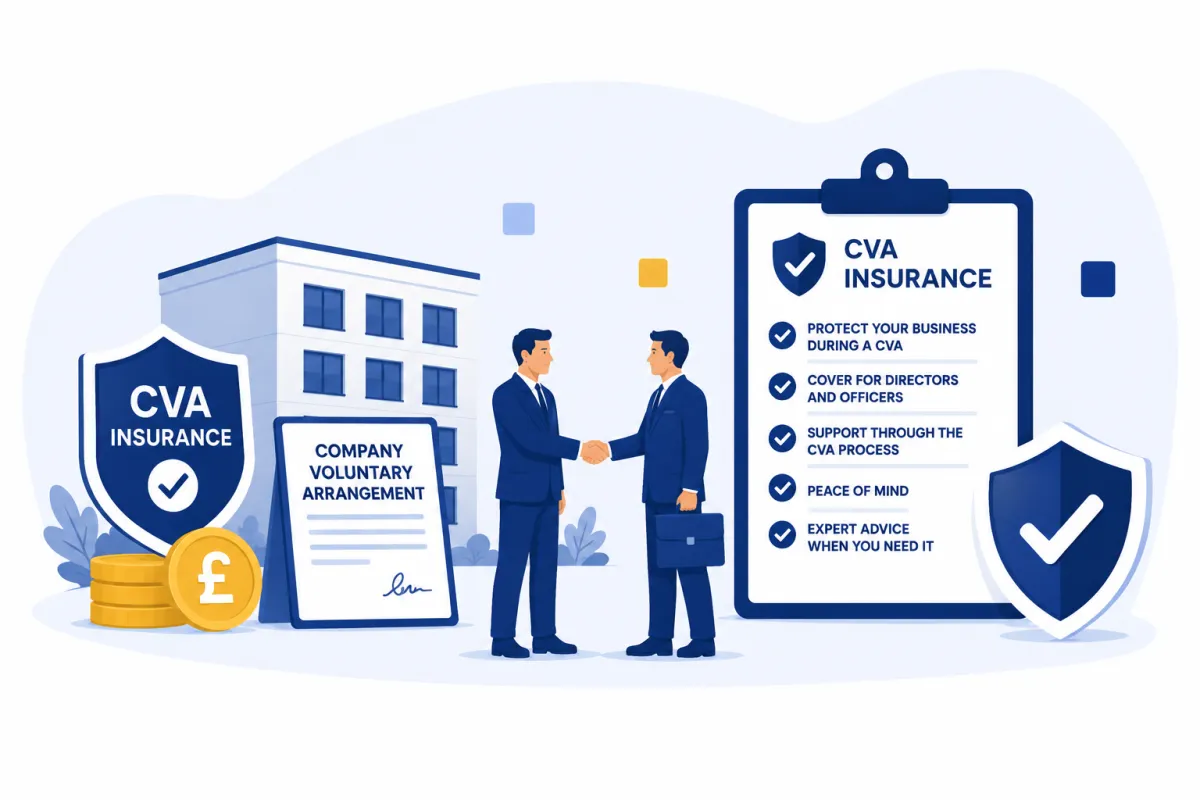
CVA Insurance UK | Cover for a Company Voluntary Arrangement
Why does a CVA need specialist insurance treatment?
A Company Voluntary Arrangement is a rescue, not a funeral. It lets an insolvent-but-viable company keep trading, keep its directors in control, and repay creditors over a fixed period — and for the right business it works. But there is a problem the insolvency practitioner rarely warns you about: the moment a CVA is in place, your insurance gets harder, more expensive and more fragile, often at the exact moment your cash flow can least absorb it.
The reasons are specific. A CVA is recorded at Companies House, which makes it a material fact you must disclose to insurers — and a disclosure trap if you don't. During the arrangement your company effectively has no credit rating, so insurers routinely withdraw the monthly and premium-finance terms you relied on and ask for the annual premium upfront. Standard markets often decline or non-renew once they see the CVA. And a lapse in cover doesn't just leave you exposed — it can breach the very leases and contracts the CVA was designed to preserve.
This is squarely adverse-risk territory, and it is what we do. At Miller & Partner we place continuous cover for businesses trading through a CVA, present the arrangement to underwriters as the structured rescue it is, and manage the cash-flow and disclosure traps that catch the unprepared. This is distinct from cover after a terminal insolvency — for that, see our guide to insurance after insolvency or liquidation and our business insurance after insolvency placement page, which covers CVAs alongside liquidation, administration and phoenix companies — and from the separate situation where your insurer goes into liquidation. The credit side of a CVA is dealt with separately on business insurance with a CCJ, since it is the credit scoring rather than the arrangement itself that usually withdraws your monthly payment terms.
A business in a CVA is exactly the kind of risk standard markets reject on sight and specialists understand. Here is how each pillar applies.
Key facts about insurance in a CVA, at a glance
- A CVA is a statutory rescue under the Insolvency Act 1986 that lets an insolvent-but-viable company keep trading while repaying creditors over a fixed period.
- It needs 75% of creditors by value to approve, then binds all unsecured creditors; the directors stay in control.
- A CVA is recorded at Companies House — so it is a material fact you MUST disclose to insurers under the Insurance Act 2015.
- During a CVA the company effectively has no credit rating, so insurers commonly withdraw monthly and premium-finance terms, demanding the annual premium upfront.
- Standard insurers often decline or non-renew once a CVA is known, pushing the business into the specialist/adverse market.
- Continuous cover is essential — lapsing employers' liability, property or liability cover can breach the very leases and contracts the CVA is designed to preserve.
- Personal guarantees given by directors survive a CVA, keeping personal exposure live alongside the company's.
What is a CVA, and how does it affect your cover?
A CVA is a binding agreement between a company and its unsecured creditors under Part I of the Insolvency Act 1986. A licensed insolvency practitioner acts as nominee before approval and supervisor afterwards, but — unlike administration or liquidation — the directors keep running the business. Once 75% of creditors by value approve, the arrangement binds all unsecured creditors, freezes the debts within it, and is recorded on the company's file at Companies House. It typically runs one to five years.
The effect on insurance flows directly from that public record and the company's financial position. Insurers credit-check at quotation and renewal; a business in a CVA shows as a company that could not pay its debts as they fell due, with no usable credit rating. That single fact changes three things at once: whether an insurer will offer terms at all, on what premium basis they'll offer them, and whether they'll let you pay monthly. A specialist broker's job is to manage all three — which starts with understanding how different insolvency routes look to an underwriter.
CVA vs administration vs liquidation — how do insurers see each?
| Feature | CVA | Administration | Liquidation |
|---|---|---|---|
| Trading status | Continues trading | May trade while restructured | Ceases — company wound up |
| Who's in control | Directors | Administrator | Liquidator |
| Purpose | Rescue & repay over time | Rescue or better creditor outcome | Terminal — close down |
| Need for ongoing cover | High — business still operating | Often high | Usually run-off only |
| Insurer view | Adverse but insurable with the right story | Adverse; case-by-case | New cover rarely needed |
| Premium terms | Monthly/finance often withdrawn | Often restricted | N/A |
The headline is that a CVA is the most insurable of the three precisely because the business is still trading and trying to recover. The challenge is that generalist insurers often can't see past the word "insolvency" — which is why a business in a CVA so often ends up refused cover by markets that would happily insure the same operation a year either side of the arrangement.
Do you have to tell insurers about a CVA?
Yes — unambiguously. Under the Insurance Act 2015 duty of fair presentation, a CVA is a material circumstance that would plainly influence a prudent insurer's decision, so it must be disclosed at every new placement and renewal. Because the arrangement is recorded at Companies House, it is also discoverable — there is no hiding it, and trying to is the worst move available.
Why do insurers withdraw monthly premium terms in a CVA?
This is the CVA-specific trap most directors never see coming. Monthly premiums and premium-finance arrangements are, in effect, the insurer or a finance house lending you the premium and collecting it in instalments. That requires them to take a credit view of your business — and a company in a CVA, with no credit rating and a recent record of being unable to pay its debts, fails that view. So the instalment facility is withdrawn and the full annual premium is demanded upfront.
The timing could hardly be worse: the cash-flow squeeze hits precisely when the CVA has already tightened every penny. We see businesses blindsided by a five-figure premium demand they expected to spread over twelve months. Managing this — through specialist insurers who will still offer instalments, short-term finance bridges, or restructured programmes — is a core part of placing cover for a business in a CVA, and we cover the practical options later in this guide.
The call I take most often on this isn't about whether cover exists — it's about the premium landing as one lump sum. A director has carefully modelled the CVA contributions to the penny, then the renewal arrives with monthly terms gone and the whole year's premium due at once. Nobody told them the rescue plan and the insurance renewal were on a collision course. When we take over a placement mid-CVA, sorting the payment structure is often the first thing we fix — because a viable rescue shouldn't fall over a cash-flow surprise that was entirely predictable.
Cover checker: what's your situation?
Select the situation that fits. Each gives the immediate priorities — and where you see "specialist placement needed," that is exactly the work a specialist broker does for you.
- ESSENTIAL Map your insurance renewals against the CVA timeline so cover never lapses during the transition.
- LEGAL Plan to disclose the CVA at the next renewal — it's a material fact under the Insurance Act 2015.
- RECOMMENDED Brief a specialist broker early so terms are lined up before standard markets non-renew. Specialist placement needed.
- CRITICAL Budget for premium finance being withdrawn — model an upfront annual premium.
- CONSIDER Check which leases/contracts require continuous insurance.
- CRITICAL Engage a specialist broker now — before the renewal date, not after a decline. Specialist placement needed.
- LEGAL Disclose the CVA in full on the renewal presentation.
- ESSENTIAL Gather your CVA proposal, supervisor details and trading figures to present the rescue properly.
- RECOMMENDED Ask specifically about instalment options to avoid an upfront cash hit.
- CONSIDER Review whether the programme can be streamlined to manage premium.
- CRITICAL Act before cover lapses — a gap can breach leases/contracts and stop you trading. Specialist placement needed.
- ESSENTIAL Have a broker rebuild the placement for the specialist/adverse market.
- LEGAL Bridge compulsory cover (employers' liability) immediately.
- RECOMMENDED Present the CVA as a supervised rescue, not a red flag.
- CONSIDER Note the reason given so it can be addressed in the new submission.
- CRITICAL Don't let cover lapse over a payment problem — solve the structure, not the policy.
- ESSENTIAL Ask a broker about insurers who still offer instalments to CVA businesses, or a short-term finance bridge.
- RECOMMENDED Consider restructuring the programme to ease the upfront cost.
- CONSIDER Factor the premium timing into the CVA cash-flow model.
- LEGAL Keep compulsory cover in force throughout.
- CRITICAL A lapse here can collapse the very leases/contracts the CVA is protecting — keep cover continuous. Specialist placement needed.
- ESSENTIAL Check each lease/contract for required limits, perils and certificate evidence.
- RECOMMENDED Have a broker confirm the new policy meets every contractual condition.
- CONSIDER Provide landlords/principals with certificates promptly to maintain confidence.
- LEGAL Ensure employers' liability remains in force without a day's gap.
- CRITICAL Personal guarantees survive the CVA — your exposure stays live alongside the company's.
- RECOMMENDED Consider directors' & officers' cover for the decisions taken during the rescue.
- ESSENTIAL Keep board decisions and insurer-disclosure records well documented.
- CONSIDER Review any personal assets exposed under the guarantee.
- LEGAL Take insolvency advice on wrongful-trading risk if the CVA struggles.
Why must cover stay continuous during a CVA?
A CVA usually preserves the contracts and leases that make the business viable — reduced rents, retained sites, ongoing client agreements. Almost all of those agreements carry an insurance condition: maintain property cover, hold the required public and employers' liability limits, evidence professional indemnity. If your cover lapses because an insurer non-renewed or a premium went unpaid, you are not only exposed to loss — you are in breach of the agreements the CVA was built to keep. That can hand a landlord or principal a reason to walk, and undermine the whole arrangement.
This is why continuity matters more in a CVA than almost any other situation. The goal is never to have a gap, which means lining up replacement terms before the old cover ends and bridging any compulsory class — like public and employers' liability — without a day's lapse.
Red-flag check: is your cover at risk during your CVA?
Tick each item that is true. Each is a sign your cover may be more fragile than you think while the arrangement is live.
Insurability assessor: how placeable are you mid-CVA?
Choose two factors for an indicative read on how straightforward your placement is likely to be. Guidance, not advice.
How do you present a CVA to underwriters?
The difference between a decline and a workable quote is almost always the presentation. An underwriter who sees only "company in a CVA" reaches for the decline stamp. An underwriter who is shown a viable business, a supervised plan, and directors who remained in control and are trading to a credible forecast can price the risk instead of refusing it. Presenting that story is the broker's craft.
A strong submission for a business in a CVA includes the CVA proposal and the supervisor's details, up-to-date management accounts and forward forecasts, an explanation of why the difficulty arose and what has changed, the trading record since approval, and confirmation of the risk-management and compliance measures in place. The goal is to move the conversation from the label to the reality — that this is a fundamentally sound operation working through historic debt under formal supervision. That reframing is the heart of specialist adverse-risk broking, and it is what turns "refused everywhere" into terms.
How do you handle the premium cash-flow shock?
When monthly and finance terms are withdrawn, a full annual premium falling due in one payment can be the hardest part of insuring through a CVA. There are practical ways to manage it, and a specialist broker works through them with you rather than leaving you to absorb the hit.
First, some specialist insurers will still offer instalments to a CVA business, particularly where the risk is well presented and the arrangement is performing — so the facility isn't always gone, it's just no longer the default. Second, a short-term premium-finance bridge from a provider that understands the situation can spread the cost even when the mainstream finance houses decline. Third, the programme itself can sometimes be restructured — adjusting cover levels, aligning renewal dates, or removing duplication — to bring the upfront figure down to something the CVA cash flow can carry. The worst outcome is letting cover lapse over a payment problem that had a solution; the right broker finds the structure before that happens.
What determines whether you can get cover mid-CVA?
Whether you secure good terms while a CVA is live comes down to a mix of how the business is performing and how the risk is presented. Most of these factors are improvable — which is exactly why a specialist placement so often succeeds where a direct approach failed.
| Factor | Why it matters | How to strengthen it |
|---|---|---|
| CVA performance | A plan being met reassures underwriters | Show the trading record since approval |
| Quality of presentation | Context turns a decline into terms | Full submission via a specialist broker |
| Disclosure | Non-disclosure voids cover | Disclose the CVA in full, up front |
| Trade / sector | Some sectors are harder regardless | Match to insurers with appetite |
| Claims history | A poor record compounds the CVA | Explain and evidence improvements |
| Supervisor & forecasts | Formal oversight adds credibility | Provide supervisor details and projections |
| Risk management | Good controls lower the risk view | Document procedures and compliance |
| Cover continuity | Gaps signal instability and breach contracts | Line up terms before old cover ends |
| Premium structure | Upfront cost can stall a placement | Seek instalments or a finance bridge |
| Broker market access | Adverse risks need specialist markets | Use a broker with Lloyd's access |
| Director guarantees | Personal exposure affects decisions | Factor into D&O and governance |
| Time in the CVA | A track record builds confidence | Terms often improve as the CVA progresses |
Three real-world CVA insurance case studies
These composites reflect the situations we see most often. Figures are illustrative, but the dynamics — and the difference the right placement makes — are real.
Marlow Hospitality Group — non-renewed at the worst moment
A multi-site hospitality group used a CVA to reduce rents and exit two loss-making sites. Three months later its property and liability renewal arrived — and the long-standing generalist insurer non-renewed on sight of the CVA, while the premium-finance facility was withdrawn, leaving a £42,000 annual premium due upfront. We rebuilt the placement for the specialist market, presented the CVA as a performing rescue, restored monthly terms through an insurer with appetite, and kept cover continuous so the renegotiated leases stayed intact. The lesson: a non-renewal mid-CVA is recoverable — but only if you move before the gap opens. Premium settled around 18% above the prior year, with instalments restored.
Tindall Engineering — the non-disclosure that backfired
A precision engineering firm in a CVA moved insurer at renewal and left the arrangement off the proposal to secure a cleaner quote. When a £90,000 fire-and-machinery claim followed, the insurer's investigation uncovered the undisclosed CVA — a clear material circumstance — and challenged the policy for breach of the duty of fair presentation. The claim was caught in a protracted coverage dispute and ultimately settled well below its value. The lesson: a CVA is recorded at Companies House and always surfaces; disclosing it gets you terms, hiding it gets the claim refused. The firm re-placed on properly disclosed, specialist terms thereafter.
Crewe Logistics — continuity saved the contracts
A haulier trading through a CVA depended on two major haulage contracts that the arrangement had carefully preserved — both requiring continuous motor fleet and goods-in-transit cover with evidenced limits. When the existing insurer pulled monthly terms and signalled non-renewal, a lapse would have breached those contracts and collapsed the income the CVA relied on. We arranged continuous fleet and goods-in-transit cover with a specialist insurer plus a short-term finance bridge, with not a day's gap, and supplied certificates to the principals to maintain confidence. The lesson: in a CVA, continuous cover isn't just risk protection — it's contract protection. Premium rose around 22%, a fraction of the contract value preserved.
How to keep your business insured during a CVA
If your company is proposing or trading through a CVA, work through these eight steps to keep cover continuous, compliant and affordable.
- Map renewals against the CVA timeline. Identify every policy renewal date so none falls due unplanned during the arrangement.
- Disclose the CVA in full. Treat the arrangement as a material fact under the Insurance Act 2015 and present it openly at every renewal and new placement.
- Engage a specialist broker early. Brief a broker with adverse-risk and Lloyd's market access before standard insurers non-renew, not after.
- Build a proper submission. Provide the CVA proposal, supervisor details, accounts, forecasts and risk-management evidence so the rescue is presented, not just the label.
- Plan for the premium structure. Expect monthly terms to be withdrawn; line up instalments with a willing insurer or a finance bridge to avoid an upfront shock.
- Keep cover continuous. Line up replacement terms before existing cover ends and bridge compulsory classes without a day's gap.
- Protect your contracts. Check every lease and contract's insurance conditions and evidence compliance to landlords and principals.
- Review as the CVA progresses. Terms usually improve as the arrangement performs — revisit cover and premium structure at each renewal.

CVA insurance glossary
- Company Voluntary Arrangement (CVA)
- A statutory agreement under the Insolvency Act 1986 letting an insolvent-but-viable company repay creditors over a fixed period while continuing to trade.
- Insolvency Act 1986
- The principal UK statute governing corporate insolvency procedures, including CVAs under Part I.
- Nominee
- The licensed insolvency practitioner who reviews and proposes a CVA before it is approved by creditors.
- Supervisor
- The insolvency practitioner who oversees the company's compliance with the CVA after approval.
- Unsecured creditor
- A creditor without security over company assets — bound by an approved CVA.
- Preferential creditor
- A creditor with priority status (e.g. HMRC for certain taxes) whose position is protected in a CVA.
- Moratorium
- A period of protection from creditor legal action, including winding-up petitions, around a CVA.
- Material fact
- Information that would influence a prudent insurer's decision — a CVA is one, and must be disclosed.
- Duty of fair presentation
- The Insurance Act 2015 obligation to disclose every material circumstance when buying or renewing cover.
- Premium finance
- An arrangement to spread an annual premium into monthly instalments — commonly withdrawn during a CVA.
- Non-renewal
- Where an insurer declines to offer renewal terms — common for standard markets once a CVA is known.
- Personal guarantee
- A director's personal promise to meet a company debt — survives a CVA and keeps personal exposure live.
- Contingent insolvency
- Where a company can currently pay its way but would be insolvent if a foreseeable liability crystallised.
- Companies House record
- The public register entry recording an approved CVA — which makes it discoverable to insurers.
- Specialist market
- Insurers and Lloyd's syndicates with appetite for adverse and hard-to-place risks, including businesses in a CVA.
- Continuous cover
- Insurance maintained without any gap — essential during a CVA to satisfy leases and contracts and avoid breach.
Frequently asked questions
Can I still get business insurance during a CVA?
Do I have to tell my insurer about the CVA?
Why has my insurer withdrawn my monthly payments?
Will my premium go up because of the CVA?
What happens to my cover if my renewal falls during the CVA?
Why does continuous cover matter so much in a CVA?
Is a CVA the same as administration or liquidation for insurance purposes?
Does a CVA affect my directors personally?
How do I present my CVA to insurers to get the best terms?
My customers don't know about the CVA — will buying insurance change that?
Can I claim on my policy while trading through a CVA?
Do you place cover for businesses in a CVA?
Related specialist guides
- Insurance After Insolvency or Liquidation
- Insurer in Liquidation
- Insurance for Businesses Refused Cover
- Business Insurance Refused Elsewhere
- Business Insurance With a Claims History
- Business Insurance With CCJs or Poor Credit
- Specialist Broker for Adverse-Risk Insurance
- High-Risk Public Liability Insurance
- Directors & Officers Insurance
- Business Interruption Insurance
- Business Insurance After a Fire Claim
- Business Insurance After a Flood Claim
- Cladding & EWS1 Buildings Insurance
- Professional Indemnity Insurance
- Commercial Insurance
- Adverse-Risk Insights Hub
This guide is general information, not advice for your specific circumstances, and does not constitute legal, insolvency or financial advice. Insurance availability, terms and premium structures during a CVA vary by insurer and circumstances. Always take regulated insolvency advice on your CVA and confirm your insurance position with a qualified broker. Miller & Partner Limited is an Appointed Representative of Gauntlet Risk Management Ltd, which is authorised and regulated by the Financial Conduct Authority.







Instagram
LinkedIn