

Martyn's Law Insurance UK | Terrorism & Liability Cover
What is Martyn's Law, and why does it change your insurance?
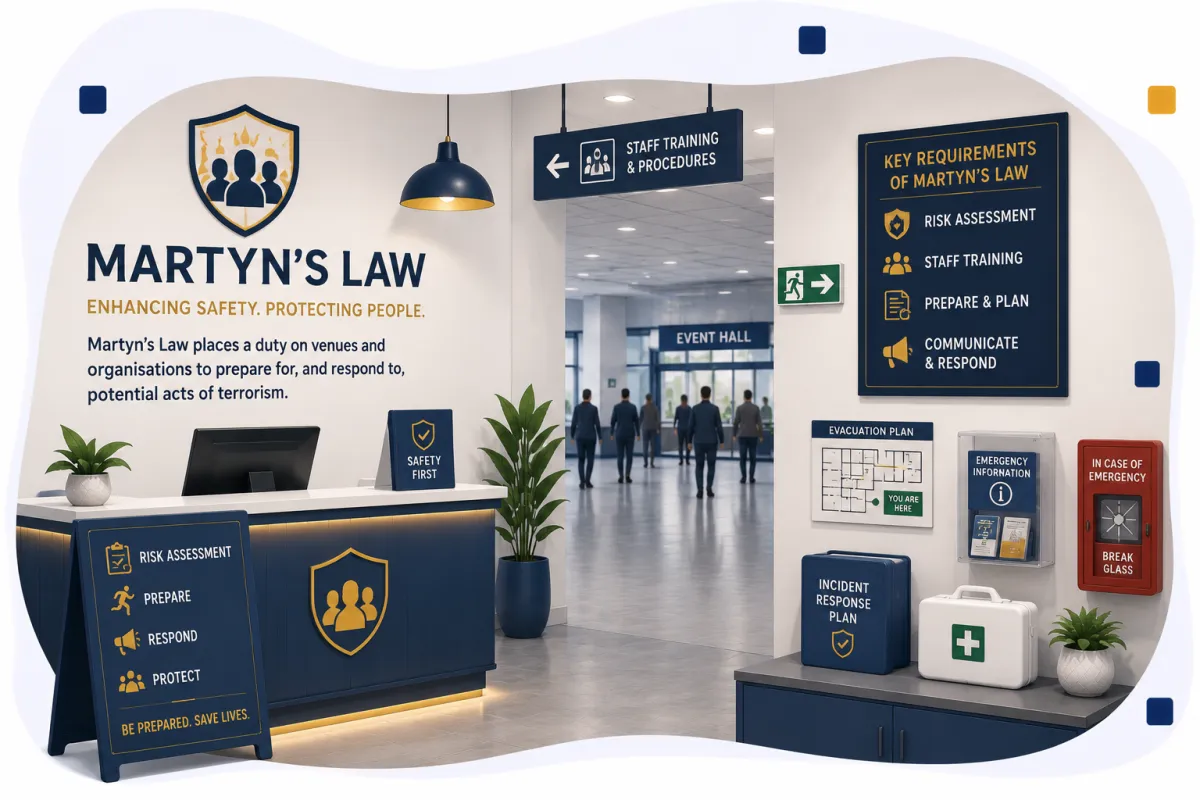
Martyn's Law — formally the Terrorism (Protection of Premises) Act 2025 — is the biggest change to public-venue safety duties in a generation. It received Royal Assent on 3 April 2025, the Home Office published its statutory guidance in April 2026, and it is expected to come into force in spring 2027 after a 24-month implementation period. It requires those responsible for qualifying premises and events to prepare for, and be ready to respond to, a terrorist attack. Named after Martyn Hett, one of the 22 people killed in the 2017 Manchester Arena attack, it follows the Manchester Arena Inquiry's recommendation that public venues be legally required to improve their protective security.
Here is the part every business owner needs to understand clearly: Martyn's Law is a compliance duty, not an insurance product — and no insurance policy makes you compliant. The government has been explicit that the required steps are largely low-cost and can be met without buying specialist services. But the Act does something just as important for your insurance: it formalises a duty of care around terrorism, sharpens your potential liability if you fail to prepare, and forces a hard look at a gap most venues don't know they have — the fact that standard property and business-interruption policies usually exclude terrorism entirely. As a specialist broker for adverse and hard-to-place risks, Miller & Partner helps venues, events and hospitality businesses understand what Martyn's Law means for their cover — the liability shift, the terrorism gap, and the non-damage exposures that catch people out. This guide sits alongside our sector guides for nightclubs, event security and crowd management and other affected sectors.
How does The Insurability Framework™ apply to Martyn's Law?
Underwriter Intelligence
We know how terrorism and liability underwriters view Martyn's Law — that evidence of a proper vulnerability assessment, public protection procedures and a named responsible person strengthens your presentation on both liability and terrorism cover. We frame it before the underwriter has to ask.
Difficult Risk Expertise
Terrorism is an excluded, specialist peril most generalists don't place. Our access to Pool Re-backed and commercial terrorism markets, and to specialist liability capacity, reaches the underwriters who genuinely write this risk — including higher-profile and higher-footfall venues.
Risk Assessment
We audit your exposure the way a liability underwriter and a claimant's solicitor will after an incident: are the tier requirements met, is terrorism cover in place, and are the non-damage gaps — denial of access, loss of attraction — closed? The gaps decide whether a claim is paid.
Claims Advocacy
A terrorism-related loss is among the most complex and emotive a business can face. When it happens, you deal with a named broker who coordinates property, terrorism, liability and business-interruption claims and fights your corner — not a call centre.
Key facts at a glance
- Martyn's Law is the Terrorism (Protection of Premises) Act 2025, expected to come into force in spring 2027 after a 24-month implementation period.
- It has two tiers: the standard tier (200–799 people) and the enhanced tier (800+ people, plus qualifying events).
- The regulator is the Security Industry Authority (SIA), with powers including compliance notices, monetary penalties and, for serious breaches, criminal offences.
- No insurance policy makes you compliant — compliance is about procedures and, for larger venues, physical measures, which the government says are largely low-cost.
- But standard property and business-interruption policies usually exclude terrorism, so many in-scope venues have no terrorism cover at all.
- Failing to prepare can sharpen your public-liability exposure if an incident occurs and you hadn't taken reasonable, required steps.
- The biggest hidden gap is non-damage business interruption — a cordon or denial of access after a nearby incident, with no damage to your own premises.
Does insurance make me compliant with Martyn's Law?
No — and this is the most important thing to be clear about, because a lot of noise in the market blurs it. Compliance with Martyn's Law is procedural, not financial. For standard-tier premises it means notifying the SIA and putting in place public protection procedures — evacuation, invacuation, lockdown and communication plans, plus staff awareness. For enhanced-tier premises and qualifying events it additionally means appropriate physical measures and a documented vulnerability assessment. The Home Office and SIA have stated plainly that businesses can comply without buying specialist services or products, and that no third-party product is endorsed as guaranteeing compliance. Any broker or consultant telling you that a policy "makes you Martyn's Law compliant" is misleading you.
So why does insurance matter here at all? Because Martyn's Law changes the risk and liability context your existing cover has to respond to. Once there is a statutory duty to prepare for terrorism, the consequences of an incident — and of failing to prepare — land partly on your insurance programme: your public liability if someone is hurt, your property and business interruption if there is damage or disruption, and your management liability if the responsible person faces regulatory action. The right response is not to buy a "Martyn's Law policy" (there is no such thing) but to do the compliance work properly and then review whether your insurance actually responds to the terrorism and liability exposures the Act throws into sharp relief. That review is where a specialist broker earns their keep.
| Aspect | Martyn's Law compliance | Insurance |
|---|---|---|
| What it is | A legal duty to prepare and protect | Financial protection if a loss occurs |
| Cost | Largely low-cost / procedural | A premium reflecting the risk transferred |
| Regulator | The SIA | The FCA (for the broker and insurer) |
| Does one satisfy the other? | No — insurance doesn't make you compliant | No — compliance doesn't insure your losses |
| Why you need both | Legal obligation; reduces the chance of harm | Covers the financial consequences if harm occurs anyway |
What are the standard and enhanced tiers?
Martyn's Law applies a tiered approach based on how many people may reasonably be present at the same time, from time to time. Getting your tier right is the foundation of both compliance and any insurance review.
Standard tier — 200 to 799 individuals
Smaller qualifying premises where between 200 and 799 people (including staff) may be present. The requirements are centred on simple, low-cost activities: notify the SIA, and put in place public protection procedures — evacuation, invacuation (moving people to safety inside), lockdown, and communication — that staff would follow in an attack. Physical security measures are not mandated at this tier. Note that childcare, education and places of worship sit in the standard tier even where 800 or more may attend.
Enhanced tier — 800 or more individuals (and qualifying events)
Larger premises and qualifying public events expecting 800 or more people. In addition to the standard-tier procedures, these must, so far as reasonably practicable, put in place appropriate public protection measures to reduce vulnerability — such as CCTV, bag-search policies or vehicle checks — carry out a documented vulnerability assessment, and identify a senior responsible person. The documentation and accountability burden is materially higher.
Under 200 people, premises are outside the scope of the Act. But scope turns on realistic capacity "from time to time", so a normally quiet venue that occasionally hosts larger events can be pulled in — which is exactly the kind of nuance worth getting right before you assess your insurance.
Is my business in scope of Martyn's Law?
Scope is broad. The Act covers premises used for a range of publicly accessible activities — entertainment and leisure venues, retail, food and drink, hotels and visitor accommodation, sports grounds, museums and galleries, places of worship, health and education settings, and public areas of larger sites. If your premises consist of at least one building, are publicly accessible, are used for a qualifying activity, and can reasonably expect 200 or more people at the same time, you are likely in scope. Even venues not traditionally thought of as high-risk — community halls, small theatres, village facilities — can qualify.
This is why Martyn's Law touches so many of the sectors we insure. A nightclub, a busy pub or bar, a trampoline park, a soft play centre or a public event will often clear the 200 threshold at peak times. The practical first step is a capacity assessment — how many people, realistically, at your busiest — because that determines your tier, your compliance obligations, and the exposures your insurance needs to answer.
From recent broker conversations
Two things come up on almost every Martyn's Law call. The first is confusion between compliance and cover — an operator who's been told, or assumed, that buying a policy ticks the Martyn's Law box. It doesn't, and I'd rather lose the sale than let a client believe a premium substitutes for the procedures the Act actually requires. The honest job is the reverse: help them do the free compliance work, then check whether their insurance responds to the risks the Act highlights.
The second is the terrorism gap. I've sat with venue owners who were genuinely surprised to learn that their comprehensive-looking property and business-interruption policy excludes terrorism entirely — and that a bomb scare closing their street for three days, with no damage to their own building, wouldn't be covered either. Martyn's Law is doing something useful here: it's making businesses look hard at a gap that was always there. The venues that handle this well treat the Act as a prompt to get both halves right — the procedures and the cover.
How does Martyn's Law change my liability exposure?
This is the subtlest, and arguably most important, insurance consequence of the Act. Today, a business's duty of care to visitors is a general one. Martyn's Law layers a specific statutory duty to prepare for terrorism on top of it. Once that duty exists and is in force, a business that suffers a terrorism-related incident and had failed to take the reasonable, required steps is in a materially weaker position if injured people or bereaved families bring civil claims. Non-compliance with the Act can become evidence that the business fell short of the standard of care the law now expects — strengthening a negligence or breach-of-duty claim against it.
The insurance implication is that your public liability cover becomes more, not less, important as Martyn's Law comes into force — and that the way you present your risk to liability underwriters changes. A venue that can evidence its tier assessment, public protection procedures, training and (where relevant) vulnerability assessment is demonstrating that it met its duty; one that ignored the regime is carrying both a regulatory exposure and a sharpened civil-liability exposure. Good compliance and good liability cover are two halves of the same protection. Our guide to high-risk public liability explains how underwriters assess this kind of duty-of-care exposure.
Why might I have no terrorism cover at all?
Most UK businesses are surprised to learn that terrorism is specifically excluded from standard commercial property and business-interruption policies. This dates back to the early 1990s, when insurers withdrew terrorism cover from standard policies and the government backed the creation of Pool Re, a mutual reinsurer, to make dedicated terrorism cover available. The upshot, decades on, is that unless you have bought terrorism cover as a specific, separate section or policy, a terrorist act that damages your premises or halts your business is very likely not covered by your normal insurance.
Terrorism insurance — whether Pool Re-backed or written in the commercial terrorism market — covers property damage and the resulting business interruption caused by an act of terrorism, and can be extended to the non-damage exposures that standard policies miss. For an in-scope venue thinking hard about terrorism because of Martyn's Law, checking whether you actually hold terrorism cover, and whether its scope matches your real exposure, is one of the most valuable reviews you can do. It is entirely possible to be diligently compliant with Martyn's Law and still have a gaping hole in your financial protection — because the two things are separate. Closing that gap for businesses the standard market handles poorly is squarely what a specialist adverse-risk broker is for.
What insurance should I review because of Martyn's Law?
Martyn's Law isn't a policy to buy — it's a prompt to review the covers that respond to terrorism and the liability it sharpens. The core review looks like this:
Terrorism insurance (property & BI)
The headline gap. Standalone terrorism cover for property damage and business interruption caused by an act of terrorism — because your standard policy almost certainly excludes it.
Public liability
Sharpened by the Act's duty of care. Ensure limits are adequate for a high-footfall venue and that your compliance evidence supports the risk. See high-risk public liability.
Non-damage business interruption
The hidden exposure: denial of access, cordons and loss of attraction after a nearby incident, with no damage to your own premises. See business interruption insurance.
Management liability / D&O
Cover for the responsible person and directors facing SIA investigation or enforcement — for defence and investigation costs. See directors' & officers' insurance.
Employers' liability & event cover
Legally required EL for staff who could be injured in an incident, and, for qualifying events, event liability and cancellation cover sized to the enhanced-tier exposure.
Cover checker: what does your business need to review?
Select the profile closest to your premises or event. Tags show what's legally required, essential, or worth considering. This maps the insurance review Martyn's Law should prompt — it is not a compliance checklist. Our guide to high-risk public liability covers the liability core.
- LEGALEmployers' & public liability — the baseline for any public venue.
- CRITICALTerrorism cover — check whether you hold it at all; standard policies exclude it.
- ESSENTIALPublic protection procedures evidenced (compliance, not insurance).
- RECOMMENDEDNon-damage BI for denial of access.
- CONSIDERCapacity assessment — confirm you're not actually enhanced-tier at peak.
- CRITICALTerrorism (property & BI) — high-footfall sites carry the sharpest exposure.
- CRITICALNon-damage BI — cordon / denial of access / loss of attraction.
- ESSENTIALManagement liability / D&O for the responsible person; see D&O.
- LEGALEmployers' & public liability at adequate limits.
- RECOMMENDEDVulnerability assessment documented and retained.
- CRITICALEvent liability & terrorism — qualifying events are treated as enhanced tier.
- CRITICALEvent cancellation / abandonment incl. terrorism triggers.
- ESSENTIALCrowd & security management; see event security cover.
- LEGALPublic & employers' liability for the event.
- CONSIDERContingency for non-appearance / disruption.
- CRITICALTerrorism & non-damage BI — town-centre and late-night sites are cordon-prone.
- ESSENTIALPublic liability at high-footfall limits; see nightclub and pub cover.
- LEGALEmployers' liability for staff.
- ESSENTIALPublic protection procedures integrated with existing safety.
- CONSIDERSIA-registered door supervision alignment.
- CRITICALTerrorism cover — worship and community sites can face heightened threat.
- ESSENTIALProperty (often listed) and correct reinstatement values.
- LEGALPublic & employers' liability incl. volunteers.
- ESSENTIALStandard-tier procedures (worship stays standard tier even at 800+).
- CONSIDERTrustee / management liability for those in control.
- CRITICALTerrorism & non-damage BI — attractions depend on footfall a cordon removes.
- ESSENTIALPublic liability for high visitor numbers.
- LEGALEmployers' liability for staff.
- ESSENTIALLoss of attraction extension where available.
- CONSIDERTier check at peak trading and events.
Why is non-damage business interruption the hidden gap?
When people think about terrorism losses, they picture a damaged building. But some of the most common — and most commonly uninsured — losses involve no damage to your premises at all. A terrorist incident, or even a security alert or suspect package, a few streets away can trigger a police cordon that closes your business for days. A high-profile attack in your town can cause a collapse in footfall — "loss of attraction" — for weeks. In both cases your building is untouched, so a standard business-interruption policy, which requires physical damage to respond, pays nothing.
This is the gap Martyn's Law is prompting sensible operators to confront. Non-damage business interruption extensions — denial of access by order of a competent authority, and loss of attraction following a terrorism incident — are available, typically alongside terrorism cover, but they are not standard and must be specifically arranged. For a venue whose entire income depends on people being able, and willing, to turn up, this is often the single most valuable cover to get right. Our guide to business interruption insurance explains how indemnity periods and non-damage triggers work.
How are directors and the responsible person exposed?
Martyn's Law creates personal accountability. Enhanced-tier premises and qualifying events must identify a senior responsible person, and the SIA's enforcement powers include compliance and restriction notices, monetary penalties, and criminal offences for serious or persistent breaches. That means the individuals in control — directors, trustees, senior managers, the designated responsible person — can face regulatory investigation and enforcement personally, not just the corporate entity.
Management liability and directors' & officers' (D&O) cover responds to this: it can fund the legal defence and investigation costs of an individual facing regulatory action, which are substantial even where no penalty ultimately follows. Note the important limit — regulatory fines and penalties themselves are generally uninsurable as a matter of public policy, so D&O covers the cost of defending yourself, not the fine. For any enhanced-tier operator, and for the trustees of larger community or worship premises, reviewing D&O and management liability ahead of the Act coming into force is a sensible step. See our directors' & officers' insurance guide.
Red-flag checklist: are you exposed under Martyn's Law?
Tap each statement that is currently true of your business. These are the gaps that leave an in-scope venue exposed as Martyn's Law comes into force — the more that light up, the more urgent your review. The first two are, on their own, potentially serious.
Risk assessor: how exposed is your business?
What does the Act actually require?
Understanding the requirements is the foundation of any insurance review, because the exposures your cover must answer flow directly from them. The detail below reflects the Home Office statutory guidance published in April 2026.
The two tiers
Standard tier premises (200–799 people) must notify the SIA and maintain public protection procedures — evacuation, invacuation, lockdown and communication. Enhanced tier premises and qualifying events (800+) must additionally put in place, so far as reasonably practicable, public protection measures such as monitoring, bag searches and vehicle checks, complete a vulnerability assessment, and identify a senior responsible person.
The regulator
The Security Industry Authority (SIA) is the UK-wide regulator, with powers to advise and support, and to take enforcement action — compliance notices, restriction notices and monetary penalties — with criminal offences for serious or persistent non-compliance.
Timing
Royal Assent was 3 April 2025; the Act is expected to come into force in spring 2027 after at least a 24-month implementation period. There is no legal duty to comply until then, but the government and regulators are clear that the window is for preparing, not waiting. Further resources are available via ProtectUK.
Compliance is free; cover is separate
Crucially, the Act's requirements are designed to be met without buying specialist products. Insurance does not deliver compliance — it protects against the financial consequences of a terrorism-related loss, which is a separate and complementary need.
What drives the cost of the cover involved?
There is no single "Martyn's Law premium" — the cover this review points to is terrorism, liability, non-damage BI and management liability, each with its own rating. What every operator can do is understand the factors and work the ones within their control:
| Rating factor | Why it moves your premium | Mitigation |
|---|---|---|
| Location & profile | Iconic, crowded or high-profile sites carry higher terrorism risk | Evidence protective security and procedures |
| Footfall & capacity | More people means higher liability and terrorism exposure | Accurate capacity assessment and crowd management |
| Tier & compliance | Documented compliance strengthens the presentation | Tier assessment, procedures, vulnerability assessment on file |
| Terrorism sum insured | Property reinstatement drives the terrorism premium | Insure at full rebuild cost, reviewed annually |
| Non-damage extensions | Denial of access and loss of attraction add cover | Arrange only the extensions your exposure needs |
| BI indemnity period | Longer recovery raises the BI element | Match indemnity period to realistic recovery time |
| Public liability limit | High-footfall venues need higher limits | Set limits to venue size and contractual needs |
| Responsible-person governance | Weak governance raises D&O risk | Named responsible person, clear roles, records |
| Security measures | CCTV, search and access control reduce vulnerability | Implement and evidence proportionate measures |
| Event profile | Large public events carry concentrated exposure | Security plan, stewarding, cancellation cover |
| Claims & incident history | Prior incidents reprice cover | Evidence remediation; see our claims history guide |
| Continuity of cover | Gaps and lapses are red flags | Review early; never let cover lapse |
What do real terrorism-related claims look like?
These three fictionalised but market-realistic case studies show how terrorism-related losses actually unfold — and where the decisions made at placement decided the outcome.
Case study 1: The cordon — £240,000 non-damage business interruption loss (uninsured)
A suspect package was found near a busy town-centre bar and event space. Police closed the street for four days while it was investigated and made safe. The venue itself was never touched — no damage, no injury — but it could not trade, lost a fully booked weekend of events, and saw footfall stay depressed for a fortnight afterwards.
The numbers: around £240,000 in lost income across the closure and the depressed period. The venue's standard business-interruption policy required physical damage to respond and paid nothing; a non-damage BI extension covering denial of access by a competent authority would have.
The lesson: the most common terrorism-related losses involve no damage to your own premises. Denial-of-access and loss-of-attraction cover, arranged alongside terrorism insurance, is the gap Martyn's Law should prompt every footfall-dependent venue to close.
Case study 2: The post-incident liability claim — £850,000 public liability settlement
An enhanced-tier venue suffered an attack during a busy event. In the civil claims that followed, claimants argued the venue had failed to implement adequate public protection measures and had no meaningful evacuation and invacuation procedures — despite being in scope of Martyn's Law. The absence of compliance evidence materially weakened the venue's defence.
The numbers: £850,000 in combined settlements and defence costs across multiple injured claimants, met under the venue's public liability — though the reputational damage and the difficulty of renewing cover afterwards were harder to quantify.
The lesson: once the Act is in force, failing to meet its requirements can strengthen a negligence claim against you. Compliance and public liability are two halves of the same protection — the venue that can evidence its procedures is in a far stronger position if the worst happens.
Case study 3: The SIA enforcement — £70,000 defence & investigation costs
A larger venue treated Martyn's Law as a box it had ticked by buying insurance, and never completed a proper vulnerability assessment or appointed a responsible person. After a complaint, the SIA opened an investigation into persistent non-compliance, issuing information requests and a compliance notice, with a monetary penalty in prospect.
The numbers: around £70,000 in legal and professional costs defending the investigation and bringing the venue into compliance, funded under its management liability / D&O cover. The regulatory penalty itself was uninsurable and paid by the business directly.
The lesson: insurance never substitutes for compliance, and the responsible person can face personal regulatory action. D&O covers the cost of defending yourself — not the fine — so doing the compliance work properly is both the legal duty and the cheapest option.
What if you can't get terrorism cover?
Some venues — high-profile sites, iconic locations, businesses with a difficult claims or location profile — find terrorism cover harder to place in the standard market, or are quoted terms that don't reflect the effort they've put into protective security. This is precisely where specialist access matters. Terrorism is an excluded, specialist peril written through Pool Re-backed and dedicated commercial terrorism markets, and reaching the underwriters with genuine appetite — and presenting your Martyn's Law compliance, vulnerability assessment and security measures as evidence of a well-managed risk — is what turns a difficult placement into terms. The approach is the one we set out in our guides to insurance for businesses refused cover and business insurance refused elsewhere: present the risk fully and on its merits, through a broker who can access the specialist market. If a prior incident is complicating your cover, our guide to business insurance with a claims history explains how competitive terms are rebuilt.
How do you respond to a terrorist incident?
Martyn's Law is about preparing to respond, and the response — for people's safety first, and for any insurance claim second — is defined in the first minutes and hours. This is the sequence, aligned with public protection procedures:
- Protect life first — evacuate, invacuate or lockdown. Follow your public protection procedures: move people away from danger, into safety inside, or lock down, as the situation dictates. This is the core of Martyn's Law and overrides everything else.
- Alert the authorities. Call 999. Follow police and emergency-service instructions completely — including cordons and directions that keep you and your staff out of a scene.
- Account for people. Account for staff and, so far as possible, visitors, and direct casualties to emergency responders. Communicate calmly using your planned communication procedure.
- Preserve the scene and evidence. Once safe, do not disturb the area — it may be a crime scene. Preserve CCTV, access records, your procedures and training logs; they matter for both the investigation and any claim.
- Notify your broker as soon as it is safe. A terrorism-related loss engages property, terrorism, business interruption and liability cover at once. Early notification lets your broker coordinate the whole response.
- Document the disruption. Record cordons, closure periods, cancelled bookings and lost trade precisely — this is the evidence for any non-damage business-interruption claim.
- Control communications. Coordinate with police on public messaging; use one spokesperson; make no admissions of liability. Statements now shape the claim and any investigation later.
- Review and strengthen afterwards. Work with the authorities and your broker to review what happened, update your procedures and vulnerability assessment, and address any gaps — protecting people and your position going forward.
About the author — John Miller
John Miller is Director & Principal Broker at Miller & Partner Limited (FS Register FRN 1029698), with over 13 years' specialist commercial insurance experience and direct access to the Lloyd's Market, Pool Re-backed and commercial terrorism markets, and specialist MGA schemes. John helps venues, events and hospitality businesses understand what the Terrorism (Protection of Premises) Act 2025 means for their insurance — the terrorism gap, the liability shift and the non-damage exposures — and places cover for businesses the standard market handles poorly. He was previously the #1 Account Executive at Brown & Brown and #1 Salesperson at AXA.
Read more about John · Office: Vivian House, Roman Bridge Close, Mumbles, Swansea SA3 5BG · 01792 001350
Glossary of Martyn's Law and terrorism-cover terms
- Martyn's Law
- The popular name for the Terrorism (Protection of Premises) Act 2025, after Martyn Hett, killed in the 2017 Manchester Arena attack.
- Terrorism (Protection of Premises) Act 2025
- The Act requiring qualifying premises and events to prepare for and respond to terrorist attacks; expected in force spring 2027.
- Standard tier
- Qualifying premises where 200–799 people may be present; requires notification and public protection procedures.
- Enhanced tier
- Premises and qualifying events where 800+ may be present; adds public protection measures, a vulnerability assessment and a responsible person.
- Public protection procedures
- The standard-tier requirements — evacuation, invacuation, lockdown and communication — followed if an attack occurs.
- Public protection measures
- The additional enhanced-tier steps to reduce vulnerability, such as CCTV, bag searches and vehicle checks.
- Invacuation
- Moving people to safety inside a building rather than evacuating, where that is the safer response.
- Responsible person
- The senior individual identified for enhanced-tier premises and qualifying events as accountable for the requirements.
- Security Industry Authority (SIA)
- The UK-wide regulator for Martyn's Law, with enforcement powers including notices, penalties and criminal offences.
- Terrorism insurance
- Standalone cover for property damage and business interruption caused by an act of terrorism — excluded from standard policies.
- Pool Re
- The government-backed mutual reinsurer established in 1993 that underpins much of the UK terrorism insurance market.
- Non-damage business interruption
- Cover for lost income where there is no physical damage to your premises — e.g. denial of access or loss of attraction.
- Denial of access
- Loss caused when a competent authority (such as the police) prevents access to your premises, e.g. via a cordon.
- Loss of attraction
- A fall in customers following a nearby incident, even where your own premises are undamaged.
- Management liability / D&O
- Cover for directors and the responsible person facing regulatory action — funding defence and investigation costs, not fines.
- Qualifying event
- A public event (800+, access-controlled) treated as enhanced tier under the Act.





Instagram
LinkedIn