


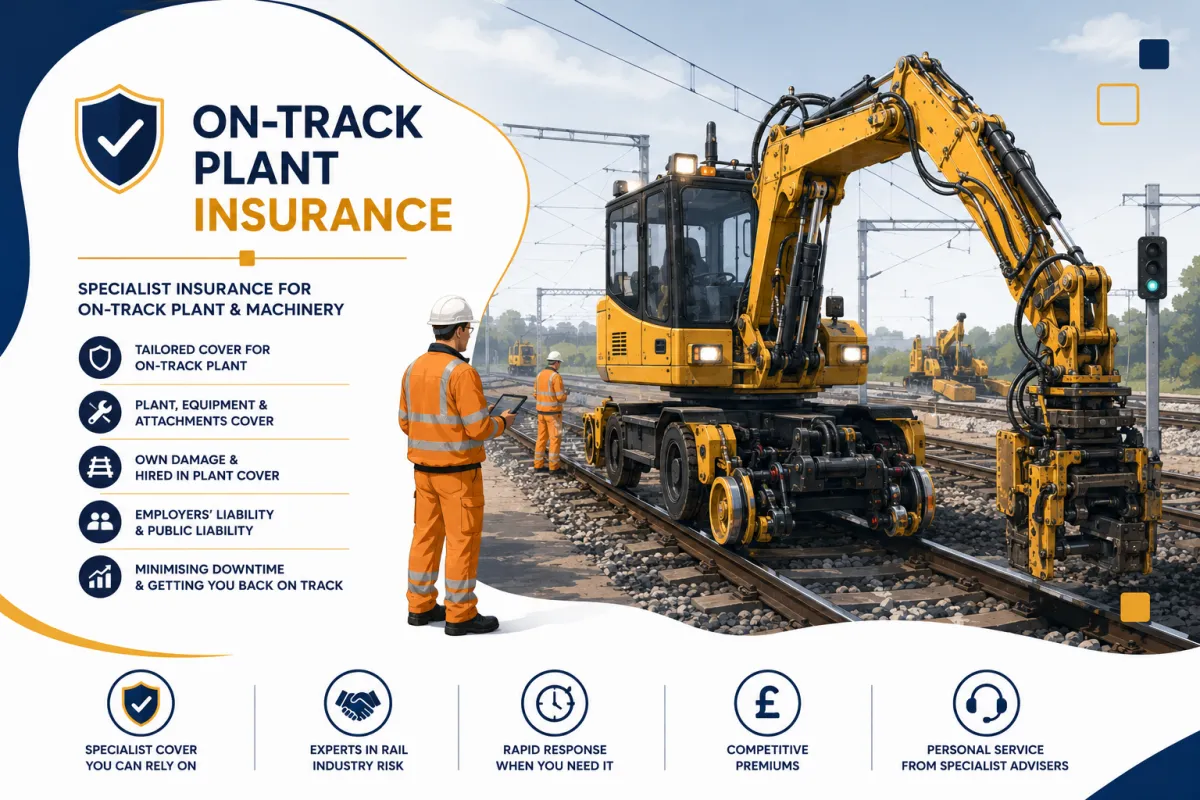
On-Track Plant Insurance UK | Road-Rail Vehicle Cover
Why does on-track plant need its own insurance treatment?
Because a road-rail vehicle changes what it legally is several times a shift, and most plant policies only contemplate one of those states. An RRV is a road vehicle on the highway, an item of plant on a compound, and a rail vehicle on the track. Many general plant wordings exclude cover while an item is on a railway track, and many more are simply silent about it — which leaves you relying on an argument rather than on cover. Add machines whose replacement lead times run into months, and an adjacent-line encroachment scenario that no plant policy limit was ever sized for, and you have a risk that has to be built rather than bought off a panel.
Key facts at a glance
- Check the operative clause, not the schedule. The most common failure in this class is a plant policy that suspends or excludes cover while the machine is on rails. Where the wording is silent rather than explicit, the position is worse, because you discover it during a claim rather than at renewal.
- The RAIB has repeatedly found that operators and machine controllers did not know how to safely on-track and off-track machines — the process of raising and lowering road and rail wheels. It is the transition, not the travelling, that generates a disproportionate share of serious incidents.
- RRVs spend roughly as much time travelling in reverse as forwards, which the RAIB identified as a fundamental issue in its investigation into the collision between two road-rail vehicles at Cholmondeston, Cheshire, where a track worker suffered life-changing injuries. Visibility of the line ahead is now a live standards question under RIS-1530-PLT.
- Runaways remain a recognised failure mode. RAIB investigations into trolley runaways have found braking systems inadequately maintained, and in some cases removed or deliberately disabled by staff. Underwriters read these reports; expect to be asked about your maintenance and inspection regime.
- People-plant interface incidents continue. In February 2024 a track worker directing the movement of one RRV on the Midland Main Line near Braybrooke was struck and injured by another. Exclusion zone discipline is an underwriting question, not just a safety one.
- Adjacent line encroachment is the catastrophe scenario. A machine slewing outside the possession into an open line is rare, drilled against constantly, and capable of producing a loss no plant policy limit contemplates. It has to be discussed explicitly at placement.
- Lead times, not market value, set the real exposure. Specialist rail gear and undercarriage components are not commodity items. Indemnity settlement after depreciation, on a machine you cannot replace for months, leaves a gap that continuing hire charges and contract penalties will fill.
On-track plant sits in an awkward place in the insurance market. It is not quite construction plant, because it operates on a railway under possession, subject to industry standards and competence regimes that no site-based machine encounters. It is not quite a rail vehicle, because it spends a substantial part of its life on the road and in a yard. And it is not quite a motor risk, because road use is often the smallest part of what it does.
The result is that the machine falls between three product categories, and the seams between them are where losses land. In our experience most on-track plant programmes fail not inside a single wording but at the joins: the liability side has been arranged properly with the railway written in, while the plant side sits on a general contractor policy nobody has reread since the business bought its first RRV.
This guide is the asset-side companion to our rail contractor insurance guide, which deals with the liability side — the railway exclusion, delay and disruption costs and the Network Rail joint-insured arrangement. It also sits alongside our plant and machinery insurance guide, which covers general plant valuation mechanics, and our RISQS insurance requirements guide, which covers the compliance evidence that goes with the codes. All three sit behind our rail contractor insurance page.
What does a "whilst on rails" clause actually do to your cover?
It suspends the policy for the part of the job the machine was bought to do. Plant wordings written for construction were drafted when nobody contemplated the insured item running on a railway. Some deal with it by excluding damage occurring while the plant is on a railway track. Others are silent, which insurers may treat as meaning railway operation was never within the scope of the risk presented. Either way, a machine damaged on track can be a declined claim under a policy the operator believed was comprehensive.
There are three drafting patterns, and it matters which one you have:
- Express exclusion. Cover does not apply while the item is on a railway track or railway premises. Clear, unambiguous, and fatal for an RRV operator. Nothing to do but replace the wording.
- Suspension or condition. Cover applies unless the machine is being operated outside a stated set of circumstances, or is conditional on the insurer having agreed the activity. Cover exists on paper; whether it responds depends on administration that is very often skipped.
- Silence. The wording says nothing about railways at all. This is the most common and the most dangerous, because the operator reads the absence of an exclusion as cover, while the insurer reads the absence of a disclosure as a risk it never agreed to write.
Silence is not cover. Under the Insurance Act 2015 a commercial policyholder owes a duty of fair presentation. A plant operator whose machines run on the railway, insured under a policy describing the business as general plant hire, has arguably not made a fair presentation — and the remedy can be a proportionate reduction in the claim or, where the insurer would have declined the risk outright, avoidance. If your RISQS RICCL codes cover on-track plant operations, that mismatch is documented and dated on a third party platform. Our RISQS guide explains why that matters.
How do the three placement routes for on-track plant compare?
A general plant policy with railway use referred and agreed; a rail-aware plant and liability programme; or a bespoke scheduled placement. The right route is driven by fleet value, whether you operate adjacent to open lines, and whether machines are hired out to other contractors. Fleet size matters less than the operating envelope.
| Feature | General plant policy (railway referred) | Rail-aware plant & liability programme | Bespoke scheduled placement |
|---|---|---|---|
| Typical fit | One or two machines, occasional possession work | Regular RISQS-registered on-track operation | Larger fleets, hire-out operations, adjacent-line working |
| Cover while on rails | Only for contracts referred and agreed in writing | Written into the wording as a permitted operating state | Written in, with defined operating parameters per machine |
| Settlement basis | Indemnity after depreciation | Agreed value available on declared machines | Agreed values throughout, reviewed annually |
| Adjacent line encroachment | Not contemplated; liability limit unlikely to be adequate | Discussed and rated at placement | Rated, with excess layers where the exposure warrants |
| Hired-in plant | Basic cover; continuing hire charges often omitted | Continuing hire charges included as standard | Matched to the hire conditions you actually sign |
| Road leg of dual-mode machines | Separate motor policy, rating may not reflect on-track use | Coordinated with the plant section, gaps identified | Integrated fleet and plant programme |
| Downtime and lead times | Not addressed | Hire of replacement plant available by extension | Sized against real component lead times |
| Indicative annual premium | Illustrative: £3,000–£12,000 | Illustrative: £10,000–£60,000 | Illustrative: £50,000–£300,000+ |
Premium ranges above are illustrative only. They indicate the shape of the market rather than being quotations. Actual pricing depends on fleet value and composition, operating envelope, claims record, competence arrangements and the contractual terms you work under.
Which insurance regime applies at which point in the shift?
Three regimes apply in sequence, and the handovers between them are where cover fails. On the highway the machine is a motor risk under the Road Traffic Act. In the compound or at the access point it is plant. On the track it is on-track plant, subject to industry standards and possession arrangements. A well-built programme makes those three states explicit and confirms that no gap exists between them; a poorly built one assumes continuity that nobody has ever tested.
| Stage | What the machine is | Primary cover | Common gap |
|---|---|---|---|
| Transport to site | Load on a low-loader, or driven on the highway | Motor / goods in transit / haulier's liability | Machine value exceeding the haulier's conditions-of-carriage cap |
| Compound and yard | Construction plant at rest or manoeuvring | Plant section, plus theft and vandalism cover | Storage conditions and security warranties not met overnight |
| On-tracking at access point | Transitioning between road and rail modes | Plant section, with railway operation permitted | The exact moment many wordings become ambiguous |
| Travelling within possession | On-track plant under machine controller direction | Plant section on rails, plus public liability with railway extension | "Whilst on rails" exclusion or silence in the plant wording |
| Working — lifting or excavating | On-track plant in operation, often lifting | Plant, liability, and statutory thorough examination in place | Lifting duties assumed to be suspended by possession working |
| Adjacent to an open line | On-track plant beside live traffic | Public liability, potentially at catastrophe limits | Limit sized for plant damage, not for a train accident scenario |
| Off-tracking and handback | Transitioning back, under time pressure | Plant section, plus delay exposure if handback is missed | Delay costs are pure economic loss and usually uninsured |
How does the Insurability Framework apply to on-track plant?
On-track plant is declined or heavily restricted by general markets as a matter of appetite, not because the operators are poor risks. Dual-mode machines, possession working and catastrophe potential put the risk outside standard plant panels. The Insurability Framework™ is our structured method for presenting it to the markets that will write it.
The Insurability Framework applied to on-track plant
Four pillars, applied to RRV operators, rail plant hirers and multi-disciplinary contractors running machines under possession.
Rail plant underwriters price on control at the transitions. Machine controller arrangements, on-tracking procedure, exclusion zone discipline, maintenance of braking systems and competence records are what move the number — and they are exactly what the accident investigators keep writing about.
Machines that operate on rails fall outside general plant appetite. Placement runs through rail-aware Lloyd's syndicates and specialist MGAs that will write on-track operation as a permitted state and schedule specialist machines at agreed values.
The gaps are at the seams: the road leg on a separate motor policy, hired-in plant on hire conditions nobody read, lifting duties assumed away, and a liability limit sized for plant damage rather than for encroachment. We map each handover in the shift against the wording.
A serious on-track plant claim usually arrives alongside a regulatory investigation and a contractual demand from a principal contractor. Getting notification, evidence preservation and the valuation position right in the first fortnight materially changes the outcome.
More on the method on our Insurability Framework page, and on comparable placements in our adverse risk insights hub.
Why is on and off-tracking the highest-risk part of the job?
Because it is the moment the machine is neither one thing nor the other, and the accident investigators keep finding that people do not know how to do it. The RAIB has reported that machine operators and machine controllers did not know how to safely carry out the process of moving machines on and off the track — the sequence of raising and lowering road and rail wheels. It happens at access points, frequently at night, usually under time pressure at the start and end of a possession.
From an insurance perspective the transition concentrates three exposures at once. The machine is unstable in a way it never is in either settled mode. It is being handled by people whose competence in that specific procedure is the thing the investigators have questioned. And it is happening at a location where the geometry is fixed and unforgiving.
What underwriters want to hear about is specific and answerable:
- Who is authorised to on-track and off-track, and how that competence is recorded and refreshed rather than assumed from a card in a wallet.
- Whether the procedure is written down for each machine type in your fleet, since the sequence differs between manufacturers and conversions.
- How access points are assessed before use, including ground conditions and approach gradients.
- What happens under time pressure — specifically, who has authority to stop the transition when handback is approaching and the machine is not behaving.
- How near-misses during transition are captured and acted on. A firm that records and reviews them is a materially better risk than one with a silent record.
Read the source material. The RAIB's summary of learning on the safe design, operation and maintenance of on-track plant and trolleys is published on GOV.UK and updated periodically. It is the single most useful document a plant operator can put in front of its own team, and referencing it in an insurance submission signals a level of engagement most operators never demonstrate.
What happens if a machine encroaches on an open line?
It becomes the only scenario in this class capable of producing a catastrophic loss. A jib, bucket or load slewing outside the protected worksite into an adjacent open line puts a solid obstruction in the path of a passenger train. The physical damage to your machine is irrelevant next to the potential consequence, and no plant policy limit was ever sized for it. This is why the liability side of an on-track plant programme has to be built alongside the asset side rather than bought separately.
Encroachment is rare because the industry treats it seriously. Exclusion zone management, physical slew restriction, machine controller supervision and possession planning all exist substantially because of it. But rarity is exactly why it gets under-insured: an operator who has never seen one may size limits against the losses they have seen, which are dented buckets and damaged undercarriages.
Three practical consequences for your programme:
- Size public liability against the consequence, not the machine. Contractual minimums of £10m are common; whether that is adequate for your operating envelope is a separate question, and excess layers are relatively inexpensive at these limits.
- Expect the encroachment conversation at placement. A specialist underwriter will ask about slew restriction, exclusion zone marking and machine controller ratios. A general underwriter will not ask, which tells you something about whether they have understood the risk they are writing.
- Understand what is not insured. Delay and disruption costs following an incident are pure economic loss and generally fall outside standard public liability. Our rail contractor insurance guide covers that exposure in detail.
From recent placement conversations
"The pattern I see again and again is a plant operator who has done the liability side properly — railway extension, indemnity to principal, correct limits, all in order — and whose plant policy is on general contractor paper bought before they ever touched a railway. The liability broker did a good job. Nobody looked at the machine."
"I ask one question early: does your plant wording say anything at all about rails? If the answer is 'I don't think so', that is the problem, not the reassurance the operator thinks it is. Silence in a plant wording is not permission. It is an argument you have to win at exactly the moment you can least afford to be having it."
What cover does your type of plant operation need?
On-track plant operations vary widely in shape. Select the closest match to see the cover set we would build.
On-track plant cover checker
Road-rail vehicle owner-operator
- CRITICAL Plant cover that operates while the machine is on rails, confirmed in the operative clause rather than assumed from the schedule.
- CRITICAL Adjacent line encroachment discussed and rated, with public liability sized against the consequence.
- LEGAL Employers' liability at £10m rail market standard, above the £5m statutory floor under the Employers' Liability (Compulsory Insurance) Act 1969.
- ESSENTIAL Motor cover for the road leg, correctly rated for a machine that also operates on rails.
- ESSENTIAL Agreed values on each machine, reviewed against current replacement cost and lead times.
- RECOMMENDED Hire of replacement plant following damage, sized against component lead times rather than a nominal period.
- CONSIDER Transit exposure between sites — see our heavy haulage and abnormal load guide.
Rail plant hire company
- CRITICAL Clarity on where your cover stops and the hirer's begins, matched to the hire conditions you actually issue.
- CRITICAL Contract lift versus plant hire distinction — the liability position is completely different and it decides who carries the operational risk.
- ESSENTIAL Agreed values across the fleet, with a schedule reviewed at least annually.
- ESSENTIAL Continuing hire charges recoverable where a machine on hire is damaged.
- ESSENTIAL Verification that hirers hold adequate cover, with minimum limits imposed in your terms.
- RECOMMENDED Loss of hire income cover reflecting utilisation on framework contracts.
- CONSIDER Products and supply exposure where you also supply operators as well as machines.
Rail contractor operating its own machines
- CRITICAL Plant and liability reviewed as one programme, not as two renewals with different brokers.
- ESSENTIAL Public liability with the railway written in as a permitted activity, at sub-contract limits.
- ESSENTIAL Hired-in plant cover including continuing hire charges, since most contractors hire in at peaks.
- ESSENTIAL Underground and buried services liability, the primary loss driver in rail civils.
- RECOMMENDED Contract works cover for the permanent and temporary works — see contractors' all risks insurance.
- CONSIDER Whether your RISQS RICCL codes match your plant schedule description.
Lifting and crane operations on track
- CRITICAL Statutory thorough examination current under LOLER — possession working creates no exemption and an out-of-date report undermines a claim.
- CRITICAL Contract lift versus hire distinction documented in writing before the lift, not after.
- ESSENTIAL Liability for damage to the load, which is frequently sub-limited or excluded.
- ESSENTIAL Appointed person and crane controller competence evidenced.
- RECOMMENDED Engineering inspection arrangements integrated with the insurance programme — see engineering inspection insurance.
- CONSIDER Whether lifting over or adjacent to an open line is contemplated, which changes the exposure entirely.
Trolleys, generators and small plant
- CRITICAL Braking system maintenance and inspection records — the RAIB has found brakes inadequately maintained, removed or deliberately disabled.
- ESSENTIAL Public liability covering runaway scenarios, which produce consequences out of all proportion to the item's value.
- ESSENTIAL Theft cover for high-value portable items in compounds and welfare units.
- RECOMMENDED Asset register kept current — small plant is chronically under-declared and over-lost.
- CONSIDER Whether unbraked items are used at all, and under what documented conditions.
Heritage and non-mainline plant
- CRITICAL Whether volunteers operate or supervise the machine — volunteers are not employees and employers' liability may not extend to them without a specific clause.
- ESSENTIAL Cover appropriate to a non-mainline environment, which is a different risk from possession working on the national network.
- ESSENTIAL Public liability reflecting the presence of visitors on or near the operating railway.
- RECOMMENDED Agreed values on historic or converted machines with no market comparator.
- CONSIDER The wider heritage picture in our heritage railway insurance guide.
Which gaps should you check before your next renewal?
Tick anything you cannot answer immediately. Each item is a gap we find regularly in on-track plant programmes.
On-track plant cover gap checklist
- You cannot point to the words in the plant wording that permit operation on a railway track.
- Your plant wording says nothing about railways at all, and you have read that as cover.
- Machines are insured on an indemnity basis rather than at agreed values.
- Values have not been reviewed against current replacement cost in the last two years.
- Hired-in plant cover does not include continuing hire charges.
- Your public liability limit was set against plant damage rather than an encroachment scenario.
- The road leg sits on a motor policy your plant insurer has never seen.
- Lifting equipment thorough examination dates are not tracked centrally.
- Your RISQS RICCL codes cover on-track plant but your policy describes general plant hire.
- There is no written on-tracking and off-tracking procedure for each machine type in the fleet.
- Braking system inspection records for trolleys and towed items are incomplete.
- You hire machines out but have never checked the hirer's insurance against your own conditions.
Three or more ticks and your plant programme was written for construction sites rather than for a railway. Every item here is fixable at renewal and expensive to discover during a claim.
How hard will your plant fleet be to place?
On-track plant placement assessor
How should road-rail vehicles be valued?
At agreed values built from replacement cost and lead time, not at market value less depreciation. There is no liquid second-hand market for a rail-converted excavator with current approvals, and depreciation curves designed for construction plant do not describe an asset whose value sits largely in its conversion, its approvals and its availability. Indemnity settlement on an RRV routinely produces a cheque that will not buy a replacement, at a moment when the machine is committed to a framework.
What a defensible RRV valuation includes
- The base machine plus the conversion. The rail gear, control systems, approvals and commissioning frequently exceed the value of the host excavator.
- Attachments scheduled separately. Rail handlers, clamshells, magnets, tilt rotators and lifting attachments are individually valuable and individually stealable.
- Current lead times, honestly assessed. If rail gear components take months, that is not a settlement issue but it drives everything you buy alongside the material damage cover.
- Approvals and documentation. Reinstating a machine's approval status after a major repair takes time and money that a simple repair estimate omits.
- Annual review against the market you actually buy in. Specialist plant costs have not tracked general inflation, and a value set three years ago is not merely stale — it is wrong.
Underinsurance bites on partial losses too. Where sums insured prove inadequate, average can apply and settlement is reduced proportionately — so a fleet insured at 65% of its true value can recover 65% of even a modest repair. Our guide to underinsurance and the condition of average explains the mechanism, and our plant and machinery insurance guide covers valuation methodology in general terms.
Who pays when hired-in plant is damaged?
You do, under the hire conditions, and your policy needs to be built to match them. Standard plant hire conditions typically make the hirer responsible for the machine from delivery to return, including for damage that is nobody's fault, plus continuing hire charges until the owner is settled with. Those charges keep accruing while a specialist machine is repaired or replaced — which on rail plant can run to months. A hired-in plant section without continuing hire charges is a partial answer to a full obligation.
Three points that decide whether the cover actually works:
Match the limit to the machines you actually hire. Hired-in plant limits are frequently set once and never revisited. If you occasionally hire a machine worth more than the limit, the exposure is uninsured for exactly the period you are most exposed.
Understand the contract lift distinction. Where lifting is involved, a contract lift and a plant hire arrangement allocate risk completely differently. Under a contract lift the crane owner takes responsibility for planning and executing the lift; under plant hire the hirer directs the machine and carries the operational risk. Signing one document while believing you have the other is a recurring and expensive error, and it is covered further in our heavy haulage and abnormal load guide.
Check the position when you hire out. Plant hire companies putting machines into rail contractors' hands should verify the hirer's cover against their own conditions rather than assuming it exists. A hirer with a general plant policy that excludes railway use is, in practical terms, an uninsured hirer.
Does LOLER apply to machines working under possession?
Yes. Possession working creates no exemption from statutory duties. Where an RRV is used for lifting, the Lifting Operations and Lifting Equipment Regulations 1998 apply exactly as they would on any other site, including thorough examination at the required intervals by a competent person. An out-of-date examination report is both a prosecution risk and a very effective route for an insurer to challenge a claim involving the lifting operation.
The practical difficulty is administrative rather than technical. Rail plant moves between depots, sites and hire arrangements, and examination dates are easy to lose track of across a fleet. The operators who manage it well hold a single central register with alerts, in the same way a well-run RISQS record is managed — and for the same reason, since both are evidence someone will ask to see at the worst possible moment.
Where an engineering inspection provider is connected to your insurer, the link is useful: the inspection regime and the insurance programme look at the same evidence. It also means a lapse is immediately visible to the party who would otherwise pay your claim. Our engineering inspection insurance guide covers how the arrangement is structured.
How does operator competence affect your premium?
More than almost any other factor, because the accident investigators keep identifying competence as the cause. The RAIB has found that operators and machine controllers did not know how to safely on-track and off-track machines, and has raised questions about how visibility and speed are managed during travelling under RIS-1530-PLT. Underwriters read those findings. A submission that evidences competence rather than asserting it gets priced differently.
What counts as evidence, in descending order of value to an underwriter:
- A competence matrix mapped to machine type, not a list of cards. The sequence for on-tracking differs between manufacturers and conversions; a card does not prove familiarity with your specific fleet.
- Machine controller arrangements and ratios, including who has authority to stop an operation and evidence that they have used it.
- Refresher and observation records showing competence is checked in practice rather than assumed from an initial assessment.
- Near-miss capture during transitions. An operator recording and acting on transition near-misses is demonstrably managing the exposure the investigators care most about.
- Sentinel sponsorship governance, including the drug and alcohol regime, where you sponsor your own operators.
The cheapest improvement available. Write down the on-tracking and off-tracking procedure for each machine type in your fleet, name who is authorised to carry it out, and record the last time each of them was observed doing it. Three documents, one afternoon, and they go straight into the submission as evidence of control at precisely the point the industry's own accident reports identify as weakest.
How do you insure plant left in a rail compound?
Carefully, and in line with whatever security warranty your policy imposes. Rail compounds are frequently remote, poorly overlooked and occupied only during possessions, which is close to an ideal profile for plant theft. Insurers respond with security conditions — immobilisers, tracking, marking schemes, storage arrangements — and a claim declined for breach of a security warranty is a claim declined regardless of how the theft occurred.
The practical checklist for compound exposure:
- Read the security warranty before the season starts. Conditions requiring machines to be immobilised, keys removed to a secure location, or items stored within a fenced compound are commonplace and routinely breached in practice.
- Mark and register the fleet. Recognised marking and registration schemes improve recovery rates and are increasingly assumed rather than credited by underwriters.
- Track high-value machines. Telematics are standard on new plant; the question is whether anybody monitors the alerts out of hours.
- Treat attachments as separate targets. Buckets, rail handlers and tilt rotators are stolen far more often than the machines they belong to, and are frequently absent from the schedule entirely.
- Consider fuel and consumables. Fuel theft from compounds is persistent, and a punctured tank causes environmental damage on ballast that costs more to remediate than the fuel was worth.
What drives the cost of on-track plant insurance in 2026?
Operating envelope, fleet values, competence evidence and claims record — with turnover a long way down the list. Two operators with identical fleets can be priced very differently if one works adjacent to open lines with machines hired out to third parties while the other works only within full possessions on its own contracts. This class is judgement-underwritten by a small number of markets, so presentation quality has a direct effect.
| Rating factor | Why it matters to the underwriter | What reduces the loading |
|---|---|---|
| Adjacent line working | The only scenario in this class capable of a catastrophic loss | Slew restriction, exclusion zone management, possession planning records |
| On-tracking and off-tracking regime | The transition the accident investigators most consistently criticise | Written procedure per machine type, named authorised operators, observation records |
| Machine controller arrangements | People-plant interface incidents continue across the network | Ratios, authority to stop, evidence that stopping has happened |
| Fleet values and settlement basis | Agreed values on specialist machines drive the material damage premium | Item-by-item schedule reviewed annually against real replacement cost |
| Component lead times | Long lead times convert a repairable loss into a contractual problem | Replacement hire arrangements and realistic downtime planning |
| Lifting duties and LOLER currency | Statutory examination lapses undermine claims and invite prosecution | Central examination register with alerts across the whole fleet |
| Braking and maintenance records | Runaways with disabled or unmaintained brakes are a documented failure mode | Inspection records, and a clear position on unbraked items |
| Hire in and hire out arrangements | Hire conditions allocate risk in ways policies often do not match | Conditions reviewed against the wording; hirers' cover verified |
| Compound security | Remote, intermittently occupied sites are a theft profile | Immobilisation, marking, tracking with monitored alerts |
| RISQS status and RICCL codes | Independent third party evidence of qualification and scope | Audit-level codes and a policy description that matches them |
| Claims frequency | Predicts management quality more reliably than severity does | Three to five clean years with documented root cause analysis |
| Contractual liability caps | Uncapped delay liability is unquantifiable and priced defensively | Negotiated caps and evidence you review schedules before signing |
| Presentation quality | Few markets write this class; ambiguity is expensive | A structured broker submission that answers questions before they are asked |
What do real on-track plant claims look like?
The three examples below are illustrative composites written for this guide. They are not real clients and not actual claims; the figures are indicative of the shape and scale of loss in this sector, not settlements we have handled.
Case study 1 — The policy that stopped at the rail head
The situation. A road-rail excavator suffered a hydraulic failure during on-tracking at an access point, dropping awkwardly onto the rail head and damaging the undercarriage and rail gear. No injuries, no third party damage, no delay to handback.
The consequence. Repair cost £96,000, with a fourteen-week lead time on rail gear components. The machine was committed to a framework, so the operator hired a replacement at £3,900 per week to avoid contractual default — a further £54,600.
The cover position. The plant policy had been arranged through a general contractor market and contained a condition suspending cover while any item of plant was on a railway track. The claim was declined. The operator's public liability, correctly extended for railway work by a different broker, was irrelevant — there was no third party liability, only own damage. Total uninsured: £150,600.
The lesson. The liability side had been done properly and the plant side had not. Rail programmes fail at the seams between policies far more often than within a single wording. Renewal impact: the whole programme moved to a rail-aware market at roughly 40% higher total premium, with agreed values and on-track operation written in.
Case study 2 — Six inches into the adjacent line
The situation. An RRV operator working a night possession slewed to reposition a length of rail. The machine was working close to the boundary with an adjacent open line. The jib crossed the demarcation by an estimated 150mm for approximately four seconds. No train was in section.
The consequence. No physical damage of any kind. The incursion was reported, the possession was stopped, an investigation followed, and the principal contractor suspended the operator from the framework pending review. The operator was off the framework for seven weeks.
The cover position. Nothing to claim for. No damage, no injury, no third party loss. The financial consequence — approximately £310,000 of lost framework revenue over the suspension and a materially harder conversation at the next renewal — was entirely uninsured and uninsurable.
The lesson. The most expensive encroachment events are frequently the ones where nothing happens. The exposure is commercial and reputational, and the only defence is control quality. Renewal impact: the incident had to be disclosed; terms were offered with a specific condition on slew restriction and exclusion zone marking.
Case study 3 — The hire charges nobody had insured
The situation. A contractor hired in a rail-mounted crane at short notice for a bridge deck installation. During the possession the machine was damaged by contact with a temporary structure. The damage was moderate and the machine was recoverable.
The consequence. Repair cost £41,000, which the hired-in plant section covered. However, the hire conditions made the hirer responsible for continuing hire charges until the owner was settled with. The machine was out of service for nineteen weeks awaiting a slewing ring, and hire charges of £2,850 per week continued throughout — £54,150.
The cover position. The hired-in plant section covered the physical damage but carried no continuing hire charges extension. The contractor met the £54,150 from its own funds, having assumed the hire cover was comprehensive.
The lesson. Continuing hire charges are contractual, unavoidable and frequently larger than the repair itself on specialist rail plant with long component lead times. Renewal impact: continuing hire charges added, and hire conditions now reviewed against the wording before any machine is taken on.
How should a plant operator manage a claim?
Assume an investigation will follow, and preserve the machine and the records before anything is moved. On-track plant incidents frequently attract regulatory and industry investigation alongside the insurance claim, and both turn on the same evidence. Make people safe, notify the same day, keep the machine as found where it is safe to do so, and separate the physical damage from any consequential cost from the first hour.
- Make people safe and follow the possession incident procedure. Nothing else matters until this is done, and the industry process takes precedence over anything commercial.
- Notify your broker the same day. Not when the repair estimate arrives. Policies require notification of circumstances that may give rise to a claim, and late notification is one of the few things that can prejudice an otherwise valid claim.
- Preserve the machine as found where it is safe to do so. Recovery pressure at handback is intense, but photographs and, where possible, an engineer's inspection before recovery are worth far more than a reconstruction afterwards.
- Download and secure the telematics. Machine data is the most objective record of what happened and it is frequently overwritten. Secure it before it cycles.
- Preserve the operational documentation. Safe work pack, on-tracking records, machine controller briefing, competence records, maintenance and examination reports, and the possession log.
- Separate physical damage from consequential cost in every record. Repair costs are usually insured; continuing hire charges, downtime and delay costs may not be, and losses recorded as one figure are harder to recover in part.
- Route correspondence through your broker. Where a principal contractor is making a contractual demand alongside the insurance claim, the coverage position and the commercial position need to stay aligned.
- Complete a documented root cause review and record what changed. At renewal, the difference between a loss that frightens underwriters and one they can price is a credible account of what you changed afterwards.

John Miller — Director & Principal Broker
John has spent over thirteen years placing specialist commercial risks, with a particular focus on infrastructure businesses whose assets fall outside standard product categories. On-track plant is a recurring example: operators who have arranged their liability cover carefully, through a broker who understood the railway, while the machines themselves sit on general plant paper bought before the business ever touched a railway. He works with RRV operators, rail plant hire companies and contractors running their own machines to close the seams between the plant, motor and liability sections — and to get agreed values that reflect what a replacement actually costs and how long it actually takes.
Former #1 Account Executive at Brown & Brown and former #1 Salesperson at AXA, with direct access to the Lloyd's Market and specialist MGA schemes.
Glossary of on-track plant insurance terms
- On-track plant (OTP)
- Mobile plant designed or adapted to operate on a railway track, including road-rail vehicles, on-track machines and rail-mounted equipment.
- Road-rail vehicle (RRV)
- An item of construction plant constructed or adapted to operate on both roads or site ground and on rails, used as an excavator, crane, access platform, spoil carrier or rail handler among other applications.
- On-tracking / off-tracking
- The process of moving a machine onto or off the rails at an access point, involving the raising and lowering of road and rail wheels. Identified by accident investigators as a recurring source of incidents.
- Access point
- A location where machines can be placed on or removed from the track. Ground conditions, gradient and geometry at the access point are underwriting considerations.
- Machine controller
- The competent person responsible for controlling the movement and operation of on-track plant within the worksite, including exclusion zone management.
- Encroachment
- Movement of a machine, jib, load or personnel outside the protected worksite into an adjacent open line. The defining catastrophe scenario for on-track plant.
- Exclusion zone
- The area around operating plant from which personnel are excluded. Discipline in maintaining it is a central control against people-plant interface incidents.
- RIS-1530-PLT
- The Railway Industry Standard covering technical requirements for on-track plant, including engineering and procedural controls for the safe travelling of road-rail vehicles.
- Agreed value
- A basis of settlement where insurer and insured agree an item's value in advance. The appropriate basis for specialist rail plant with no liquid second-hand market.
- Indemnity settlement
- Settlement at market value less depreciation. Frequently inadequate for converted rail plant, where much of the value sits in the conversion and its approvals.
- Continuing hire charges
- Hire costs that continue to accrue after hired-in plant is damaged, until the owner is settled with. Contractual, unavoidable and often larger than the repair on specialist plant.
- Contract lift
- An arrangement where the crane owner takes responsibility for planning and executing the lift, as distinct from plant hire where the hirer directs the machine and carries the operational risk.
- Thorough examination
- The statutory examination of lifting equipment required under LOLER 1998, carried out by a competent person at prescribed intervals. Not suspended by possession working.
- Possession
- A planned period during which a section of railway is closed to traffic so engineering work can be carried out, with a fixed handback time.
- Runaway
- Uncontrolled movement of a trolley, trailer or item of plant, frequently associated with inadequate, removed or disabled braking systems.
- Condition of average
- The mechanism by which a claim is reduced proportionately where the sum insured is inadequate. Applies to partial losses as well as total ones.
- Security warranty
- A policy condition requiring specified security measures, such as immobilisation or secure storage. Breach can defeat a theft claim regardless of how the theft occurred.
Frequently asked questions
Is my plant covered while it is on the rails?
Check the operative clause rather than the schedule. Many general plant wordings either exclude cover while an item is on a railway track or are silent about it, and silence is the more dangerous of the two because you discover the position during a claim. Road-rail vehicles need cover that works in both modes, written in as a permitted operating state rather than assumed.
Do I need separate motor insurance for a road-rail vehicle?
Where the machine is driven on the public highway, road traffic requirements apply and a motor policy is needed for that leg. The important point is coordination: the motor policy, the plant section and the liability section should be arranged in the knowledge of each other, because the gaps between them are where claims fail. An RRV changes what it legally is several times a shift.
How should RRVs be valued for insurance?
At agreed values built from replacement cost and lead time, not market value less depreciation. There is no liquid second-hand market for a rail-converted machine with current approvals, and the conversion frequently exceeds the value of the host machine. Schedule attachments separately, review annually, and remember that inadequate sums insured can trigger average on partial losses as well as total ones.
What is the biggest risk in on-track plant operation?
Adjacent line encroachment — a jib, bucket or load moving outside the protected worksite into an open line. It is rare because the industry drills against it constantly, but it is the only scenario in this class capable of a catastrophic outcome, and no plant policy limit was ever sized for it. It should be discussed explicitly at placement rather than left to the standard liability limit.
Why is on-tracking and off-tracking treated as high risk?
Because the accident investigators keep finding that people do not know how to do it safely. The RAIB has reported that machine operators and machine controllers did not know how to safely carry out the process of moving machines on and off the track. It happens at fixed geometry access points, usually at night, under time pressure at the start and end of a possession.
Does LOLER apply to lifting on a possession?
Yes. Possession working creates no exemption from statutory duties. Where an RRV is used for lifting, the Lifting Operations and Lifting Equipment Regulations 1998 apply as they would on any other site, including thorough examination at the required intervals by a competent person. An out-of-date examination report is both a prosecution risk and a route for an insurer to challenge a claim.
What are continuing hire charges and do I need cover for them?
They are the hire costs that keep accruing after hired-in plant is damaged, until the owner is settled with. Standard hire conditions typically make the hirer responsible for them. On specialist rail plant with long component lead times, they can exceed the repair cost itself — nineteen weeks at a few thousand pounds a week adds up quickly. A hired-in plant section without this extension is a partial answer to a full obligation.
What is the difference between a contract lift and plant hire?
Under a contract lift, the crane owner takes responsibility for planning and executing the lift. Under plant hire, the hirer directs the machine and carries the operational risk. They allocate liability completely differently, and signing one while believing you have the other is a recurring and expensive error. Confirm which arrangement applies in writing before the lift, not afterwards.
Will my insurer ask about the RAIB reports?
A specialist rail plant underwriter will ask about the themes in them, even if not by name — braking system maintenance on trolleys and towed items, visibility when travelling in reverse, on-tracking competence and exclusion zone discipline. These are the recurring findings, so they are the recurring questions. An operator who can answer them specifically is priced differently from one who cannot.
Does my plant cover extend to attachments?
Only if they are scheduled. Rail handlers, clamshells, magnets and tilt rotators are individually valuable and are stolen more often than the machines they belong to, yet they are frequently missing from the schedule entirely. List them separately with their own values, and check that your compound security arrangements cover items detached from a machine.
Can I get cover if I have had an encroachment incident?
Usually yes, but the presentation has to do more work. Encroachment incidents must be disclosed even where no damage occurred, and underwriters will want the investigation outcome and, more importantly, what changed afterwards. Expect conditions on slew restriction and exclusion zone management. Our guides to business insurance with a claims history and insurance for businesses refused cover explain how we build those submissions.
How do I find a specialist on-track plant insurance broker?
Ask four questions: where does the wording permit operation on rails, how are machines valued, are continuing hire charges included, and how is encroachment rated. A specialist answers all four without hesitating and will want to see your plant schedule, your RICCL codes and your competence arrangements before quoting. Miller & Partner approaches every rail placement through the Insurability Framework — underwriter intelligence, difficult risk expertise, risk assessment and claims advocacy. Start at our rail contractor insurance page or call 01792 001350.
About this guide
This guide is general information about insurance for UK on-track plant and road-rail vehicle operators. It is not advice, and it is not a recommendation to buy or hold any particular policy. Any cover described is subject to insurer acceptance, underwriting and the terms of the policy actually issued.
References to Rail Accident Investigation Branch findings and to industry standards are drawn from published sources as at the publication date and are summarised in outline only. They are included to illustrate underwriting considerations and are not a substitute for reading the source material or for your own safety advice. Miller & Partner is not affiliated with the RAIB, the Office of Rail and Road, RSSB or RISQS.
Premium ranges are illustrative and are included to indicate the shape of the market. They are not quotations. The case studies are illustrative composites written for this guide — not real clients and not actual claims; the figures are indicative and are not settlements handled by Miller & Partner. The interactive cover checker, gap checklist and placement assessor are general information tools only — not personalised advice, not a recommendation and not a quotation.
Legislation and regulatory guidance are described as at the publication date shown at the top of this guide and may change. For our regulatory status, please see the footer of this website. To discuss an on-track plant placement, email enquiries@millerandpartner.co.uk or call 01792 001350.







Instagram
LinkedIn