


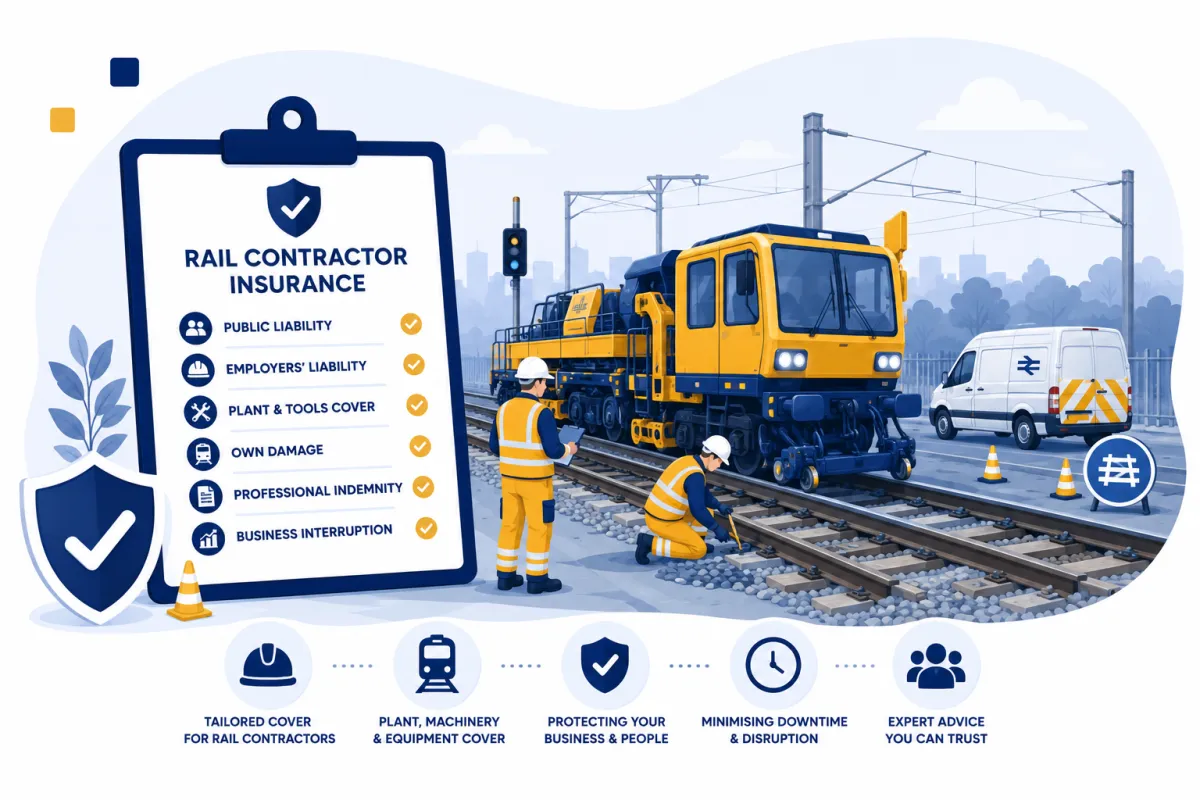
Rail Contractor Insurance UK | RISQS & Network Rail Cover
Why does rail contracting need specialist insurance treatment?
Rail contractor insurance is specialist because most standard UK liability wordings exclude or restrict work on or near an operational railway by name. A contractor who buys a normal trades or contractors' combined policy and then wins rail work is frequently uninsured for the thing they are actually doing. Three exposures drive the specialism: the railway exclusion itself; delay and disruption costs charged by Network Rail or a train operator, which are pure economic loss and fall outside standard public liability; and the RISQS qualification process, which requires insurance evidence to be uploaded, verified and kept in date as a condition of remaining visible to buyers. Placement is usually into rail-aware Lloyd's or specialist MGA markets rather than the general contractor panel.
Key facts at a glance
- Most standard liability wordings carry a railway exclusion. General contractors' and tradesman policies routinely exclude work on, over, under or within a stated distance of an operational railway, or make it subject to prior written referral. Buying cover and then bidding rail work is the single most common uninsured-loss mechanism in this sector.
- Network Rail includes its contractors as joint insureds under its own third party liability programme — confirmed annually to the Office of Rail and Road under its general approval. The published contractor letter has stated a limit of £155m per occurrence. It is not a substitute for your own cover, and Network Rail expressly reserves the right to push excesses and primary insurance back onto contractors by contract.
- RISQS is operated by RSSB and is the entry point to the GB rail supply chain — around 4,000 supplier members serving 90-plus buyers including Network Rail, TfL, freight and passenger operators and the major tier-one contractors. Insurance certificates are uploaded evidence with expiry dates; letting them lapse can create a limitation visible to every buyer.
- Delay and disruption costs are pure economic loss. Standard public liability responds to injury and physical damage, not to the compensation Network Rail pays train operators when your work overruns a possession. This is the largest single gap in rail contractor programmes and needs to be addressed by wording, not assumed.
- The ORR's annual health and safety report for 2025–26 records continuing concern over track worker safety, including a fatality at Radlett, twenty high-potential workforce safety events, and an Improvement Notice served over worsening hand-arm vibration exposure. Underwriters read this report; it shapes the questions you get asked.
- Network Rail was fined £3.41m plus costs of £43,096 in February 2025 following the death of a track worker at Surbiton, after prosecution by the ORR under the Health and Safety at Work etc. Act 1974. Health and safety fines are not insurable; the defence costs and the civil claim that follows are.
- Rail buyers commonly require £10m public liability as a minimum, with £5m employers' liability the statutory floor but £10m the market standard, and principal contractors on major projects frequently specifying higher. Limits are contractual, not regulatory — read the schedule before you price the job.
Rail is one of the few UK sectors where a competent, well-run, profitable contractor can find itself completely uninsured while holding what looks like a perfectly valid insurance certificate. That is not a failure of the contractor. It is a structural feature of how the general insurance market treats railway exposure — and of how quickly a civils, plant, fencing, vegetation or drainage business can drift from highway and industrial work into rail work without anyone stopping to reread the policy.
The drift usually happens the same way. A groundworks or plant firm is approached by a tier-one contractor to sub-contract on a station car park, an access road, a compound, a culvert, some lineside vegetation clearance. The work is nowhere near a running line, so nobody thinks about it. Then the next package moves inside the boundary fence. Then there is a Sentinel card requirement, a RISQS registration request, an insurance schedule attached to the sub-contract with limits and endorsements nobody in the office has read. By the time the firm is working under possession on the operational railway, the policy that was written for general civils has been quietly doing something it was never designed to do.
This guide is written for that business, and for the established rail specialist that wants to test whether its programme has kept pace with the work it is now winning. It sits alongside our contractors' combined insurance page and our broader construction insurance offering, and it deliberately overlaps with the adjacent guides on civil engineering insurance, groundworks contractors and heavy haulage and abnormal loads — because in practice most rail contractors are also doing at least one of those things.
How does the Insurability Framework apply to rail contractors?
Rail work is a textbook difficult-risk placement. The activity is excluded by default in mainstream wordings, the loss severity is driven by consequential costs rather than physical damage, and the buyer imposes contractual insurance terms the contractor cannot negotiate. That combination is exactly what The Insurability Framework™ was built for — a structured method of turning a risk that standard markets decline into one a specialist underwriter can price with confidence.
The Insurability Framework applied to rail contracting
Four pillars we apply to every rail placement, from a two-van fencing firm to a multi-disciplinary infrastructure contractor.
Rail underwriters price on control, not sentiment. What moves the needle is your RISQS status and RICCL codes, your Sentinel sponsorship arrangements, your safe work planning documentation, your possession record, and whether you can evidence competence rather than assert it. We tell you what the underwriter will ask before they ask it.
Work on or adjacent to an operational railway is declined or referred by most general contractor markets. Placement runs through rail-aware Lloyd's syndicates and specialist MGAs that will write the railway extension, on-track plant, and delay exposures as a coherent programme rather than three disconnected policies.
The hidden exposures in rail are rarely the obvious ones. Buried services and signalling cables, adjacent-line encroachment by plant, design responsibility that has migrated to you through a sub-contract, and long-latency disease claims from vibration and dust all sit behind the headline liability limit. We map them against the wording.
A rail claim usually arrives as a contractual demand from a principal contractor with a delay schedule attached, not as a conventional third party letter. Getting the notification, the reservation of rights and the quantum argument right in the first fortnight materially changes the outcome. That is a broker job, not a call centre job.
You can read more about how the framework works across sectors on our Insurability Framework page, and see how the same method is applied to other declined and hard-to-place risks in our adverse risk insights hub.
What does the railway exclusion in a standard liability policy actually do?
It removes cover for the work, not just for accidents involving trains. A typical railway exclusion applies to liability arising from work carried out on, over, under, or within a stated distance of an operational railway — commonly expressed as a proximity limit or as "railway premises". Where the wording is a referral condition rather than an absolute exclusion, cover exists only if the insurer has agreed the specific contract in writing beforehand. Verbal agreement with a broker is not agreement by an insurer.
The commercial logic behind the exclusion is straightforward. Insurers underwriting a general contractor panel are pricing for injury and property damage claims where the damaged property is a building, a vehicle, a pipe or a wall. On the railway, a modest physical event has a disproportionate financial tail: a damaged cable is worth a few thousand pounds, but the signalling failure it causes cancels services across a route for a shift, and somebody will be billed for that. General market pricing does not contemplate it, so general market wordings exclude it.
There are three broad drafting patterns, and it matters enormously which one you have:
- Absolute exclusion. No cover for liability arising out of work on or adjacent to a railway, full stop. Nothing can be done with this wording other than replace it.
- Proximity exclusion. Cover falls away within a stated distance of a running line or of railway property. This catches far more work than contractors expect — compound access, crane oversail, scaffolding, and vegetation work are routinely inside the boundary even when the operatives never set foot on ballast.
- Referral condition. Cover applies only where the insurer has confirmed the specific contract in writing. This is the most dangerous of the three, because the policy technically covers the work — but only if a piece of administration was completed, and that administration is very often skipped when a contract is won quickly.
The disclosure trap. Under the Insurance Act 2015, a commercial policyholder owes a duty of fair presentation. A contractor who describes its business as "civil engineering" or "groundworks" when a material and growing share of turnover is rail work has arguably not made a fair presentation, even if no question about rail was asked. The remedy for a careless non-disclosure can be a proportionate reduction in claim payment or, where the insurer would have declined the risk outright, avoidance. We cover this mechanism in more detail in our guide to business insurance with a claims history.
How do the three placement routes for rail work compare?
There are three realistic routes: a standard contractors' policy with the railway referred and agreed; a rail-endorsed contractors' combined policy from a rail-aware market; or a bespoke programme built layer by layer. The right route depends less on your turnover than on whether you go inside the boundary fence, whether you operate on-track plant, and whether your contracts expose you to delay and disruption costs.
| Feature | Standard contractors' policy (railway referred) | Rail-endorsed contractors' combined | Bespoke rail programme |
|---|---|---|---|
| Typical fit | Occasional lineside or station work, outside the boundary | Regular RISQS-registered sub-contracting on the operational railway | Tier-one sub-contractors, on-track plant operators, multi-disciplinary rail specialists |
| Railway exposure | Covered only for the specific contracts referred and agreed in writing | Written into the wording as a permitted activity | Written into the wording, with defined operational parameters |
| Public liability limit | Usually £2m–£5m; £10m sometimes available | £5m–£10m standard, higher by negotiation | £10m primary with excess layers to £25m+ |
| Delay / disruption costs | Not covered — pure economic loss | Sometimes available by extension, often sub-limited | Addressed explicitly; limits set against contract exposure |
| On-track plant / RRVs | Excluded or unrated | Rated as a declared category | Scheduled with agreed values and on-track operating cover |
| Indemnity to principal / joint insured | Sometimes available, often restrictive | Standard feature | Drafted to match the sub-contract schedule |
| RISQS evidence acceptability | Certificate may be acceptable; scope may not match RICCL codes | Aligned to declared rail activities | Aligned, with broker letters where buyers require them |
| Indicative annual premium | Illustrative: £2,000–£8,000 | Illustrative: £7,000–£35,000 | Illustrative: £30,000–£250,000+ |
Premium ranges above are illustrative only. They are shown to indicate the shape of the market, not as quotations. Actual pricing depends on turnover split, RICCL codes, claims record, limits, plant schedule and the contractual terms you are working under.
Are you already covered by Network Rail's own insurance?
Partly, and only for work under contract for or on behalf of Network Rail. Network Rail confirms to the ORR each year that contractors and operators are included as joint insureds under its third party liability programme, with the published letter stating a limit of £155m per occurrence. It covers third party liability arising from that contracted work. It does not cover your employees, your plant, your professional advice, your own contractual liabilities, or any work for any other client — and Network Rail expressly reserves the right to make contractors responsible for excesses or primary insurance.
This is the most misunderstood point in the whole sector, and it produces two opposite errors.
The first error is assuming the arrangement covers everything, so a modest own-account policy will do. It does not. The joint-insured arrangement is a third party liability programme; it is not employers' liability, it is not damage to your own plant, it is not professional indemnity for your design work, and it is not the delay compensation your principal contractor will levy against you under the sub-contract. Nor does it help you at all on the same day you leave a Network Rail possession and drive to a private siding job for a freight terminal operator.
The second error is assuming the arrangement is irrelevant, so the contractor's own policy must be sized to absorb a catastrophic railway loss unaided. Also wrong, and expensive. Where the arrangement applies, it sits above a level of exposure no SME contractor could ever purchase commercially. Understanding where your own programme stops and the Network Rail programme starts is what allows you to buy sensible limits instead of guessing.
The ORR publishes the current Network Rail broker confirmation alongside its general approval material for operator third party liability insurance. The letter is reissued on renewal of Network Rail's programme, and the arrangement can be terminated on notice. It is not a permanent entitlement, and it should never be described in a tender response as though it were your own cover.
What this means for your excess. Where a principal contractor passes down responsibility for the policy excess or requires you to sit primary, that obligation is contractual and it is yours. We have seen sub-contract schedules requiring a contractor with a £2,500 policy excess to carry a £25,000 contractual deductible on rail work. If your wording does not match the schedule, you are self-insuring the difference whether you have budgeted for it or not.
What insurance evidence does RISQS actually require?
Current certificates for the liabilities relevant to your RICCL codes, uploaded to the RISQS portal with valid expiry dates. RISQS is operated by RSSB and is the qualification route into the GB rail supply chain. Suppliers select Rail Industry Commodity Classification List codes describing what they do; each code is either verification-level or audit-level. Insurance sits in the compliance evidence set alongside management systems, competence management and financial information, and lapsed evidence can produce a limitation visible to every buyer on the platform.
Three things about RISQS regularly catch contractors out, and none of them are obvious from the outside.
Your RICCL codes must match your policy scope
Suppliers pick RICCL codes for the products and services they want to sell into rail. Those codes are the description of your business that every buyer sees. If your codes say you undertake on-track plant operations, and your insurance schedule describes your business as "general civil engineering contractor", you have created a mismatch between what you have told the industry you do and what you have told your insurer you do. Under a fair presentation analysis, that mismatch is documented, dated and sitting on a third party platform. It is the first thing a claims investigator will find.
Verification and audit are different gates
Codes carry a pre-set risk level. Verification codes complete on submission and checking of evidence. Auditable codes require your organisation to undergo and pass a RISQS audit before you are qualified to supply against them. Audit-level codes generally reflect higher safety consequence — and, unsurprisingly, they attract different underwriting treatment too. A supplier holding audit-level codes is a materially better presentation to an underwriter than one holding verification codes only, and we use that in submissions.
Evidence expiry is a live commercial risk
Insurance evidence on the portal is tied to the expiry dates of the documents you upload. Renewal paperwork that arrives late, or a mid-term change of insurer that nobody uploads, can leave your record showing expired evidence. Buyers see limitations. In a sector where qualification is the gate to being invited to tender at all, a paperwork gap is a commercial problem long before it is an insurance problem. Build the upload into your renewal process, not into somebody's memory.
A practical fix. Ask your broker to issue certificates with an anniversary date that suits your RISQS record, and to send the renewal documents to whoever administers the portal on the same day they go to your accounts team. It costs nothing and removes an entire category of avoidable disruption. Note also that RISQS operates as a qualifying utilities dynamic market under the Procurement Act 2023, so your record has a procurement function as well as an assurance one.
From recent placement conversations
"The conversation I have most often with rail contractors starts with them sending me a certificate and asking whether it is good enough for RISQS. That is the wrong question, and it is the question the whole market has trained them to ask. The certificate is almost always 'good enough' to upload. What nobody checks is whether the policy behind the certificate actually covers the work described by the RICCL codes they have selected."
"I have seen a fencing and vegetation contractor with a perfectly valid £5m public liability certificate, fully compliant on the portal, whose underlying wording excluded work within ten metres of a running line. Every single job they had done that year was inside that distance. They had been trading, invoicing and evidencing compliance for eleven months with no effective cover for their core activity. Nobody had lied to anybody. The certificate simply does not tell you what the policy does."
Why do possession overrun and delay costs sit outside most liability policies?
Because they are pure economic loss, and public liability insures injury and physical damage. When engineering work overruns its possession, or a contractor's error causes services to be cancelled, the money that changes hands is compensation for disruption — not payment for damaged property. Standard PL wordings do not reach it. On the railway this is not a marginal exclusion: the disruption cost of an incident routinely exceeds the physical damage by one or two orders of magnitude, which inverts the normal relationship between a policy limit and a real loss.
Railway access is sold in time. Engineering possessions are planned months in advance, published, and locked into the timetable. Train operators are compensated when planned or unplanned disruption affects them, through the contractual regimes that sit between Network Rail and the operators. When a possession overruns, that compensation flows, and Network Rail looks down the chain to recover it. Your principal contractor then looks at you.
The result is a demand that has almost nothing in common with a conventional third party claim. There is often no injury. There may be no damage to anybody's property at all. There is simply a schedule of delay minutes, a rate, and a total. A contractor whose entire insurance programme is built around bodily injury and property damage finds that the largest financial event in its history is not an insured peril.
What can actually be done about it
- Negotiate the contract first. The most effective control is a liability cap in the sub-contract. Caps are more achievable than contractors assume, particularly for specialist packages where the principal contractor needs you more than it needs the clause.
- Buy the extension where it exists. Some rail-aware markets will extend liability wordings to pick up defined delay and disruption costs arising from a covered event, usually with a sub-limit. It is not standard, it is not cheap, and it does not exist on general contractor paper — but it exists.
- Separate physical from consequential in your own reporting. When something goes wrong, the physical damage element is usually insured and the delay element usually is not. Recording them separately from the first hour protects the recoverable part of the claim.
- Do not rely on a professional indemnity policy to fill the gap. PI responds to negligent advice or design, not to operational overrun. Where design is genuinely implicated it matters a great deal, which is why we deal with rail PI separately below.
What happens when a contractor strikes a signalling cable?
A cable strike is the classic rail claim because it converts a small physical loss into a very large economic one. The cable itself may cost a few thousand pounds to repair. The signalling failure it causes can suspend services across a route, generating compensation and delay costs that dwarf the repair. Public liability typically responds to the physical damage to the cable; it typically does not respond to the disruption costs, unless the wording has been specifically extended.
Buried services are the single most common source of serious loss in rail civils, and the risk is worse than in highway work for three reasons. Records are frequently incomplete on older infrastructure. Cable routes do not always follow the alignment you would expect. And the consequence of a strike is not a localised outage but a network effect — signalling, telecoms, power and level crossing control can all be affected by a single excavation.
Underwriters know this, and the questions they ask about buried services are a reliable indicator of whether you are talking to a rail-aware market. A general contractor underwriter asks whether you use a CAT and Genny. A rail underwriter asks about your permit-to-dig process, who signs it, whether trial holes are hand-dug, how you manage the interface with the infrastructure manager's records, and what happened the last time you found something unrecorded.
Related exposure — cable theft. Copper theft from the lineside remains a persistent problem, and contractors holding cable on site or in compounds carry both a stock exposure and a duty-of-care exposure to the infrastructure manager. Where you handle recovered or surplus metal you may also touch the licensing regime discussed in our guide to scrap metal dealer insurance.
Which covers does your type of rail business actually need?
Rail is not one risk. A signalling design consultancy, a vegetation clearance crew and an on-track plant operator sit in three genuinely different underwriting worlds, and the cover priorities are not the same. Select the closest match below. Every route can be quoted through our contractors' combined facility or placed as a bespoke programme, depending on scale.
Rail contractor cover checker
Choose the description that best fits your business to see the cover set we would build.
Rail civils, earthworks and structures
- LEGAL Employers' liability — £5m statutory minimum under the Employers' Liability (Compulsory Insurance) Act 1969; £10m is the rail market standard and is commonly specified contractually.
- ESSENTIAL Public and products liability with the railway written in as a permitted activity — £10m is the usual contractual floor for work on the operational railway.
- CRITICAL Buried services / underground services cover. Standard wordings frequently exclude damage to underground services or apply a punitive sub-limit. On rail this is the primary loss driver.
- ESSENTIAL Contract works cover for the permanent and temporary works, including free-issue materials. See our guide to contractors' all risks insurance.
- RECOMMENDED Owned and hired-in plant, with continuing hire charges — the hire company will invoice regardless of whose fault the loss was.
- RECOMMENDED Delay and disruption extension where the market will offer it, sized against your possession exposure.
- CONSIDER Environmental impairment liability for earthworks, dewatering and lineside drainage discharge. Our geotechnical and ground engineering guide covers the ground-risk interface in depth.
On-track plant, RRVs and machine operations
- LEGAL Employers' liability at £10m, reflecting the injury severity profile of machine operations under possession.
- CRITICAL Plant cover that operates while the machine is on rails. Many standard plant wordings suspend cover when the equipment is on a railway track — read the operative clause, not the schedule.
- CRITICAL Adjacent line encroachment. Over-slewing into an open line is the industry's defining near-miss scenario and it needs to be discussed explicitly at placement.
- ESSENTIAL Motor cover for the road leg of dual-mode machines, correctly rated for their on-track use.
- ESSENTIAL Public liability with the railway extension and adequate indemnity to principal provisions.
- RECOMMENDED Agreed-value scheduling for high-value machines rather than indemnity settlement — see our plant and machinery insurance guide.
- CONSIDER Engineering inspection where lifting equipment is involved; statutory thorough examination obligations do not disappear because you are inside a possession. See engineering inspection insurance.
Signalling, telecoms and electrification & plant
- LEGAL Employers' liability at £10m — electrical work under possession carries a severe injury profile.
- CRITICAL Professional indemnity on a claims-made basis where you hold any design, verification or engineering assurance responsibility. Check the retroactive date every year.
- ESSENTIAL Public liability with the railway extension, at limits matching the sub-contract schedule.
- ESSENTIAL Efficacy / performance exposure review — a wrong-side failure is a design and workmanship question, not a simple damage question.
- RECOMMENDED Cyber cover where you touch operational technology, control systems or asset data. See our construction cyber insurance guide.
- CONSIDER Product liability where you manufacture, modify or supply components as well as installing them.
Lineside vegetation management and fencing
- LEGAL Employers' liability at £10m — chainsaw work at height beside a live railway is one of the sharper injury profiles in the sector.
- CRITICAL Confirmation that your policy covers work at height and climbing, not just ground-level clearance. Many trades schemes cap arboricultural work — the boundary is explained in our tree surgeon and arboriculture insurance guide.
- CRITICAL Timber or debris falling onto the running line — a small physical event with a very large disruption tail.
- ESSENTIAL Public liability with the railway extension; lineside work is almost always inside a proximity exclusion.
- RECOMMENDED Herbicide and spraying pollution cover where you undertake weed control on the ballast or cess.
- CONSIDER Overhead line proximity training and isolation evidence — underwriters ask about it, and prosecutions turn on what was isolated on the day.
Rail design consultancy and engineering assurance
- CRITICAL Professional indemnity with a limit matched to project value, not to fee income. Rail design errors are discovered late and cost far more than the fee that generated them.
- CRITICAL Continuity of the retroactive date. A gap or a change of insurer that resets the retroactive date can orphan years of past work — see professional indemnity run-off cover.
- LEGAL Employers' liability where you employ anyone, including where staff attend site for surveys or witnessing.
- ESSENTIAL Public liability for site attendance, at the limits your access agreements demand.
- RECOMMENDED Review of fitness-for-purpose and net contribution wording against the appointment. Absolute obligations in a contract can sit outside a PI policy that only insures negligence. Our professional indemnity page sets out the structure.
- CONSIDER Cyber and data cover for asset models, survey data and BIM environments.
Rail labour supply and Sentinel sponsorship
- LEGAL Employers' liability covering the correct employment status of every worker — agency, PAYE, and self-employed operatives are treated differently and the distinction is frequently wrong on paper.
- CRITICAL Confirmation that labour-only supply is a declared activity. Supplying labour that works under someone else's direction changes the liability analysis materially.
- ESSENTIAL Public liability including liability for the acts of supplied personnel, with indemnity to principal.
- ESSENTIAL Competence and sponsorship record-keeping — drug and alcohol testing and competence data sit on Sentinel and are the first evidence any investigation reviews.
- RECOMMENDED Professional indemnity where you also provide safe work planning or competence assurance services rather than bodies alone.
- CONSIDER Legal expenses and employment practices cover, given the contractual and employment status complexity in rail labour supply.
Which contract clauses should trigger a call to your broker?
Rail sub-contracts routinely contain insurance obligations that a standard policy cannot meet. Work through the list below and tick anything you recognise from a schedule you have signed or are about to sign. Each one is a genuine mismatch we see; each one is fixable before signature and expensive afterwards.
Rail sub-contract red flag checklist
- A public liability limit higher than the limit on your current schedule — commonly £10m where you hold £5m.
- A requirement to name the principal contractor or infrastructure manager as joint insured, or to provide indemnity to principal.
- A waiver of subrogation in favour of the client and its group companies.
- Liability for delay, disruption or Network Rail access charges with no cap — the single most dangerous clause in rail sub-contracting.
- A contractual deductible or excess higher than the excess on your own policy.
- Professional indemnity required on a project-value basis, or for a stated number of years after completion.
- A fitness-for-purpose or absolute performance obligation where you carry design responsibility.
- An obligation to maintain cover for a period after practical completion, which becomes a run-off obligation if you stop trading.
- Underground services liability required without sub-limit, where your policy sub-limits it.
- A requirement that insurers be rated at a stated financial strength, which your current market may not meet.
- On-track plant operations included in scope where your plant policy is silent about rails.
- A collateral warranty or third party rights schedule extending your liability to funders or end users.
Three or more ticks means your current programme is very unlikely to satisfy the contract as drafted. Send us the insurance schedule before you sign — reviewing a clause costs nothing; discovering the mismatch during a claim costs everything.
How hard will your rail operation be to place?
Placement difficulty in rail is driven by two things above all others: how close you get to the running line, and whether you carry design or delay exposure. Use the assessor below for an indication of where your operation is likely to sit.
Rail contractor placement assessor
How is on-track plant and road-rail equipment insured?
Separately from ordinary plant, and usually not by an ordinary plant policy. Road-rail vehicles are dual-mode machines that travel on the highway and then operate on rails, and many standard plant wordings either exclude operation on a railway track or are simply silent — which is worse. On-track plant needs cover that operates in both modes, adequate liability for adjacent-line encroachment, and a schedule that reflects the real replacement cost and lead time of specialist machines.
The insurance treatment of on-track plant fails in three predictable places.
The mode gap. A road-rail excavator is insured as plant when it is on the road and as plant when it is working — but a meaningful number of plant wordings suspend or exclude cover while the machine is on rails, on the basis that railway operation was never contemplated when the wording was drafted. Where the wording is silent rather than explicit, you are relying on an argument, not on cover.
The encroachment exposure. The scenario that keeps rail managers awake is a machine slewing outside the possession into an open line. It is rare, it is drilled against relentlessly, and its consequence is catastrophic. Every specialist underwriter will ask about your machine controller arrangements, your exclusion zone management and your possession planning. A vague answer costs money.
The valuation and lead-time gap. Specialist rail plant is not a commodity. Replacement lead times are long, and settlement on an indemnity basis after depreciation can leave a very large hole between the cheque and the machine. Agreed-value scheduling, hired-in plant cover with continuing hire charges, and a realistic view of downtime are the fixes. Our plant and machinery insurance guide deals with the valuation mechanics in detail, and the road-leg exposures overlap heavily with our heavy haulage and abnormal load guide.
Lifting operations. Where a machine is used for lifting, the statutory thorough examination regime under the Lifting Operations and Lifting Equipment Regulations 1998 applies exactly as it would on any other site. Possession working does not create an exemption, and an out-of-date examination report is both a prosecution risk and a very effective way for an insurer to challenge a claim. See engineering inspection insurance.
Where does professional indemnity bite in rail work?
Wherever you take a decision the client relies on — which is far more often than most rail contractors think. Temporary works design, method statements that specify a sequence, engineering assurance roles, surveys, and design-and-build packages all create advice-based liability that public liability does not cover. Rail professional indemnity is written on a claims-made basis, so it responds to the policy in force when the claim is made, not when the work was done. That makes retroactive dates and run-off cover structurally important.
The three PI traps specific to rail
Design migration. Contractors regularly acquire design responsibility without negotiating for it. A sub-contract that asks you to "develop" or "complete" a design, or to produce temporary works calculations, has transferred professional risk. If the sub-contract also imports a fitness-for-purpose obligation, you may have accepted a standard higher than negligence — and PI policies insure negligence. The gap between what you promised and what you insured is uninsured by definition.
The long discovery tail. Rail assets are inspected, monitored and re-assessed for decades. A design or workmanship defect can surface many years after completion, by which time the contract is closed, the team has moved on and the policy has renewed a dozen times. This is why continuity of the retroactive date matters more in rail than in almost any other construction sector, and why a cheap policy that resets the retroactive date is not a saving. Our guide to professional indemnity run-off cover explains what happens when a business stops trading with liabilities still live, and professional indemnity after a claim covers the renewal consequences.
Limit sized to fee, not to consequence. A £40,000 design fee on a package whose failure closes a route for a weekend does not justify a £1m limit. Rail PI limits should be set against the consequence of the work, tempered by what the contract requires and what the market will offer. Where the limit required exceeds what is economically sensible on an annual basis, a project-specific policy is often the better structure.
What employers' liability disease exposures does rail carry?
A long-latency disease tail that outlives most of the businesses that create it. Rail work concentrates hand-arm vibration, noise, silica and ballast dust, welding fume and legacy asbestos in a single workforce. Because employers' liability responds on an occurrence basis, claims can arrive decades later against policies written long ago — which makes historic policy records a genuine business asset rather than filing clutter.
The ORR's health and safety reporting has repeatedly flagged occupational health as an area where the rail industry lags its progress on safety. The regulator served an Improvement Notice over worsening hand-arm vibration exposure at a Network Rail delivery unit, and has highlighted the management of welding fume as needing further work across the industry. Slips, trips and falls remain the largest single contributor to workforce injuries, which is unglamorous but claims-relevant: they are frequent, they are well-documented, and they drive the claims frequency that shapes your EL rate.
- Hand-arm vibration. Tampers, breakers, grinders and rail saws. Control of Vibration at Work Regulations 2005 duties apply; health surveillance records are the defence.
- Noise-induced hearing loss. A high-frequency, low-value claim type that arrives in volume and is very difficult to defend without contemporaneous exposure assessments.
- Respirable crystalline silica and ballast dust. Increasingly recognised, increasingly litigated, and directly relevant to tamping, ballast handling and cutting operations.
- Welding fume. Reclassified as a carcinogen, with control expectations that have risen sharply since 2019.
- Legacy asbestos. Victorian structures, station buildings, older signal boxes and lineside assets. Where you disturb it, the regime in our asbestos removal contractor guide applies.
- Fatigue and shift working. Night possessions and shift patterns are an accepted contributory factor in incident causation, and the ORR has flagged weaknesses in fatigue management.
Keep your historic policy records. Employers' liability claims are made against the policy in force at the date of exposure. If you cannot identify who insured you in 2004, you may end up funding a claim yourself. Keep certificates, schedules and insurer names indefinitely — the Employers' Liability Tracing Office exists precisely because so many businesses cannot.
How does electrification change the liability picture?
It converts proximity into a fatal-injury risk and raises the evidential bar for every job. Overhead line equipment at 25kV AC and third-rail systems at 750V DC both create exclusion zones that constrain plant, scaffolding, access and lifting. Under the Electricity at Work Regulations 1989, what matters is what was actually isolated and proved dead on the day — not what was arranged in principle at planning stage. Prosecutions and insurance disputes both turn on that distinction.
For contractors, the practical consequences are about method rather than cover. Machine operations near live OLE require documented exclusion zones and, frequently, physical constraint of the machine. Scaffolding and access design must account for both the conductor position and the possibility of movement. Vegetation work near OLE carries the risk that a falling branch bridges the conductor, causing a dewirement — a small physical event with an outsized disruption cost, exactly like the cable strike scenario.
Underwriters treat electrification exposure as a competence question. The submissions that get the best terms are the ones that can evidence isolation procedures, permit systems, authorised person arrangements and the training records behind them — not the ones that simply confirm the work is done "in accordance with the standards".
What drives the cost of rail contractor insurance in 2026?
Proximity to the running line, activity mix, claims record, contractual liabilities and evidenced competence — roughly in that order. Turnover matters, but far less than contractors expect. Two businesses with identical turnover can be priced three times apart if one works inside possessions with on-track plant and uncapped delay liability while the other builds station car parks. The rating factors below are the ones that actually move a rail premium.
| Rating factor | Why it matters to the underwriter | What reduces the loading |
|---|---|---|
| Proximity to the running line | Determines whether a physical event can become a network disruption event | Accurate work-mix split by percentage of turnover; evidence of how much work is genuinely outside the boundary |
| On-track plant operations | Encroachment into an open line is the sector's catastrophe scenario | Machine controller arrangements, exclusion zone management, possession planning documentation |
| RISQS status and RICCL codes | Independent third party evidence of qualification and scope | Audit-level codes rather than verification-only; clean audit outcomes; no active limitations |
| Design responsibility | Adds claims-made PI exposure with a long discovery tail | Clear design scope in appointments; net contribution and liability caps; competent design assurance |
| Contractual liability caps | Uncapped delay liability is an unquantifiable exposure | Negotiated caps in sub-contracts; evidence you review schedules before signing |
| Claims record — frequency | Frequency predicts management quality more reliably than severity | Three to five clean years; documented root cause analysis on past losses |
| Claims record — severity | One cable strike or dewirement reshapes the whole submission | Full narrative of what changed afterwards, not just the loss run |
| Buried services controls | The single most common source of serious rail civils loss | Permit-to-dig process, trial holes, records management, named authorising person |
| Employers' liability disease profile | Long-latency claims price into the EL rate for years | Health surveillance records, exposure monitoring, tool rotation, vibration data |
| Competence and Sentinel management | Sponsorship and competence failures are an underwriting red flag | Sponsorship governance, drug and alcohol regime, competence matrix |
| Subcontractor control | Your liability follows your sub-contractors' mistakes | Verified sub-contractor insurance, minimum limits imposed downward, written agreements |
| Limits and excess structure | Higher limits cost less proportionally; excess is the cheapest lever you control | Realistic excess against balance sheet; avoid buying a low excess you never claim on |
| Client mix and contract quality | Tier-one and infrastructure manager contracts impose stricter obligations | Sharing actual sub-contract schedules at submission rather than describing them |
| Presentation quality | Rail underwriting is judgement-led; ambiguity gets priced | A structured broker submission that answers questions before they are asked |
The lever most contractors ignore. Of everything in this table, the one with the best return on effort is the sub-contract review. A negotiated cap on delay liability changes an unquantifiable exposure into a priced one, and underwriters respond to that immediately. It also happens to be free. If you want the broader picture on how limits and values interact, our guide to underinsurance and the condition of average is the companion piece.
What do real rail contractor claims look like?
The three claims below are illustrative composites written for this guide. They are not real clients and not actual claims; the figures are indicative of the shape and scale of loss in this sector, not settlements we have handled. They are included because the pattern they show — small physical loss, large consequential loss — is the defining feature of rail claims and is very hard to convey in the abstract.
Case study 1 — The £4,000 cable and the £310,000 bill
The situation. A civils sub-contractor was excavating a trench for a new cable route within a weekend possession on a two-track section. The permit-to-dig referenced a services drawing that did not show a legacy signalling cable installed during a resignalling scheme years earlier. The excavator bucket severed the cable at around 02:15.
The consequence. The physical repair cost approximately £4,000. The signalling failure was not resolved before the possession handback deadline. Services on the route ran under degraded working for the first six hours of the Monday service, and eleven services were cancelled. The principal contractor received a disruption charge and passed a claim of £310,000 down the chain under the sub-contract.
The cover response. Public liability responded to the £4,000 physical damage to third party property. The £310,000 was pure economic loss arising without physical damage to the claimant's property, and fell outside the standard wording. The contractor had no delay and disruption extension. After a negotiated settlement the contractor contributed £185,000 from its own funds over two financial years.
The lesson. The insurance problem was created at contract signature, not at 02:15. An unlimited delay liability clause had been accepted without review. A negotiated cap — even a generous one — would have converted a business-threatening loss into a manageable one. Renewal impact: public liability premium rose approximately 65% and the underground services sub-limit was reduced at the following renewal.
Case study 2 — The plant policy that stopped at the rail head
The situation. A plant operator's road-rail excavator was damaged during on-tracking at an access point when a hydraulic failure caused the machine to drop awkwardly onto the rail head, damaging the undercarriage and rail gear. No injuries and no third party damage.
The consequence. Repair cost £96,000, with a fourteen-week lead time on rail gear components. The machine was committed to a framework and the operator had to hire a replacement at £3,900 per week to avoid a contractual default, adding a further £54,600.
The cover response. The plant policy had been arranged through a general contractor market and contained a condition suspending cover while any item of plant was on a railway track. The insurer declined the claim. The operator's public liability, correctly extended for railway work, was irrelevant — there was no third party liability, only own damage. Total uninsured loss: £150,600.
The lesson. The liability side had been dealt with properly and the plant side had not. Rail programmes fail at the seams between policies far more often than they fail within a single wording. Renewal impact: the operator moved the whole programme to a rail-aware market at roughly 40% higher total premium, with agreed values and on-track operation written in.
Case study 3 — The temporary works design nobody was paid for
The situation. A structures contractor was engaged to install a footbridge span. The sub-contract asked it to "develop and complete" the temporary works design for the lift, including the propping arrangement. No separate design fee was charged; the work was treated as part of the method statement.
The consequence. Differential settlement of a temporary support caused misalignment during installation. The span was recovered and reset, the possession overran by four hours, and remedial works and re-survey followed. The principal contractor claimed £268,000, of which £91,000 was physical remedial work and £177,000 was delay and standing time.
The cover response. The contractor held a £1m professional indemnity policy taken out three years earlier with a retroactive date matching inception. The design work fell inside the retroactive period, so PI responded to the design element after a coverage investigation, with a £10,000 excess. The delay element was argued at length; part was recovered as flowing from the negligent design, part was not. Net recovery was approximately £198,000 of the £268,000 claimed.
The lesson. Design responsibility had been accepted for no fee and with no conscious decision. It was insured only because a PI policy happened to be in place with an intact retroactive date. Had the contractor switched insurer for a cheaper premium in the intervening years and reset the retroactive date, the entire claim would have been uninsured. Renewal impact: PI limit increased to £5m and design activities were formally declared; premium roughly doubled but the programme finally matched the work.
How should a rail contractor manage a claim?
Treat the first fortnight as the whole claim. Rail claims usually arrive as a contractual demand with a delay schedule attached, not as a conventional third party letter, and the quantum is largely settled by the evidence gathered in the first days. Notify immediately, separate physical loss from consequential loss in your own records, preserve the possession documentation, and route everything through your broker rather than corresponding directly with the principal contractor's commercial team.
- Make the site and the workforce safe, and comply with the infrastructure manager's incident process. Nothing that follows matters if this is not done first. Follow the site incident procedure and the possession management arrangements exactly as written.
- Notify your broker the same day. Not when the claim is quantified, not when you know whose fault it is. Liability policies require notification of circumstances that may give rise to a claim, and late notification is one of the few things that can prejudice an otherwise valid claim.
- Preserve the possession documentation before it disperses. Safe work pack, permit to dig, services drawings, briefing records, competence records, plant checks, the possession log, and the handback timings. These documents move between organisations quickly after an incident.
- Photograph and record the physical scene. Wide context shots and close detail, timestamped, before anything is remediated. Where an asset has been damaged, record its condition and surroundings as found.
- Separate physical loss from consequential loss in every record you create. The physical element is usually insured; the delay element frequently is not. Losses recorded as one undifferentiated number are harder to recover in part.
- Do not admit liability, and do not agree a delay quantum informally. Commercial teams will seek early agreement on delay minutes. Anything agreed without insurer involvement can bind you and can prejudice cover under the policy's conduct conditions.
- Route all correspondence through your broker. Rail claims are usually contractual disputes with an insurance dimension. Your broker coordinates insurer, loss adjuster and, where needed, legal advice, and keeps the coverage position aligned with the commercial position.
- Complete a documented root cause review and record what changed. This is not just good practice. At the next renewal, the difference between a loss that frightens underwriters and a loss they can price is a credible account of what you changed afterwards.

John Miller — Director & Principal Broker
John has spent over thirteen years placing specialist commercial risks, with a particular focus on infrastructure contractors whose activities sit outside standard market appetite. Rail is one of the clearest examples: businesses that are competent, well-run and profitable are routinely declined or under-covered simply because the activity is excluded by default in mainstream wordings. He works with civils, plant, vegetation, signalling and design businesses across the rail supply chain to align liability, plant and professional indemnity into a single coherent programme — and to review sub-contract insurance schedules before they are signed rather than after a loss.
Former #1 Account Executive at Brown & Brown and former #1 Salesperson at AXA, with direct access to the Lloyd's Market and specialist MGA schemes.
Glossary of rail insurance and contract terms
- Railway exclusion
- A clause in a liability policy removing or restricting cover for liability arising from work on, over, under or near an operational railway. May be absolute, distance-based, or expressed as a referral condition requiring the insurer's prior written agreement.
- Railway extension
- Wording that writes railway work back into a liability policy as a permitted activity, usually with defined operational parameters. The single most important feature of a rail contractor's liability programme.
- RISQS
- The Railway Industry Supplier Qualification Scheme, operated by RSSB. The qualification route into the GB rail supply chain, used by Network Rail, TfL, operators and tier-one contractors to assure suppliers before engagement.
- RICCL code
- Rail Industry Commodity Classification List code. Describes the products and services a supplier offers. Each code carries a pre-set risk level of either verification or audit.
- Possession
- A planned period during which a section of railway is closed to traffic so that engineering work can be carried out. Possessions are booked in advance and have a fixed handback time.
- Possession overrun
- Failure to hand a possession back at the agreed time, causing service disruption and generating compensation obligations that flow down the contractual chain to the responsible contractor.
- Pure economic loss
- Financial loss not flowing from injury or physical damage to the claimant's property. Delay and disruption costs are the classic rail example, and standard public liability wordings do not cover them.
- On-track plant / RRV
- Road-rail vehicles and other plant designed to operate on the railway track. Frequently excluded, suspended or unrated under general plant wordings while on rails.
- Encroachment
- Movement of plant, a load or personnel outside the protected worksite into an adjacent open line. The sector's defining catastrophe scenario and a central underwriting question.
- Sentinel
- The industry scheme recording competence, sponsorship and drug and alcohol testing data for personnel working on Network Rail infrastructure.
- Indemnity to principal
- A liability policy provision extending the indemnity to a principal such as a client or main contractor in respect of the insured's work, commonly required by rail sub-contracts.
- Waiver of subrogation
- A contractual agreement preventing an insurer from pursuing recovery against a named party after paying a claim. Requires the insurer's agreement and should never be accepted without it.
- Retroactive date
- The date in a claims-made professional indemnity policy before which work is not covered. Changing insurer can reset it, orphaning years of past work.
- Fitness for purpose
- A contractual obligation to achieve a specified result, which is a higher standard than reasonable skill and care. Professional indemnity policies insure negligence, so absolute obligations frequently fall outside cover.
- Wrong-side failure
- A failure of a safety system that results in a less safe rather than a more restrictive state. In signalling, the most serious category of failure, and a design and assurance question as much as a damage question.
- Contract works
- Cover for the permanent and temporary works during construction, including materials on site and often free-issue materials supplied by the client.
- Continuing hire charges
- Hire costs that keep running after hired-in plant is damaged or destroyed, until the hire company is settled with. Frequently overlooked and contractually unavoidable.
Frequently asked questions
Do I need special insurance to work on the railway in the UK?
In practice, yes. Most standard UK liability wordings exclude or restrict work on or near an operational railway, so a general contractors' or tradesman policy is frequently ineffective for rail work even though the certificate looks valid. You need either a policy with the railway written in as a permitted activity, or written confirmation from your insurer that the specific contract has been agreed. There is no separate licence to buy — but there is a wording problem to solve.
What insurance limits does RISQS require?
RISQS itself does not set universal limits. It requires you to upload current insurance evidence appropriate to the RICCL codes you have selected, with valid expiry dates, as part of your compliance record. The limits that actually bind you come from your contracts: rail buyers commonly specify £10m public liability and £10m employers' liability, with higher limits on major projects. Always price the job against the contract schedule, not against the platform.
Am I covered by Network Rail's insurance when working for them?
Partly. Network Rail confirms annually to the ORR that contractors and operators are included as joint insureds under its third party liability programme, with the published contractor letter stating a limit of £155m per occurrence. That applies to third party liability arising from work under contract for or on behalf of Network Rail. It does not cover your employees, your own plant, your professional advice, or work for any other client, and Network Rail expressly reserves the right to make contractors responsible for excesses or primary insurance by contract.
Does public liability cover possession overrun and delay costs?
Usually not. Delay and disruption compensation is pure economic loss — money paid because services were affected, not because property was damaged. Standard public liability responds to injury and physical damage. Some rail-aware markets will offer a delay and disruption extension, generally sub-limited. The more effective control is a negotiated liability cap in the sub-contract, agreed before signature.
Why is my rail contractor insurance so much more expensive than my civils cover?
Because the loss shape is different. On a normal civils site, a physical incident produces a physical claim. On the railway, a small physical incident can suspend services across a route and generate disruption costs many times the repair. Underwriters are pricing that tail, plus the narrower market appetite, the on-track plant exposure and the long-latency disease profile. Proximity to the running line and activity mix drive the price far more than turnover does.
Do I need professional indemnity if I only carry out construction work?
If your sub-contract asks you to develop, complete or design anything — including temporary works — then you have taken on advice-based liability that public liability does not cover, whether or not you charged a design fee. Rail PI is claims-made, so it also matters that you maintain continuity: changing insurer and resetting the retroactive date can leave past work uninsured. Read the scope in the appointment, not the job title.
Is my plant covered while it is on the rails?
Check the operative clause rather than the schedule. Many general plant wordings either exclude cover while an item is on a railway track or are silent about it, which leaves you relying on an argument rather than on cover. Road-rail vehicles need cover that works in both modes, plus a realistic view of replacement lead times, which is why agreed-value scheduling is usually the right structure for specialist rail plant.
What happens if my RISQS insurance evidence expires?
Your record can show expired evidence and a limitation can be applied that is visible to buyers on the platform. In a sector where qualification is the gate to being invited to tender, that is a commercial problem before it is an insurance one. The fix is procedural: have your broker send renewal documents to whoever administers the portal on the same day they are issued, rather than relying on someone remembering.
Can I get rail contractor insurance if I have had a claim?
Usually yes, but the presentation has to do more work. Underwriters in this sector expect losses; what they are pricing is whether the business learned from them. A loss run with no narrative is priced defensively. A loss run accompanied by a documented root cause review and evidence of what changed afterwards is priced on the facts. Our guides to business insurance with a claims history and insurance for businesses refused cover explain how we build those submissions.
What does the ORR do, and does it regulate my insurance?
The Office of Rail and Road is the independent safety and economic regulator for Britain's railways. It enforces health and safety law on the railway and it operates the licensing regime under which operator third party liability insurance arrangements are approved. It does not regulate contractors' commercial insurance purchasing, but its approval framework is why the Network Rail contractor arrangement exists, and its annual health and safety reporting shapes what underwriters ask about.
Do health and safety fines get covered by insurance?
No. Criminal fines are uninsurable as a matter of public policy in the UK, and rail fines are substantial — Network Rail was fined £3.41m plus costs following the Surbiton track worker fatality. What can be insured is the cost of defending a prosecution or investigation, usually through a legal expenses section, and the civil compensation claim that typically follows through employers' or public liability.
How do I find a specialist rail contractor insurance broker?
Look for direct access to Lloyd's and specialist MGA markets rather than a panel of general contractor insurers, and ask specifically how the broker handles the railway extension, on-track plant and delay exposures. A specialist will want to read your sub-contract insurance schedule and your RICCL codes before quoting. Miller & Partner approaches every placement through the Insurability Framework — underwriter intelligence, difficult risk expertise, risk assessment and claims advocacy. You can start with our contractors' combined insurance page or speak to us directly on 01792 001350.
About this guide
This guide is general information about insurance for UK rail contractors. It is not advice, and it is not a recommendation to buy or hold any particular policy. Any cover described is subject to insurer acceptance, underwriting and the terms of the policy actually issued.
Premium ranges and rating commentary are illustrative and are included to indicate the shape of the market. They are not quotations. The interactive cover checker and placement assessor are general information tools only — not personalised advice, not a recommendation and not a quotation.
The case studies are illustrative composites written for this guide. They are not real clients and not actual claims; the figures are indicative and are not settlements handled by Miller & Partner.
Legislation, regulatory guidance and industry scheme requirements are described as at the publication date shown at the top of this guide and may change. For our regulatory status, please see the footer of this website. To discuss a rail placement, email enquiries@millerandpartner.co.uk or call 01792 001350.







Instagram
LinkedIn