


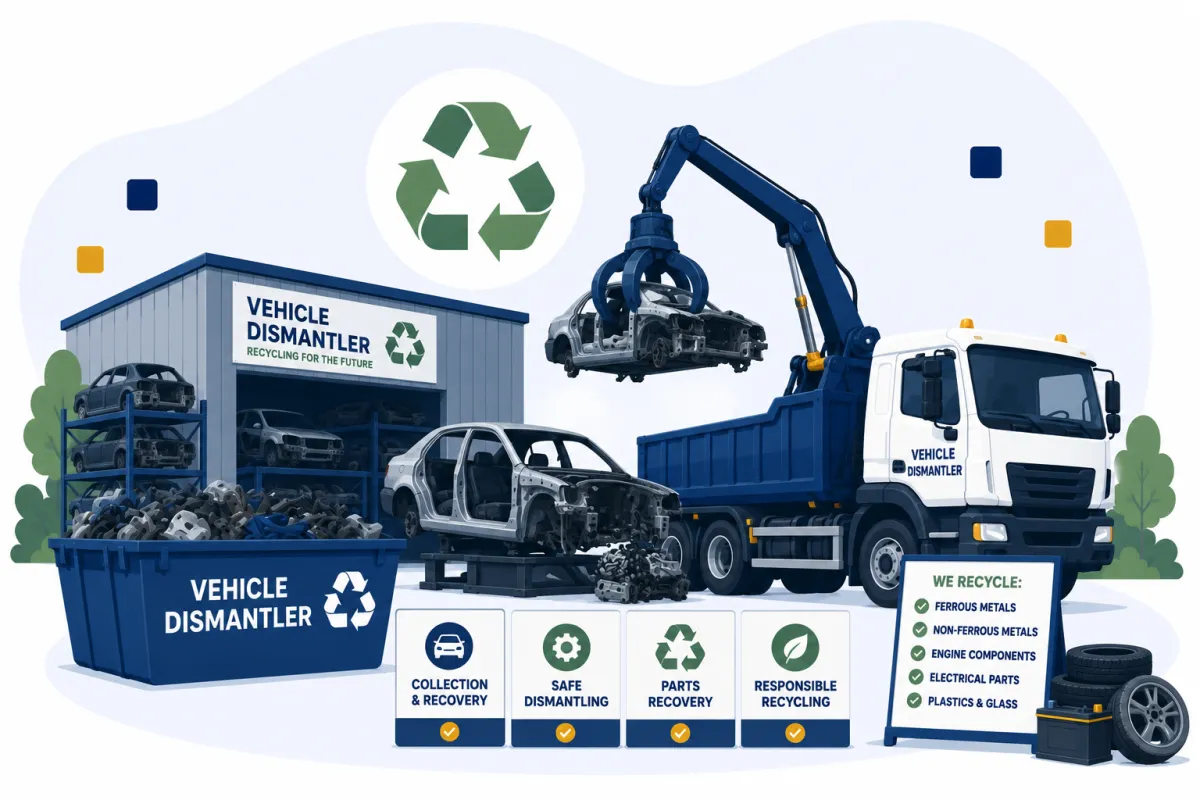
End-of-Life Vehicle & Dismantler (ATF) Insurance UK | Specialist
Why does vehicle dismantling need specialist insurance treatment?
An Authorised Treatment Facility is one of the most exposure-dense businesses in the motor sector. In a single site you depollute hazardous fluids, quarantine high-voltage batteries, store fuel-laden vehicles, resell safety-critical parts, issue legal documents that transfer liability, and handle scrap metal under a separate cashless-payment regime. Around two million vehicles are scrapped in the UK each year, and only a licensed ATF can legally process them — which is exactly why standard insurers, seeing pollution, fire, product and motor exposures stacked together, so often decline the risk. Vehicle dismantling is a specialist, hard-to-place placement, and it is the lane Miller & Partner's motor trade insurance team works in.
This guide covers end-of-life vehicle and dismantler insurance from a broker's chair: the covers that matter, what ATF authorisation demands, why EV and hybrid batteries are the fastest-hardening exposure in the sector, and how to handle a claim. It bridges two worlds — it sits with our EV garage insurance guide on the battery side and our scrap metal dealer insurance guide on the metal and cashless-payment side — but where it is distinct is the depollution-and-authorisation package unique to a licensed ATF.
How does The Insurability Framework apply to an ATF?
Placing a vehicle dismantler is exactly what The Insurability Framework™ was built for. An ATF is rarely refused because it is careless — it is refused because the underwriter sees pollution, EV-battery fire, product and motor exposures at once and cannot tell how each is controlled. The framework is the structured method we use to turn that stacked risk into one an insurer will confidently write.
Underwriter Intelligence
We know which motor and specialist markets still write ATFs, what they scrutinise most (EV-battery handling and depollution containment), and the evidence that moves them: EV accreditation, a bunded depollution rig and clean Environment Agency compliance.
Difficult Risk Expertise
Vehicle dismantling is a sector generalists avoid. We specialise in placing ATFs others refuse — salvage and parts operations, EV-processing sites and yards with a prior fire or an enforcement history.
Risk Assessment
We surface the exposures that quietly wreck insurability: EV batteries stored with no fireproof quarantine, fluid stores without bunding, safety-critical parts resold without process, and CoD/DVLA gaps. Finding these before the insurer does keeps cover in force.
Claims Advocacy
When a battery fire, pollution incident or product claim hits, you get a broker who fights the claim with you — managing loss adjusters, the Environment Agency and any product recall — not a call centre.
Key facts at a glance
- Around two million vehicles are scrapped in the UK each year, and only an Authorised Treatment Facility (ATF) can legally depollute and dismantle them. There are roughly 1,500 registered ATFs.
- Under the End-of-Life Vehicles Regulations 2003, running an ATF requires planning permission, the correct environmental permit, and compliance with hazardous-waste and duty-of-care rules.
- Only an ATF can issue a Certificate of Destruction (CoD) via the DVLA system — the document that ends the last owner's liability. Errors in the CoD/DVLA chain create liability.
- Depollution is mandatory: fuels, oils, brake fluid, refrigerants, airbags, tyres, catalytic converters and batteries must be removed and stored correctly before a vehicle is crushed.
- EV and hybrid vehicles carry 400–800V lithium-ion batteries classed as hazardous waste; not all ATFs hold EV accreditation, and damaged packs carry thermal-runaway fire risk.
- Payments for scrapped vehicles must be cashless under the Scrap Metal Dealers Act 2013, and ATFs must keep records for at least three years.
- Because dismantling stacks motor, waste, scrap and product exposures, most standard insurers decline it; cover is placed through specialist motor and Lloyd's markets.
Which covers does a vehicle dismantler actually need?
An ATF bundles motor-trade, waste, scrap and product exposures, and no single off-the-shelf policy fits it. The table below sets out the core covers we build into a typical dismantler programme, why each matters for this trade specifically, and how essential it is. Use it as a checklist against your own schedule.
| Cover | Why it matters for a vehicle dismantler | Priority |
|---|---|---|
| Environmental / pollution (EIL) | Depollution fluids — fuel, oil, brake fluid, refrigerants, battery acid — are a leading land and water contamination exposure. | Essential |
| EV / hybrid battery fire | High-voltage lithium packs carry thermal-runaway risk; damaged packs can reignite in storage. | Essential |
| Property & stock (fire) | Depollution rigs, buildings, vehicle stock and salvaged parts against fire and theft. | Essential |
| Motor trade road risk | Driving, moving and recovering vehicles on trade plates must be insured for business use. | Legal |
| Employers' Liability | Legally required if you employ anyone; hazardous fluids, plant and high-voltage work make EL strict. | Legal |
| Public Liability | Visiting members of the public, hauliers and part-buyers on a hazardous site. See our business liability guide. | Essential |
| Product liability (reused parts) | Resold engines, brakes, airbags and steering parts carry serious injury exposure if they fail. | Essential |
| Business interruption | A fire or enforcement action can halt processing and part sales for months. | Recommended |
What does ATF authorisation require, and why does it matter to insurers?
An end-of-life vehicle is legally classed as waste, so you cannot dismantle it on an ordinary motor-trade footing. Under the End-of-Life Vehicles Regulations 2003, running an ATF requires planning permission, the correct environmental permit for the treatment you carry out, and compliance with hazardous-waste and duty-of-care rules. The Environment Agency (or NRW/SEPA) regulates and inspects ATFs, and you must keep records for at least three years and meet a 95% recovery target by vehicle weight.
For insurers, your authorisation is a proxy for how well the site is run. A clean ATF authorisation with a matching environmental permit and good compliance history tells an underwriter the pollution and waste risks are controlled; a mismatch — treatment you are not permitted for, or an enforcement notice outstanding — tells them the opposite. Because ELV transactions also fall under the cashless-payment rules of the Scrap Metal Dealers Act 2013, your payment and record-keeping discipline is part of the same picture. A poor compliance record pushes the placement towards the refused-cover market.
What cover does my type of ATF operation need?
Pick the operation that best matches your business to see the cover priorities we would typically build in. This is a starting point for a conversation, not a quote — every site is rated on its own controls and accreditation. For any of these, the route runs through our motor trade insurance team.
Which compliance red flags make you uninsurable?
Tick each control you already have in place. The more you can honestly tick, the more markets will look at your site — and the better the terms. Unticked items are the ones underwriters ask about first.
How hard-to-place is my dismantling risk?
Choose your two biggest factors for an indicative placement tier. This is guidance only — a proper assessment always looks at the whole site.
Why are EV and hybrid batteries the fastest-hardening exposure?
The single biggest change in vehicle-dismantling insurance is the electric vehicle. The first mass-market EVs are now reaching end-of-life, and every year more arrive at ATFs — each carrying a lithium-ion battery pack running at 400 to 800 volts, classed as hazardous waste and governed by the ELV Regulations alongside the newer battery rules. A standard vehicle runs at 12 volts; an EV pack is a different order of hazard, and handling it wrongly creates a genuine risk of electric shock, arc flash and — most seriously for insurers — thermal-runaway fire.
Crucially, a standard ATF environmental permit does not automatically cover EV work. Processing EVs safely needs trained, high-voltage-certified technicians, specialist isolation equipment, and battery storage in fireproof, temperature-monitored containers away from flammable material. Damaged salvage EVs — Category S and Category N write-offs with compromised battery casings — are the highest-risk intake of all, because a damaged pack can enter thermal runaway hours or days after arriving. This is the same battery-fire dynamic that drives our EV garage insurance work and sits behind the lithium-fire concerns across the whole scrap and recycling sector.
How does depollution create a pollution liability?
Depollution is the first and most heavily regulated stage of vehicle recycling. Before a vehicle can be crushed, an ATF must remove fuel, engine and gearbox oils, coolant and antifreeze, brake and hydraulic fluid, air-conditioning refrigerant, screen wash, the battery, airbags, tyres and catalytic converter. Every one of those substances is a pollution risk if it leaks, and the rules require them to be drained on an impermeable surface and stored in separate, labelled, leakproof, bunded containers — with different battery types never mixed.
For insurers, this concentrated fluid handling is why Environmental Impairment Liability (EIL) is close to essential for an ATF. Standard public liability pollution wording is narrow and often excludes gradual pollution altogether, yet a leaking fluid store or a spill during depollution can contaminate soil and watercourses and trigger Environment Agency clean-up liability. It sits alongside your ATF duties and environmental permit — the documents an insurer and the regulator will both examine when a pollution claim lands.
Why does selling reused parts create product liability?
This is the exposure most often under-insured on an ATF. A dismantler does not just recycle metal — it salvages and resells reusable parts: engines, gearboxes, alternators, panels, and crucially safety-critical components such as brakes, suspension, steering and airbags. If a resold part fails and causes injury or damage, the dismantler can face a product liability claim, and standard-market wordings often restrict or exclude product cover for used vehicle parts.
The controls that make this insurable are traceability and process: recording where each part came from, checking condition, and being clear about what is and is not sold as fit for safety-critical use. A yard that resells safety-critical parts casually, with no process, is carrying a serious uninsured exposure. Where a claim has already occurred, the placement moves into claims-history territory and needs careful presentation.
How does the Certificate of Destruction create liability?
Only an ATF can issue a Certificate of Destruction, generated through the DVLA system, which formally removes a vehicle from the register and ends the last owner's liability. That makes the CoD a powerful document — and a source of liability if the process goes wrong. Failing to issue a CoD, issuing one incorrectly, or not notifying the DVLA can leave the previous owner exposed to fines and continued liability for a vehicle they believed was scrapped, and can expose the ATF to complaint and claim.
Good practice — accurate records, prompt DVLA notification, and clear documentation retained for at least three years — is both a regulatory duty and a risk-management measure. It also intersects with the cashless-payment and record-keeping discipline of the Scrap Metal Dealers Act 2013, which applies to ELV transactions. The same joined-up compliance thinking runs through our whole adverse-risk approach.
What drives the cost of vehicle dismantler insurance?
There is no meaningful "average premium" for an ATF — the range is wide because the risks are. What matters is which factors below apply to you, and crucially, what you can evidence to mitigate each one. The mitigation column is where a good broker earns their keep: every documented control is a lever on the price.
| Rating factor | Why it pushes premium up | How to mitigate it |
|---|---|---|
| EV / hybrid processing | High-voltage battery fire is the fastest-hardening exposure in the sector. | EV accreditation, trained technicians, fireproof quarantine. |
| Salvage / damaged intake | Cat S/Cat N EVs arrive with compromised, higher-risk battery packs. | Isolation and quarantine on arrival; declared salvage mix. |
| Depollution containment | Fluid handling without bunding is a direct pollution exposure. | Bunded rig, impermeable surface, separate labelled containers. |
| Battery storage | Mixed or unquarantined batteries are a fire and pollution risk. | Segregated, fireproof, temperature-monitored storage. |
| Reused-parts resale | Safety-critical parts resold carry product-injury exposure. | Traceability, condition checks, clear resale terms. |
| ATF permit vs activity | A permit that does not match the treatment carried out is a compliance gap. | Correct environmental permit for every activity on site. |
| Stock values & theft | Vehicles, parts and catalytic converters are theft targets. | Monitored CCTV, secure fencing, out-of-hours protection. |
| Fire load & layout | Fuel-laden vehicles and tightly packed stock raise fire severity. | Separation distances, fuel drainage, fire detection. |
| Motor road-risk exposure | Recovering and moving vehicles adds road-traffic exposure. | Trade-plate discipline, driver checks, recovery procedures. |
| CoD / DVLA record-keeping | Errors in the destruction chain create liability and complaint. | Accurate CoD issuance, prompt DVLA notification, 3-year records. |
| Compliance / enforcement history | Notices signal poor control to insurers. | Resolve notices; evidence corrective action. |
| Claims & fire history | A prior fire or product claim is a major hardener. | Independent risk report showing what changed since. |
What do real ATF and dismantler claims look like?
The following three cases are composite, anonymised examples drawn from the types of ATF and dismantler claims we see. Figures are realistic and illustrate how a loss develops — and how cover, or the lack of it, decides the outcome.
Case 1 — EV battery thermal-runaway fire (£1.6m)
A dismantler took in a flood-damaged electric vehicle as ordinary salvage and parked it in the general stock line without isolating the battery. Two days later the compromised pack entered thermal runaway and ignited; with no fireproof quarantine and vehicles stored close together, the fire spread across the stock line and reached the depollution store. Property, plant and stock loss came to about £1.1 million, business interruption over a 10-month rebuild added £400,000, and pollution clean-up from firewater a further £100,000 — roughly £1.6 million in total. Because the yard had no EV accreditation or quarantine process, the insurer initially challenged the claim; it was ultimately paid at a reduced level, and continued cover was made conditional on a full EV handling and quarantine regime. Renewal premium rose around 70%.
Case 2 — Reused safety-critical part failure (£480,000)
A breaker resold a used steering component that failed in service, contributing to a road collision and serious injury. The injured party pursued a product liability claim against the dismantler as the supplier of the part. The settlement and defence costs reached about £480,000. Product liability cover responded, but the yard's traceability was poor, which complicated the defence and lengthened the claim. The insurer required a documented parts-traceability and safety-critical resale process as a condition of renewal; product liability premium rose about 45%.
Case 3 — Depollution fluid spill and CoD failure (£130,000)
An under-maintained fluid store allowed waste oil and coolant to leak onto unsealed ground, reaching a drain during heavy rain; separately, a batch of vehicles had not been correctly notified to the DVLA, leaving several previous owners exposed. The Environment Agency pursued the pollution, and the notification failures generated owner complaints and a compliance review. Clean-up, remediation and administrative costs came to about £130,000, alongside a permit review. Environmental Impairment Liability responded to the clean-up; the compliance failings fell on the business. We re-placed the ATF afterwards as an adverse-history risk with upgraded containment and record-keeping.
How should you handle an incident at an ATF?
When a battery fire, pollution incident or product claim hits an ATF, the first hours shape the whole claim. This is the sequence we walk clients through — and the one an insurer expects to see followed.
- Make people safe first. Evacuate, account for staff and visitors, and call the emergency services. Treat any EV battery fire as capable of reigniting — keep people clear and tell the fire service a high-voltage battery is involved.
- Isolate and contain where safe. Isolate power and high-voltage systems if safe, and deploy containment to stop firewater and fluids reaching drains and watercourses.
- Notify your broker and insurer immediately. Early notification lets a loss adjuster and, where needed, a fire or battery specialist attend while evidence is fresh.
- Report to the regulators. Notify the Environment Agency for any pollution, and the HSE under RIDDOR for a reportable injury. For a product-failure claim, preserve the part and records.
- Preserve the scene and evidence. Do not clear debris until released; photograph everything and keep CCTV, depollution and DVLA/CoD records.
- Pull your compliance records. Gather the ATF authorisation, environmental permit, EV accreditation, depollution and consignment logs, parts traceability and training records.
- Manage business continuity. Arrange alternative processing or storage and start the business interruption claim promptly to protect cash flow.
- Let your broker lead the negotiation. A specialist broker manages the adjuster, challenges reservations and coordinates any product or regulatory dimension — our Claims Advocacy pillar in practice, not a call centre.

John Miller — Director & Principal Broker
John has 13+ years placing adverse and hard-to-place commercial insurance, with direct access to the Lloyd's market and specialist motor and waste schemes. He works hands-on with Authorised Treatment Facilities standard insurers decline — car and van dismantlers, EV-processing sites, salvage yards and parts breakers, including those with a prior fire or product claim — building placements that answer the pollution, battery, product and motor sides together. Miller & Partner Limited is an Appointed Representative of Gauntlet Risk Management Ltd, which is authorised and regulated by the Financial Conduct Authority.
Vehicle dismantler insurance glossary
- End-of-life vehicle (ELV)
- A vehicle classed as waste once it reaches the end of its usable life, subject to the ELV Regulations and duty-of-care rules.
- Authorised Treatment Facility (ATF)
- A site licensed by the Environment Agency (or NRW/SEPA) to depollute, dismantle and recycle end-of-life vehicles.
- End-of-Life Vehicles Regulations 2003
- The main UK regulations governing ATFs, implementing the EU ELV Directive; retained in UK law post-Brexit.
- Certificate of Destruction (CoD)
- The DVLA-registered document only an ATF can issue, confirming a vehicle is permanently scrapped and ending the owner's liability.
- Depollution
- The mandatory removal of hazardous fluids and components — fuels, oils, refrigerants, batteries, airbags, tyres — before a vehicle is crushed.
- Environmental permit
- The Environment Agency authorisation required for the specific treatment an ATF carries out.
- Environmental Impairment Liability (EIL)
- Cover for gradual and sudden pollution and clean-up costs excluded by standard public liability wording; near-essential for an ATF.
- Thermal runaway
- A self-sustaining, hard-to-extinguish reaction in a damaged lithium-ion battery that can ignite hours or days after damage.
- High-voltage (HV) battery
- The 400–800V lithium-ion pack in an EV or hybrid, classed as hazardous waste and requiring certified handling.
- Category S / Category N
- Insurance write-off categories for structurally (S) or non-structurally (N) damaged vehicles, often arriving at ATFs as salvage.
- Product liability
- Liability for injury or damage caused by a defective product — for a dismantler, a resold vehicle part that fails.
- Scrap Metal Dealers Act 2013
- The law requiring cashless payment and record-keeping for scrap and ELV transactions.
- Motor trade road risk
- Cover for driving, moving and recovering vehicles in the course of the business, typically on trade plates.
- Business interruption (BI)
- Cover for lost income and continuing costs while a site cannot operate after a loss.
- Bunding
- A secondary containment barrier around fluid stores to catch leaks and spills before they reach the ground or drains.
- Adverse risk
- A business standard insurers decline — through hazard, sector, incident history or complexity — requiring specialist placement.
Vehicle dismantler insurance: frequently asked questions
Employers' Liability is legally required if you employ anyone, and motor trade road-risk cover is required to move and recover vehicles. Holding ATF authorisation and the correct environmental permit is a separate legal requirement to operate. Property, pollution, product liability and business interruption covers are not compulsory but are close to essential for a working ATF.
Because an ATF stacks several difficult exposures at once — depollution pollution, EV-battery fire, reused-parts product liability, fuel-laden vehicle fire load and motor road risk. Most standard insurers will not write that combination, so cover is placed through specialist motor, waste and Lloyd's markets.
In practice, yes. EV and hybrid batteries run at 400–800V and are classed as hazardous waste; a standard ATF permit does not cover EV work. Insurers look for EV accreditation, high-voltage-trained technicians and fireproof, temperature-monitored battery quarantine. Damaged salvage EVs are the highest-risk intake and need isolation on arrival.
Only if product liability is arranged for it, and many standard wordings restrict or exclude used vehicle parts. Reselling safety-critical components — brakes, steering, airbags — carries real injury exposure, so you need product cover plus traceability and a clear resale process. A casual approach to safety-critical parts is a serious uninsured risk.
For essentially every ATF, yes. Depollution concentrates fuels, oils, brake fluid and refrigerants on site, and standard public liability pollution wording is narrow. EIL responds to gradual and sudden pollution and clean-up costs, and it is close to essential given the fluid-handling and firewater exposure.
A valid authorisation and matching environmental permit, an active CoD/DVLA process, a bunded depollution rig with separate fluid storage, EV accreditation and fireproof battery quarantine, cashless payment under the SMDA, battery segregation, a reused-parts traceability process, and records kept for at least three years.
Only an ATF can issue a CoD, and it ends the last owner's liability. Failing to issue one, issuing it incorrectly, or not notifying the DVLA can leave previous owners exposed to fines and expose the ATF to complaint and claim. Accurate records and prompt notification, kept for three years, are both a duty and a risk-management measure.
There is no meaningful average — the range is wide because the risks are. Cost is driven by EV processing, salvage intake, depollution containment, parts resale, stock values, permit status and claims history. The most effective way to control premium is to document every mitigating control before the risk goes to market.
Yes. A Category S or N EV can arrive with a compromised battery casing that carries thermal-runaway risk, making it the highest-risk intake at any ATF. Insurers want to see that damaged EVs are isolated and quarantined on arrival rather than parked in the general stock line, and cover often depends on that process.
A prior fire is the single biggest hardener, but it does not make you uninsurable. Insurers want evidence of what changed since — EV quarantine, separation distances, containment and detection. As a specialist adverse-risk broker we present that story to the markets that still write post-fire ATF risks.
Yes. Under the Scrap Metal Dealers Act 2013, payments for scrapped vehicles must be cashless — by bank transfer or cheque, never cash — and records must be kept. This overlaps with your ATF record-keeping, and the audit trail supports both compliance and any theft or stolen-vehicle claim.
Because vehicle dismantling is a hard-to-place risk that most generalists decline. Miller & Partner approaches every placement through the Insurability Framework — underwriter intelligence, difficult-risk expertise, risk assessment and claims advocacy — and places ATFs through specialist motor trade and adverse-risk markets, including yards refused elsewhere.






Instagram
LinkedIn