


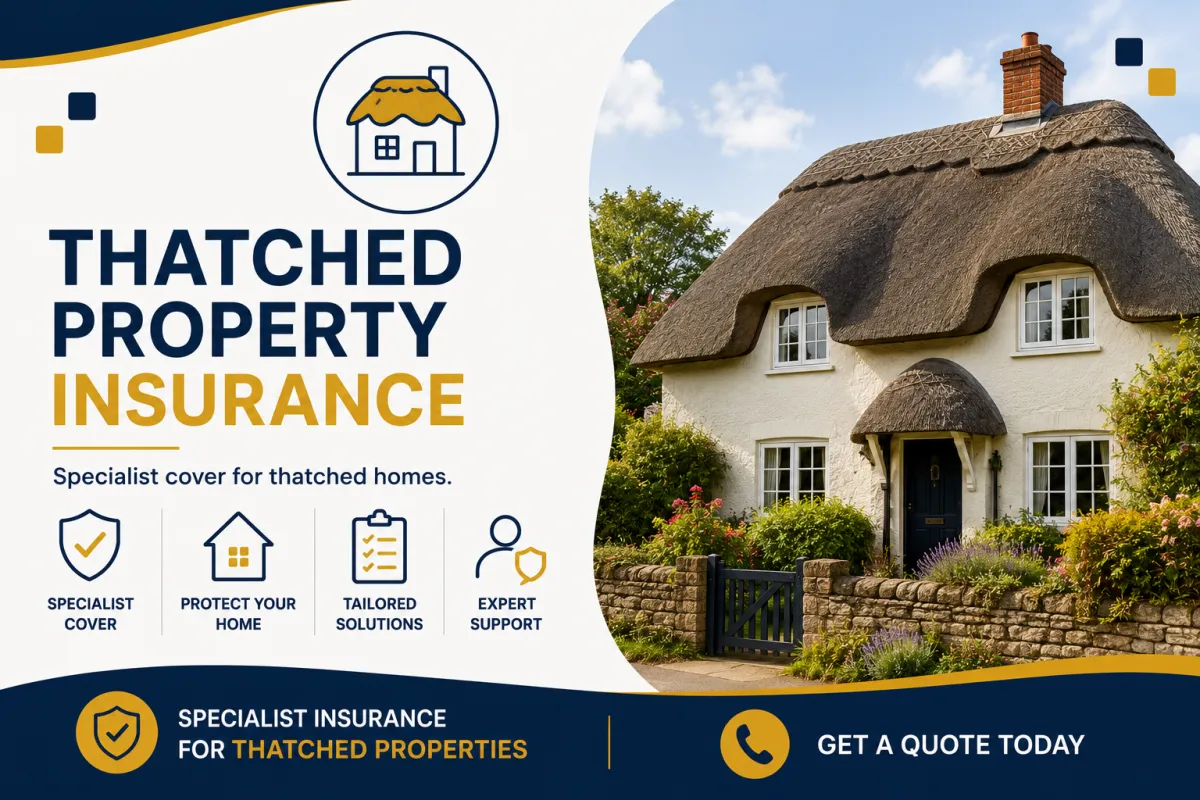
Thatched Property Insurance UK | Cover for a Fire-Rated Risk
A thatched roof is beautiful, and it is also the single feature that most narrows the market of insurers willing to cover a property. The reason is simple and stark: when a thatched building catches fire, the loss is usually severe and often total. That fire severity — not the age of the property, not its charm — is why many mainstream insurers decline thatch outright, and why the ones that don't rate it carefully around a specific set of fire-safety measures.
This guide is written for owners, landlords and operators of thatched property — a thatched cottage let, a thatched pub or B&B, a holiday let — and it focuses on the thing that actually drives cover: fire. It explains where thatch fires come from, the measures that decide whether you get a quote and at what price, what the Insurance Act 2015 requires you to disclose, and how a specialist market prices thatch that a portal won't touch. If your thatched property is also listed, the heritage reinstatement obligation stacks on top of the fire risk — our listed building insurance guide covers that side.
Why does a thatched property need specialist insurance treatment?
There are roughly 50,000 to 60,000 thatched properties in the UK, and each year between 50 and 80 suffer a serious fire. Those numbers sound small until you look at the outcome: recent analysis of English home fires found that thatched dwellings averaged around six times the fire damage of an ordinary house. When thatch burns, it tends to take the roof and frequently the whole building — and it burns fast. That is the risk an underwriter is really pricing.
Because of it, thatch falls firmly outside standard, automated appetite. A price-comparison engine that quotes a tiled semi in seconds will simply decline a thatched cottage, or return nothing. The insurers who do cover thatch are specialists, and they underwrite around a well-established set of fire-safety measures — chimney height, flue lining, sweeping regime, how any wood burner is used, and whether a fire barrier is fitted. Get those right and thatch is very insurable; leave them vague and it isn't.
For a landlord or commercial operator, keeping that cover in force is essential — a thatched let or trading pub that loses buildings insurance breaches most mortgage conditions and leaves a high-severity risk uninsured. This is specialist, fire-rated property placement, and it is core Miller & Partner territory.
The Insurability Framework™
A thatched property is exactly the kind of risk the Insurability Framework was built for. Where a portal sees "thatch" and returns nothing, our task is to present the fire-safety picture so a specialist underwriter can price it fairly. We apply four pillars to every thatch placement.
Underwriter Intelligence
We know which specialist markets underwrite thatch and exactly what they need to see — chimney height, flue lining, sweeping certificates, wood-burner usage and any fire barrier. Presenting these turns a decline into a quote and a heavy loading into a fair one.
Difficult Risk Expertise
Thatch is a sector generalists avoid. We place it through specialist and Lloyd's-backed markets that understand thatch fire behaviour and reinstatement, rather than declining it on the material alone.
Risk Assessment
We identify the exposures thatch creates — chimney-related ignition, fire spread to neighbours, the high cost and long lead time of re-thatching, and underinsurance where the sum insured never reflected specialist reinstatement.
Claims Advocacy
A thatch fire is a big, emotive, specialist claim. You get a named broker who manages it alongside the loss adjuster and master thatcher — not a call centre reading a script.
Key facts at a glance
- There are around 50,000–60,000 thatched properties in the UK; roughly 50–80 suffer a serious fire each year.
- Thatched dwellings average around six times the fire damage of an ordinary house fire — thatch fires tend to be severe or total.
- Approximately 90% of thatch fires are chimney-related, driven by flues, sparks and heat from open fires and wood burners.
- A chimney or flue should terminate at least 1.8 metres above the thatch, be correctly lined, and be swept quarterly when burning wood.
- A wood burner or multi-fuel stove is a material fact — it changes the fire risk and must be disclosed under the Insurance Act 2015.
- Many mainstream insurers decline thatch outright, so it usually needs a specialist market.
- If the property is also listed, a heritage reinstatement obligation applies on top of the fire risk.
Where do thatch fires actually come from?
Overwhelmingly, from the chimney. Around 90% of thatch fires are chimney-related — sparks and embers landing on the thatch, or heat from the flue igniting the surrounding material. The rise of wood-burning and multi-fuel stoves has sharpened the risk: research funded by Historic England and NFU Mutual found stoves are more likely to cause thatch fires than traditional open fires, and — importantly — that the old "heat-transfer through the chimney wall" theory doesn't explain every fire. Some occurred shortly after lighting, or even where an insulated liner was fitted, pointing to how the appliance is operated as a key factor.
The practical message is that the chimney and how you use it are the heart of the risk. The table below sets out the fire-safety factors an underwriter weighs, and the difference each makes to insurability.
| Fire-safety factor | Higher risk / harder to place | Lower risk / better appetite |
|---|---|---|
| Chimney height | Low chimney, near ridge | ≥1.8m above the thatch |
| Flue lining | Unlined or old liner | Correct insulated liner, properly installed |
| Sweeping | Rarely / annually only | Quarterly when burning wood, with certificates |
| Heat source | Wood/multi-fuel stove used heavily | No solid fuel, or careful, correct use |
| Fire barrier | None under the thatch | Fire-retardant barrier fitted |
| Detection | No / basic alarms | Interlinked smoke & heat alarms |
| Spread | Attached / close neighbours | Detached, good separation |
"The thatch enquiries that fall over are almost always the ones where a wood burner went in and nobody thought to tell the insurer. It feels like a home-improvement, not an insurance event — but it's one of the most material changes you can make to a thatched roof's fire risk. The first an insurer hears of it should not be at the claim."
"What we've learned is that thatch rewards preparation. The owner who turns up with chimney-height confirmation, sweeping certificates, a flue-liner spec and a fire barrier gets a very different reception from the market than the one who just says 'it's thatched.' Same roof — but one is a priced risk and the other is a shrug and a decline."
What fire-safety measures do insurers expect on a thatched property?
Specialist thatch insurers converge on a recognisable checklist. None of it is exotic, but the difference between having it and evidencing it — versus assuming it — is the difference between a competitive quote and a decline. The core expectations are: a chimney terminating at least 1.8 metres above the thatch; a correctly specified and installed flue liner; a documented sweeping regime (quarterly when wood is burned); careful, correct operation of any stove, burning only dry, seasoned hardwood; a fire-retardant barrier beneath the thatch on newer or re-thatched roofs; interlinked smoke and heat detection; and up-to-date electrical safety, since faulty wiring is the second most common ignition source.
The point of assembling this isn't box-ticking — it is that each measure is something an underwriter can price against. A thatched property with the full set, evidenced, is a fundamentally more attractive risk than an identical one where none of it can be shown.
Do I have to declare a wood burner or stove?
Yes — unequivocally. Installing or using a wood-burning or multi-fuel stove is one of the most material changes you can make to a thatched property's risk, and under the Insurance Act 2015 a material change must be disclosed as part of a fair presentation of the risk. Fitting a stove after your policy started, and not telling your insurer, is a classic route to a declined claim: if a subsequent fire is linked to that undisclosed stove, the insurer may treat the non-disclosure as grounds to avoid the policy or reduce the claim.
The right approach is to disclose the stove, evidence how it's installed and used, and let the insurer price it. A properly disclosed wood burner on a well-managed chimney is insurable; an undisclosed one is a live grenade in your policy.
Why does re-thatching drive the sum insured?
Because reinstating thatch is expensive and slow. A full re-thatch uses specialist materials — long straw, combed wheat reed or water reed — and a master thatcher, with scaffolding, ridge work and long lead times. After a serious fire, you are often looking at re-thatching and rebuilding the structure beneath, and the combined figure routinely exceeds what owners assume. Insure to an out-of-date or generic number and you meet the same condition of average that catches so many non-standard properties.
The fix is a reinstatement figure that reflects real thatch and rebuild costs, reviewed regularly. Where the property is also listed, that figure must additionally meet the heritage standard — see the listed building insurance guide for how that stacks up.
What if my thatched property is also listed?
Many thatched cottages are — a large share of thatched properties carry a listing. When they do, two specialist requirements combine: the fire-severity risk this guide addresses, and the heritage reinstatement obligation that requires like-for-like rebuilding to a conservation standard. That combination narrows the market further and makes the sum insured even more critical, because a listed thatch reinstatement is both fire-prone and expensive to restore correctly. If your thatch is listed, read this guide alongside our listed building insurance guide — and place the risk with a broker who handles both dimensions at once.
Cover Checker: what does your thatched property need?
Pick the thatched property type closest to yours to see the cover a specialist builds around it. Indicative only — your placement is built around your fire-safety measures and reinstatement figure.
Is your thatched property underwriter-ready?
Tick each item you can already evidence. The more you tick, the closer your thatch is to a clean, well-priced placement. Blanks are what to resolve before going to market.
- My chimney terminates ≥1.8m above the thatch
- The flue has a correct insulated liner, properly installed
- I sweep quarterly when burning wood and keep certificates
- Any wood burner is disclosed and used correctly
- A fire-retardant barrier is fitted beneath the thatch
- I have interlinked smoke & heat alarms
- My electrical inspection is current
- My sum insured reflects re-thatch + rebuild reinstatement
How insurable is your thatched property right now?
Two questions give an indicative insurability tier. Guidance only — not a quote or a survey.
What drives the premium on a thatched property?
Once you're with a specialist thatch market, the premium turns on the fire picture above all else — but a familiar set of factors sits around it. Most owners focus on price; the better move is the mitigation column, because on thatch each measure genuinely moves the dial from decline to quote and from loaded to fair.
| Rating factor | Why it raises the premium | How to mitigate it |
|---|---|---|
| Chimney height | Low chimneys drop sparks on the thatch | Ensure the flue is ≥1.8m above the thatch |
| Flue lining | Unlined / old flues transfer heat | Fit a correct insulated liner, evidenced |
| Sweeping regime | Soot build-up ignites | Sweep quarterly when burning wood; keep certificates |
| Heat source | Wood/multi-fuel stoves raise risk | Disclose and manage; consider limiting solid-fuel use |
| Fire barrier | No barrier means faster spread | Fit a fire-retardant barrier under the thatch |
| Detection | Late detection = bigger loss | Install interlinked smoke & heat alarms |
| Electrics | Faulty wiring is the 2nd top cause | Keep electrical inspections current |
| Reinstatement value | Underinsurance drives caution | Set the sum insured to full re-thatch + rebuild |
| Spread exposure | Attached / close neighbours spread fire | Evidence separation; document adjoining risk |
| Use / occupancy | Pub, B&B, let rated above private use | Match cover to use; disclose fully |
| Listing | Heritage reinstatement adds cost | Provide a heritage reinstatement assessment |
| Water / access | Rural sites slow the fire brigade | Note water supply and access for responders |
How do owner and landlord duties interact with a thatched property?
A thatched let carries the same duties as any other, sharpened by the fire risk. The Homes (Fitness for Human Habitation) Act 2018 expects a let home to be free from serious hazards, and fire is the definitive serious hazard on a thatched roof — which makes working smoke and heat detection, sound electrics and a well-managed chimney part of your landlord obligations, not just your insurance ones. For a thatched pub or B&B, fire-safety duties under the fire safety regime apply to the commercial operation on top of the buildings risk. The Thatch Advice Centre and local fire services publish practical guidance worth following. Keeping continuous, correctly-valued cover in force — with the fire-safety measures evidenced — is central to managing a thatched property responsibly, because an uninsured thatch fire is close to a worst-case outcome for owner and tenant alike.
Three real-world claim scenarios thatch owners should learn from
These are fictionalised composites of the placements and claims we see, with realistic figures. The first two show the classic ways thatch cover fails; the third shows measures and specialist cover working together.
The undisclosed wood burner
A landlord fitted a multi-fuel stove into a thatched let after the policy started, pleased with the upgrade, and never told the insurer. A winter chimney fire spread to the thatch and took most of the roof and the upper floor. When the loss adjuster established that an undisclosed stove had been installed — a clear material change — the insurer had grounds to act.
The non-disclosure of the stove under the Insurance Act 2015 let the insurer avoid the policy, and the landlord funded the entire reinstatement before placing fresh cover through a specialist.
The underinsured re-thatch
A thatched cottage had been insured to an old figure of £130,000 for years, never revisited. When a fire damaged the roof and upper storey, the true cost of re-thatching in water reed with a master thatcher, plus rebuilding beneath, came to £220,000 for a full reinstatement — meaning the property was insured at around 59% of its real rebuild cost.
Because the property was under-insured, the condition of average reduced the £150,000 loss proportionately, leaving a shortfall of around £61,000 on a claim the owner assumed was fully met.
The properly-placed thatched holiday let
A thatched holiday let was placed through a specialist market with the full fire-safety set — 1.8m chimney, correct liner, quarterly sweeping, a fire-retardant barrier and interlinked heat alarms. When a chimney fire did start, the heat alarm triggered early and the barrier slowed the spread, so the fire brigade contained it before it consumed the roof.
The £45,000 of damage was met in full, and — just as importantly — the fire-safety measures turned what could have been a total loss into a contained, recoverable one.
How to insure a thatched property: a step-by-step approach
If you own or let a thatched property, work through these eight steps in order. Done properly, they turn a risk portals decline into one a specialist prices fairly — and often limit the fire itself.
- Establish the thatch. Record the type (long straw, combed wheat reed or water reed), the depth and the date of the last re-thatch — insurers and reinstatement figures depend on it.
- Get the chimney right. Confirm the flue terminates at least 1.8m above the thatch and has a correct insulated liner, professionally installed to current standards.
- Set a sweeping regime. Sweep the chimney regularly — quarterly when burning wood — and keep the certificates as evidence for your insurer.
- Manage and disclose solid fuel. Use any wood burner correctly, burning only dry, seasoned hardwood — and disclose the appliance to your insurer as a material fact.
- Add detection and barriers. Fit interlinked smoke and heat alarms, consider a fire-retardant barrier beneath the thatch, and keep electrical inspections current.
- Set the sum insured properly. Base it on a full re-thatch plus rebuild reinstatement figure — and, if the property is listed, on a heritage reinstatement basis.
- Disclose fully and place with a specialist. Present the fire-safety picture to a broker with specialist thatch and Lloyd's market access, who reaches insurers that underwrite thatch on its merits.
- Keep evidence and review. Retain sweeping and electrical certificates, review the reinstatement figure annually, and update after any works, re-thatch or appliance change.

John Miller
John has 13+ years placing property risks that standard markets decline, with direct access to Lloyd's and specialist heritage schemes. Thatch — cottages, lets, pubs and B&Bs, listed and non-listed — is a core part of Miller & Partner's practice. If your thatched property has been refused, loaded or left uninsured, John's team presents the fire-safety picture to the markets that will actually cover it. More about John.
Thatched property insurance glossary
- Thatch
- A traditional roof covering of dry vegetation, carrying a high and often total fire risk.
- Long straw
- A thatching material with a shaggy appearance and a shorter lifespan than reed.
- Combed wheat reed
- A neater straw thatch, dressed to lie with cut ends exposed.
- Water reed
- A durable thatching material, generally the longest-lasting and most costly.
- Ridge
- The capping along the top of a thatched roof, replaced more often than the main coat.
- Flue liner
- The lining inside a chimney; a correct insulated liner reduces heat transfer to the thatch.
- Chimney height rule
- The guidance that a chimney should terminate at least 1.8m above the thatch to keep sparks clear.
- Fire barrier
- A fire-retardant membrane or board fitted beneath the thatch to slow fire spread into the roof.
- Spark arrestor
- A mesh cap intended to catch sparks — generally advised against on thatch, as it can clog and cause problems.
- HETAS
- The registration scheme for competent installers of solid-fuel and biomass heating appliances.
- Sweeping certificate
- Documentary evidence that a chimney has been professionally swept, expected by thatch insurers.
- Reinstatement (re-thatch) cost
- The true cost to re-thatch and rebuild after a loss, using specialist materials and a master thatcher.
- Property owners' liability
- Cover for an owner's legal liability to third parties, including where fire spreads to a neighbour.
- Fair presentation of risk
- The Insurance Act 2015 duty to disclose all material circumstances, or enough to prompt a prudent underwriter to ask.
- Material fact
- Information that would influence an insurer's decision — a wood burner on a thatched roof clearly qualifies.
- Condition of average
- A clause that reduces a claim proportionately where the sum insured is below the true reinstatement value.
- Master thatcher
- A qualified specialist who re-thatches roofs — the trade a thatch reinstatement depends on.
Frequently asked questions
Yes, but usually only through a specialist market, not a price-comparison site. Many mainstream insurers decline thatch because of its fire severity. A specialist will underwrite it around your fire-safety measures — chimney height, flue lining, sweeping, wood-burner use and any fire barrier.
Because when a thatched roof catches fire, the loss is usually severe and often total — thatched dwellings average around six times the damage of an ordinary house fire. The premium reflects that genuine severity, though strong, evidenced fire-safety measures can significantly improve the terms.
Yes. A wood-burning or multi-fuel stove is one of the most material changes you can make to a thatched roof's fire risk, so it must be disclosed under the Insurance Act 2015. Fitting one after your policy started and not telling your insurer is a common cause of declined claims.
Typically: a chimney terminating at least 1.8m above the thatch; a correct insulated flue liner; regular sweeping (quarterly when burning wood) with certificates; careful use of any stove; a fire-retardant barrier beneath the thatch; interlinked smoke and heat alarms; and current electrical safety. Evidencing these is what secures a competitive quote.
Guidance is that a chimney or flue should terminate at least 1.8 metres above the thatch, to keep sparks and embers clear of the roof. A low chimney near the ridge is a recognised high-risk feature and a common reason for loadings or declines.
Regularly — and quarterly during the burning season if you use wood or solid fuel. Keep the sweeping certificates, because insurers expect to see evidence of a proper regime rather than just a statement that it's done.
A fire-retardant barrier beneath the thatch can slow fire spreading into the roof structure, which insurers view favourably — so it can help both appetite and price. It works best as part of the full fire-safety set rather than in isolation. Note that spark arrestors, by contrast, are generally advised against on thatch.
It's more involved, because you're combining the thatch fire risk with a commercial operation. A specialist can package the thatch buildings cover with the public and employers' liability and business-interruption cover a pub or B&B needs — with an extended indemnity period to reflect the long re-thatch after a serious fire.
If it's also listed, yes. A large share of thatched cottages are listed, which adds a heritage reinstatement obligation on top of the fire risk — the building must be restored like-for-like to a conservation standard. In that case, read this guide alongside our listed building insurance guide and place both dimensions together.
It varies with the size of the roof, the thatch type and access, but a full re-thatch by a master thatcher — with scaffolding, ridge work and long lead times — is a substantial, specialist cost, often alongside rebuilding the structure beneath. This is why the sum insured must be based on a proper reinstatement figure, not a generic estimate.
A refusal from a standard insurer or a portal is normal for thatch, not a verdict. A specialist broker can present the fire-safety measures and reinstatement figure to markets that actively underwrite thatch. The issue is almost always that it was offered to the wrong insurer, not that the property is uninsurable.
Almost certainly. A specialist broker makes the difference between a decline and a fairly-priced quote on a thatched property. Miller & Partner places thatch — listed and non-listed, homes, lets, pubs and B&Bs — through Lloyd's-backed and specialist markets, and approaches every case through The Insurability Framework — underwriter intelligence, difficult-risk expertise, risk assessment and claims advocacy.







Instagram
LinkedIn